Learn about Leverage and Judgment: The Two Skills That Create Wealth with this comprehensive guide from GPTnius.
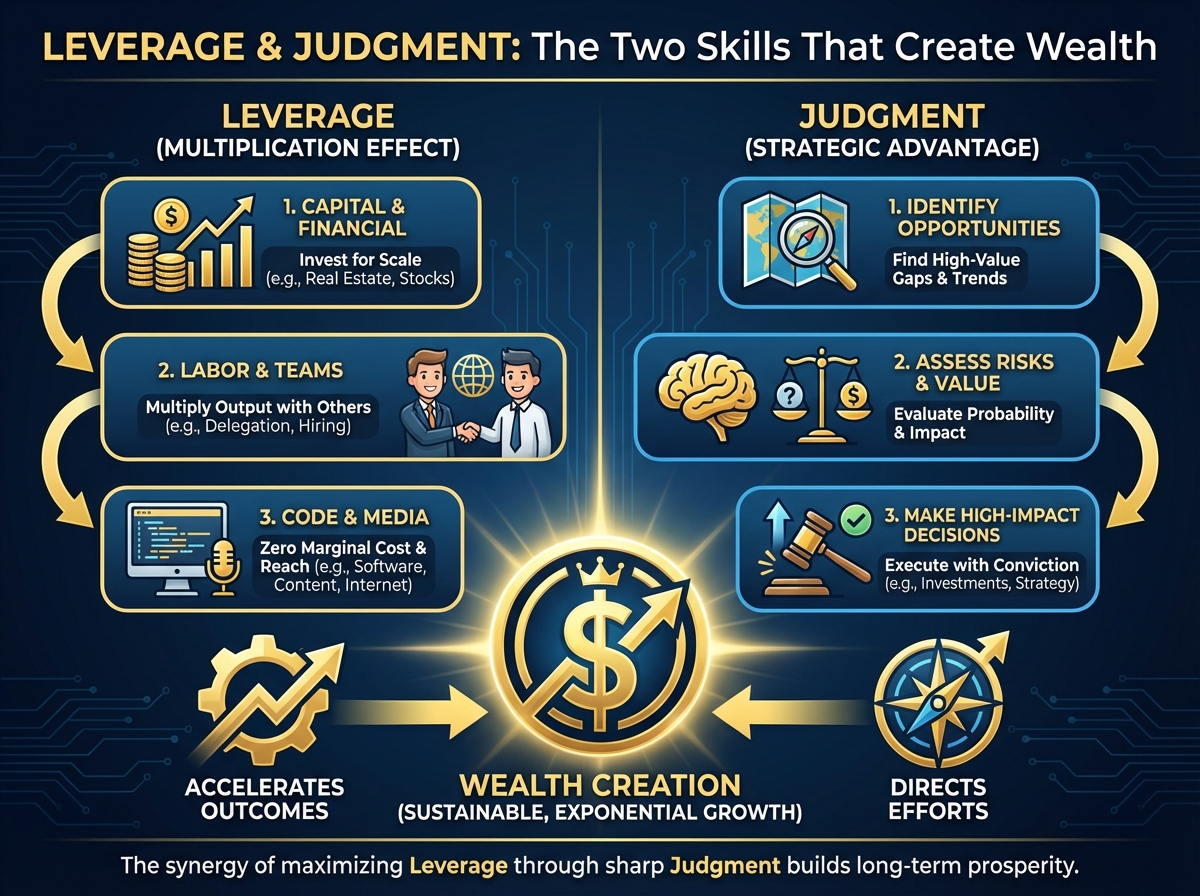
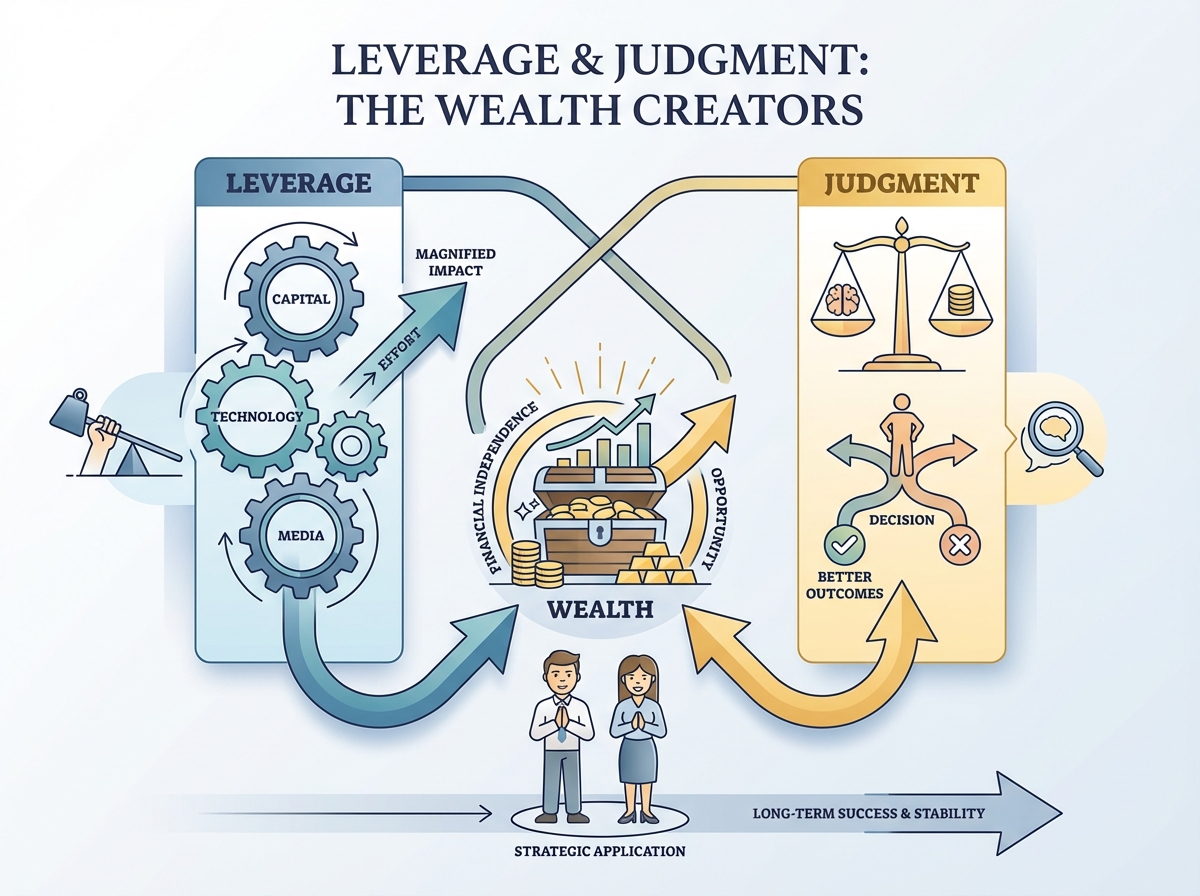
{ "title": "Unlocking Wealth: Mastering Leverage and Judgment in Business", "description": "Discover how combining permissionless leverage (code & media) with high-stakes judgment skill creates massive wealth. Learn the principles of modern business scaling.", "tldr": "Wealth isn't just a product of hard work; it requires the multiplication of effort through leverage and the precision of decision-making through judgment. This article explores the four types of leverage—labor, capital, code, and media—and explains why developing specific judgment skills is the ultimate multiplier for your career.", "content": "## The Equation for Modern Wealth Creation\n\nFor generations, the roadmap to success was linear: go to school, get a job, work hard, and retire. In the industrial age, inputs roughly equaled outputs. If you worked eight hours, you got paid for eight hours. But we are no longer in the industrial age; we are in the age of infinite leverage.\n\nToday, the correlation between hours worked and value created has broken down. A software engineer can write a script in four hours that automates the work of hundreds of people. A podcaster can speak for an hour and reach millions of listeners. In this landscape, wealth creation principles have shifted from \"renting out your time\" to \"owning equity and leverage.\"\n\nHowever, leverage alone is a double-edged sword. Leverage amplifies output, which means it amplifies both success and failure. To wield leverage effectively, you need a steering mechanism. That mechanism is judgment.\n\nThis article breaks down the two most critical components of the modern wealth equation: the four forms of leverage and the cultivation of judgment skill.\n\n## Part 1: The Four Forms of Leverage\n\nArchimedes famously said, \"Give me a lever long enough and a fulcrum on which to place it, and I shall move the world.\" In business, leverage is what allows you to disconnect your inputs from your outputs. It is the tool that allows your judgment to have a massive impact.\n\nThere are four distinct types of leverage. Understanding the hierarchy of these levers is essential for anyone looking to scale their business or career.\n\n### 1. Labor Leverage (The Oldest Form)\nThis is the most traditional form of leverage: other people working for you. If you manage a team of ten people, your output is theoretically the sum of their efforts. \n\n The Pro: It is socially prestigious. having a large staff makes you look important.\n The Con: It is the most difficult to manage. Humans are complex, require high-touch management, and labor markets are competitive.\n\nWhile necessary for many businesses, relying solely on labor leverage is often the least efficient way to start building wealth today due to the high marginal cost of replication.\n\n### 2. Capital Leverage (The Industrial Form)\nCapital leverage means using money to make more money. This was the dominant form of leverage in the 20th century. If you have \$100 million to invest in a factory, you can produce goods at a scale that a craftsman cannot match.\n\n The Pro: It scales mathematically and creates massive asset value.\n The Con: It is permissioned. You need someone to give you the money (banks, VCs) or you need to have saved it. It comes with high barriers to entry.\n\n### 3. Code and Media (Permissionless Leverage)\nThis is the breakthrough of the digital age. Permissionless leverage refers to tools that allow you to scale without asking anyone for approval. \n\n Code: Software runs while you sleep. Once written, the marginal cost of adding another user to your SaaS platform is near zero.\n Media: Content (blogs, videos, podcasts) is the leverage of the new rich. You record a video once, and it can be viewed by ten people or ten million people. The effort required to produce the asset is the same; the output varies wildly.\n\nLabor, capital, code, and media form the hierarchy of leverage. The most successful modern entrepreneurs usually combine all four, but they start with code and media because the barrier to entry is effectively zero.\n\n> 💡 Struggling to Identify Your Leverage Points?\n> \n> It can be difficult to see where your specific knowledge fits into the landscape of code and media. GPTnius AI Mentors, trained on proprietary research into wealth-building frameworks, can help you analyze your skills and identify the highest-leverage opportunities available to you.\n> \n> Meet the AI mentors built from this research →\n\n## Part 2: Judgment—The Steering Wheel\n\nIf leverage is the engine that drives the ship, judgment is the captain steering it. You can have the fastest ship in the world (massive leverage), but if you steer it into a rocky shore, you will sink faster than a rowboat.\n\nIn a world of infinite leverage, judgment skill becomes the most valuable asset. But what exactly is judgment in a business context?\n\n### Defining Business Judgment\nJudgment is not raw intelligence (IQ). There are plenty of high-IQ individuals who lack the ability to make effective decisions in ambiguous environments. \n\nJudgment is the ability to predict the long-term consequences of your actions. It is wisdom applied to practical problems. It is the ability to look at a complex situation, filter out the noise, and identify the one or two variables that actually matter.\n\n### The Cost of Bad Judgment\nWhen you are an entry-level employee with zero leverage, your judgment doesn't matter much. If you make a mistake, you might waste a few hours of company time. \n\nHowever, consider a CEO managing billions in capital and thousands of employees (High Leverage). One bad decision—like a failed acquisition or a PR disaster—can destroy billions of dollars in value overnight. \n\nThis is why CEOs are paid exponentially more than the average worker. They are not paid for their labor (hours worked); they are paid for their judgment. In a leveraged position, being right 10% more often can result in 100x better outcomes.\n\n
\n\n## Part 3: The Intersection of Leverage and Judgment\n\nTo create significant wealth, you must position yourself at the intersection of high leverage and high judgment. \n\n### The \"Specific Knowledge\" Factor\nYou cannot outsource judgment completely, and you cannot buy it off the shelf. Judgment comes from experience, but specifically from experience in a domain where you have specific knowledge.\n\nSpecific knowledge is knowledge that you cannot be trained for. If you can be trained for it, someone else can be trained to replace you. Specific knowledge is found by pursuing your genuine curiosity and passion. When you combine your unique interests with accountability, you develop a distinct worldview.\n\n### Accountability as a Reputation Engine\nTo get leverage, people must trust your judgment. To get them to trust your judgment, you must demonstrate accountability. You must take risks under your own name.\n\nThis is why equity is so important. Equity is a claim on future cash flows, but it is also a badge of accountability. When you own a piece of the business, your incentives are aligned with the outcome. Society rewards those who accept accountability with leverage (capital and labor).\n\n## Practical Steps to Apply These Principles\n\n1. Audit Your Time: Are you spending your day on low-leverage tasks (answering emails, manual data entry) or high-leverage tasks (strategy, content creation, building systems)?\n2. Productize Yourself: Identify what you are naturally good at (specific knowledge) and find a way to scale it using code or media.\n3. Take Smart Risks: Step out from behind the corporate shield. Start a side project, publish your thoughts, or invest your own capital. Taking accountability builds the track record necessary to acquire leverage.\n4. Slow Down to Speed Up: Judgment requires clear thinking. A stressed, overworked mind makes poor decisions. In a leveraged role, one hour of clear thinking is worth a month of busy work.\n\n## How GPTnius Helps You Apply These Principles\n\nUnderstanding the theory of leverage and judgment is one thing; applying it to your specific career path is another. This is where GPTnius bridges the gap.\n\nGPTnius offers AI Mentors—such as \"The Architect\" or \"The Strategist\"—that have been trained on proprietary research analyzing the published works, mental models, and proven methodologies of the world's top wealth creators and thought leaders. \n\nHere is how these AI Mentors can assist you:\n\n Simulate High-Stakes Decisions: Before you apply leverage (capital or reputation) to a decision, you can roleplay the scenario with an AI Mentor. The Mentor can help you stress-test your judgment, pointing out blind spots you may have missed.\n Identify Permissionless Leverage: You can discuss your current skills and resources with a Mentor to brainstorm how to utilize code and media. For example, a Mentor can help you outline a content strategy that scales your specific knowledge.\n* Refine Your Mental Models: GPTnius Mentors synthesize researched frameworks to provide personalized coaching. They can help you adopt the mental models necessary to think clearly and improve your judgment over time.\n\nBy engaging in guided discussions with these AI Mentors, you aren't just reading about wealth creation; you are actively training your mind to operate with the precision and strategic foresight required to succeed.\n\n> 💡 Upgrade Your Decision-Making Engine\n> \n> Your judgment is the ceiling on your wealth. Use GPTnius AI Mentors to refine your thinking, validate your strategies, and unlock the power of leverage in your career.\n> \n> Meet the AI mentors built from this research →",
!Key Concept Diagram "keywords": [ "leverage business", "judgment skill", "labor capital code media", "wealth creation principles", "permissionless leverage" ], "faqs": [ { "question": "What is permissionless leverage?", "answer": "Permissionless leverage refers to tools like code (software) and media (content) that allow you to scale your output without needing approval from gatekeepers like banks or employers. Unlike labor or capital, you can utilize these forms of leverage essentially for free to reach millions of people." }, { "question": "Why is judgment considered a wealth creation skill?", "answer": "In an age of infinite leverage, the impact of every decision is magnified. Judgment is the ability to make the correct decision in complex, ambiguous situations. Good judgment ensures that the force of leverage is applied in the right direction, maximizing returns and minimizing catastrophic risks." }, { "question": "How do I acquire specific knowledge?", "answer": "Specific knowledge is found at the intersection of your natural talents and your genuine curiosity. It is often knowledge that feels like play to you but looks like work to others. It cannot be easily taught in schools, but it can be learned through apprenticeship and self-directed experimentation." } ], "heroImagePrompt": "A surreal, cinematic 16:9 visualization of a small, glowing golden fulcrum lifting a massive, dark geometric structure representing 'Work'. The scene is set in a minimalist, futuristic void. On the left, a single human silhouette pushes a long lever made of light. This represents the concept of leverage amplifying effort. High contrast, professional lighting, 8k resolution.", "inlineImagePrompt": "A clean, modern 4:3 infographic illustrating the 'Hierarchy of Leverage'. A pyramid structure. Bottom layer: Labor (Blue). Second layer: Capital (Green). Top layer split into two: Code (Purple) and Media (Orange), labeled as 'Permissionless Leverage'. Icons for each (people, coins, computer chip, broadcast signal). White background, vector style.", "inlineImage2Prompt": "A 4:3 2x2 matrix chart titled 'The Wealth Zone'. X-axis: Leverage (Low to High). Y-axis: Judgment (Low to High). \n- Top Right Quadrant (High/High): 'Wealth Creation' (Gold color).\n- Top Left Quadrant (High Judgment/Low Leverage): 'Consultant/Advisor' (Blue).\n- Bottom Right Quadrant (Low Judgment/High Leverage): 'Catastrophic Risk' (Red).\n- Bottom Left Quadrant (Low/Low): 'Employee' (Grey)." }