Master the art of value investing with strategies based on Warren Buffett's methodology. Learn how to find undervalued stocks and calculate intrinsic value.
In the volatile world of the stock market, where prices fluctuate wildly based on news cycles and investor sentiment, one strategy has consistently stood the test of time: value investing. While it is a philosophy that dates back to Benjamin Graham, it was his student, Warren Buffett, who refined it into the most famous investment strategy in history.
At its core, value investing is simple: it is the art of buying a dollar for 50 cents. However, executing this strategy requires discipline, patience, and a deep understanding of business fundamentals. For beginners, the challenge isn't just understanding the math; it's adopting the mindset.
This guide explores the research-backed frameworks of Warren Buffett’s investment philosophy. We will break down how to identify high-quality businesses, determine their true value, and purchase them at a discount to ensure a margin of safety. Whether you are looking to build a retirement nest egg or generate long-term wealth, understanding these principles is the first step toward financial independence.
Value investing is often misunderstood as simply buying "cheap" stocks. However, a low stock price does not necessarily indicate value. A company with a declining business model and massive debt might have a low share price, but it could still be expensive relative to its actual worth.
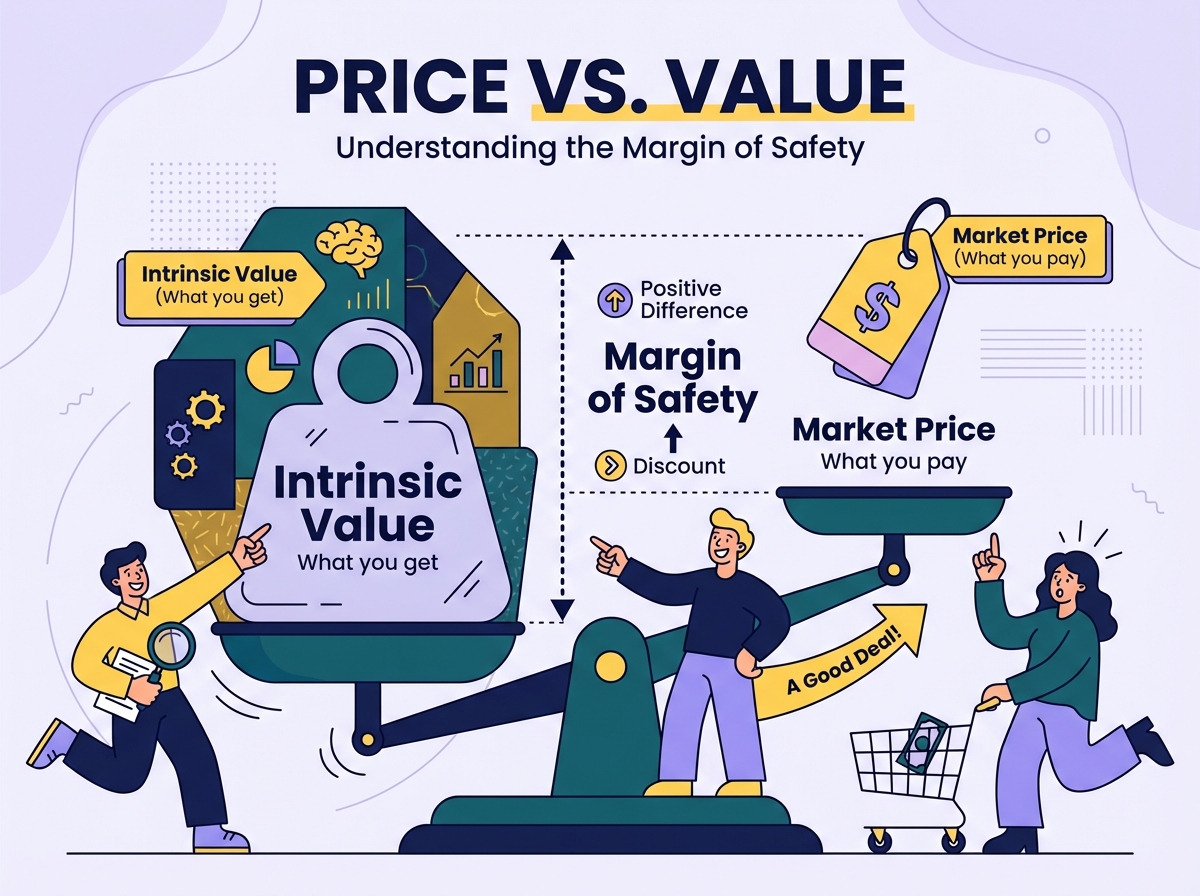
The fundamental tenet of value investing is the distinction between price and value.
Warren Buffett famously uses the allegory of "Mr. Market" (originally created by Ben Graham). Mr. Market is a manic-depressive business partner who offers to buy your share of the business or sell you his share every day at a different price. Sometimes his prices are rational; often, they are driven by euphoria or panic. The value investor looks at Mr. Market’s price, compares it to their own calculation of intrinsic value, and only acts when the discrepancy is in their favor.
To be a successful value investor, you must be comfortable standing apart from the crowd. When the market is crashing and everyone is selling in a panic, value investors see a sale on quality assets. Conversely, during a bubble when everyone is buying, value investors often sit on the sidelines, waiting for prices to return to reality. This requires emotional stability and a firm reliance on data over sentiment.
> 💡 Master the Value Investor Mindset > > Adopting the emotional discipline to separate price from value is the hardest part of investing. Our AI Mentors, trained on research analyzing the psychology of great investors, can roleplay market scenarios to help you practice rational decision-making. > > Meet the AI mentors built from this research →
Through decades of shareholder letters and interviews, a clear framework has emerged from Buffett’s investing style. While he doesn't use a rigid checklist, his decisions generally filter through four key pillars. Understanding these is essential for any beginner looking to pick value investing stocks.
Before looking at numbers, you must look at the business. Buffett advises investors to stick to their "Circle of Competence." This means you should only invest in businesses you actually understand. If you cannot explain how a company makes money, who its competitors are, and what the industry will look like in ten years, you cannot accurately value it.
Perhaps the most critical concept in Buffett’s philosophy is the "Economic Moat." Just as a medieval castle is protected by a moat, a great business must have a durable competitive advantage that protects its profits from competitors. Without a moat, high profits attract competition, which eventually drives profits down.
Common types of moats include:
Since you (as a retail investor) cannot run the company yourself, you are relying on the management team to do it for you. Buffett looks for management that is rational, honest, and shareholder-oriented.
Key indicators of good management:
This is the risk management tool of value investing. If you calculate a company is worth $100 per share, you shouldn't buy it at $98. You should wait until it trades at $70 or $60.
The difference between the intrinsic value ($100) and the purchase price ($70) is the Margin of Safety. This buffer protects you against errors in your calculation, bad luck, or unforeseen economic downturns. The wider the margin, the lower the risk and the higher the potential return.
While qualitative factors (like Moats) are crucial, you eventually need to look at the financial statements. Here are the primary metrics used in a value investing strategy.
The P/E ratio measures how much you are paying for every dollar of earnings.
This compares the market value of the company to its book value (total assets minus total liabilities).
Buffett prefers this metric to measure management efficiency. It shows how much profit the company generates with the money shareholders have invested.
Value investors hate excessive debt. High debt kills companies during recessions.
Earnings can be manipulated by accounting tricks; cash is fact. Free Cash Flow is the cash left over after the company pays for its operating expenses and capital expenditures.
Ready to apply this value investing strategy? Here is a practical workflow.
Use a stock screener (available on most brokerage sites or financial websites) to filter thousands of stocks down to a manageable list. Set criteria such as:
Once you have a list of potential candidates, pick one that falls within your Circle of Competence. Download their latest 10-K (Annual Report).
Do not just look at the numbers. Read the "Business" section. Understand how they make money. Read the "Risk Factors" section to see what could go wrong. Look for evidence of a competitive moat.
Attempt to estimate the intrinsic value. There are several methods to do this, but the Discounted Cash Flow (DCF) analysis is the gold standard used by professionals.
Apply the Margin of Safety. If you estimate the stock is worth $100, set a buy price at $70 (a 30% margin of safety). If the stock is currently $85, you do not buy. You add it to a "Watch List" and wait.
Even experienced investors fall into traps. Here is what to avoid.
A value trap is a stock that looks cheap because it has a low P/E ratio, but the business is fundamentally deteriorating (e.g., a newspaper company in 2005). The stock is cheap for a reason. Always ask: "Is the market wrong, or is the business dying?"
While Buffett says not to obsess over the economy, you cannot ignore major shifts. Rising interest rates generally lower the value of all assets. Buying a cyclical stock (like a car manufacturer) at the peak of an economic cycle can be disastrous, even if the P/E looks low.
Value investing is a long-term game. The market may not recognize the true value of your stock for months or even years. If you need the money next year, do not put it in the stock market.
Learning value investing is like learning a new language; immersion and practice are key. GPTnius offers AI Mentors trained on proprietary research analyzing the published works, philosophies, and proven methodologies of thought leaders, including investors like Warren Buffett and Charlie Munger. Our mentors do not impersonate anyone. They synthesize researched frameworks, such as margin of safety analysis and mental models, into personalized coaching conversations built around your specific goals.
Here is how these AI Mentors can assist your investing journey:
By synthesizing these researched frameworks into personalized coaching conversations, GPTnius allows you to apply the wisdom of history's greatest investors to your specific financial situation.
> 💡 Build Your Bulletproof Investment Thesis > > Don't invest on a hunch. Use an AI Mentor trained on the methodologies of financial greats to stress-test your value investing ideas and identify your blind spots before you put money at risk. > > Meet the AI mentors built from this research →
Value investing is more than a strategy; it is a philosophy of business ownership. By viewing stocks as pieces of a business, insisting on a margin of safety, and remaining rational when others are emotional, you place the odds of financial success in your favor.
Warren Buffett did not become a billionaire overnight. He did it through decades of consistent, rational decision-making. By starting today, defining your circle of competence, and utilizing tools like GPTnius to refine your thinking, you are taking the first steps on a proven path to wealth generation.
The definitive book on value investing is 'The Intelligent Investor' by Benjamin Graham. Warren Buffett has called it the best book on investing ever written.
You can start with very little money. Many brokerage platforms now allow you to buy 'fractional shares,' meaning you can invest in high-priced stocks (like Berkshire Hathaway Class B) with as little as $5 or $10.
No. While growth stocks have outperformed in recent years, value investing is a long-term strategy. Furthermore, value investing principles apply to tech stocks too; Buffett himself invests heavily in Apple because he views it as a value play with a strong moat.