Transform your management style using Bill Campbell's legendary framework. Discover the ultimate 1 on 1 meeting agenda, template, and questions for effective leadership.
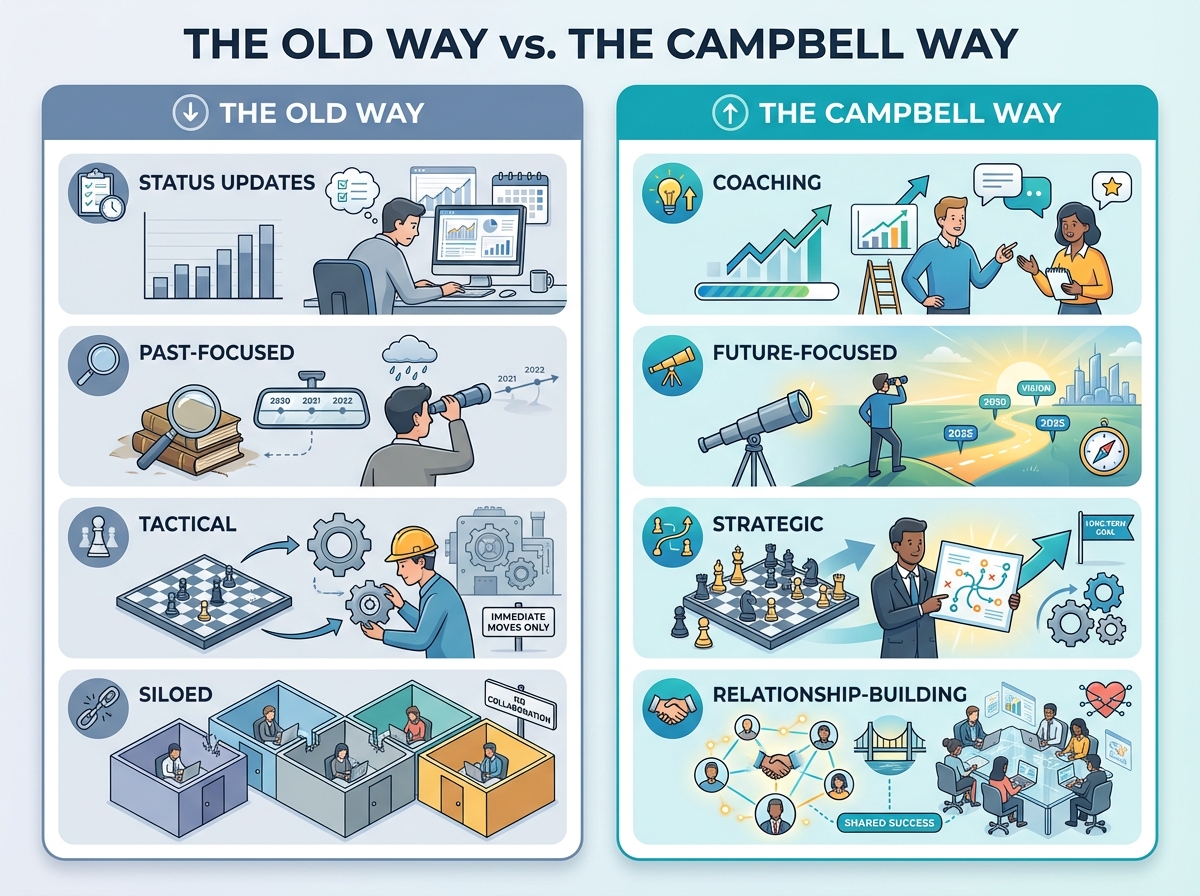
If you look at the average manager's calendar, it is likely peppered with recurring "1:1" blocks. Yet, if you were to sit in on these meetings, you would likely witness a repetitive, low-value ritual: the status update.
"What's the status of Project X?" "Did you send that email?" "What are you working on next week?"
While functional, these conversations miss the point of what an effective 1 on 1 meeting should be. They are tactical, backward-looking, and often could have been an email.
To truly unlock the potential of your team, you need to shift from being a task-master to being a coach. To do this, we look to the man who coached some of the most successful CEOs in history (including Steve Jobs, Larry Page, and Eric Schmidt): Bill Campbell.
Known as the "Trillion Dollar Coach," Campbell didn't rely on complex software or bureaucratic forms. He walked into meetings with a simple list scribbled on a whiteboard—five key themes that ensured every conversation was strategic, personal, and high-impact.
This article will dissect Bill Campbell’s framework and provide you with a practical 1 on 1 meeting agenda to revolutionize your leadership style.
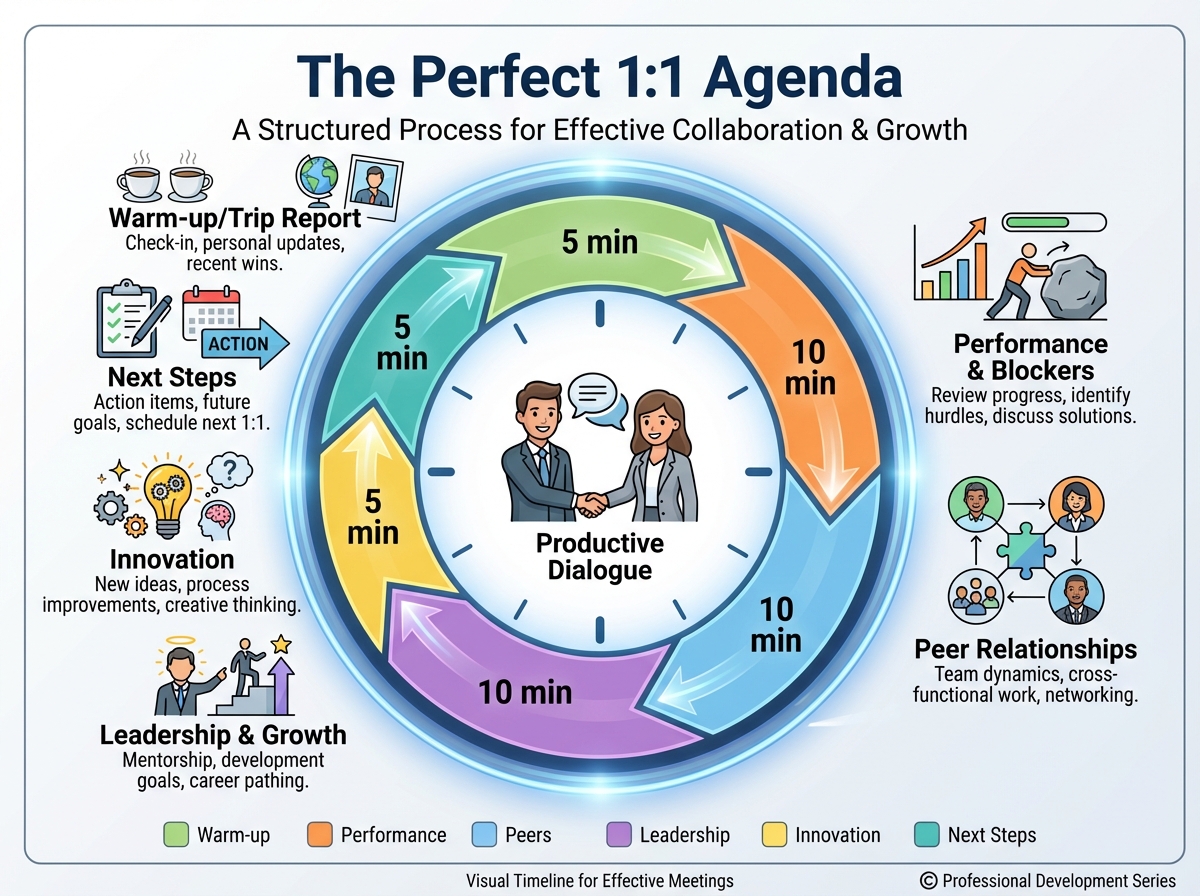
Bill Campbell’s genius lay in his simplicity. He understood that for a meeting to be effective, it needed structure, but that structure had to allow for organic conversation. Before his meetings, he would write five words (or categories) on the whiteboard. These served as the roadmap for the discussion.
This isn't just about "did you hit your numbers?" It is a holistic look at the work itself. Campbell focused on the quality of the work and the results against the goals.
This is the most overlooked aspect of standard management. Campbell knew that friction between teams kills velocity. He used 1:1s to gauge how his direct reports were getting along with their peers.
Even if the employee isn't a manager of people, they are a manager of processes and projects. For those who do manage teams, this section is critical coaching time.
Campbell was deeply passionate about the product. He ensured that meetings didn't get so bogged down in HR issues or timelines that they forgot about the thing they were building.
> 💡 Master the "Trillion Dollar" Coaching Style > > Applying Bill Campbell's framework requires shifting from a "boss" mindset to a "coach" mindset. It can be difficult to know exactly how to phrase questions about peer relationships or innovation without sounding accusatory. > > Meet the AI mentors built from this research →
Most managers download a 1 on 1 meeting template that looks like a checklist. The problem with checklists is that they encourage binary answers (Done/Not Done).
Effective leadership is nuanced. When you focus solely on the "what" (tasks), you miss the "how" (behaviors) and the "why" (motivation). Campbell’s whiteboard method forces a conversation about the ecosystem surrounding the employee, not just their output.
By ignoring peer relationships, you allow toxic cultures to fester. By ignoring innovation, you allow stagnation. The whiteboard ensures you are looking at the employee as a complete professional human being, not just a production unit.
How do you take these five words and turn them into a recurring 1 on 1 meeting agenda? You don't need a literal whiteboard, but you do need a shared structure. Here is how to operationalize the Campbell method.
Don't spend the first 15 minutes of the meeting updating context. Ask your direct report to send a brief bulleted list 24 hours in advance covering the "Performance" aspect (wins, losses, blockers). This allows the meeting time to be spent on solutions, not reporting.
Campbell often started meetings with personal connection—sometimes called a "trip report" (discussing what they did over the weekend or on a recent trip). This builds psychological safety. You cannot coach someone who doesn't trust you.
Structure the remaining time (assuming a 45-minute meeting) using the framework:
To get the most out of this framework, you need to ask open-ended questions. Here are specific 1 on 1 meeting questions mapped to the 5 words:
Even with the best 1 on 1 meeting template, managers often fall into traps that derail the process.
Nothing says "you are not a priority" louder than constantly rescheduling or canceling 1:1s. Treat this time as sacred. If you must move it, reschedule it immediately within the same week.
This is their meeting, not yours. You should be speaking less than 40% of the time. Your job is to ask questions and listen, not to pontificate.
If peer relationships are straining, or performance is dipping, bring it up. The whiteboard framework gives you a dedicated slot (Relationships/Performance) to discuss this, so use it. Avoiding difficult feedback destroys the value of the meeting.
Reading about Bill Campbell’s framework is one thing; applying it in a high-stakes environment is another. It takes practice to transition from a task-manager to a strategic coach.
GPTnius offers AI Mentors trained on proprietary research analyzing the published works, philosophies, and proven methodologies of thought leaders, including coaches like Bill Campbell. Our mentors do not impersonate anyone. They synthesize researched frameworks, such as effective management and coaching models, into personalized coaching conversations built around your specific goals.
Here is how GPTnius can help you master the 1:1:
The AI Mentors synthesize these researched frameworks to provide personalized coaching conversations, allowing you to apply proven principles to your specific management challenges.
> 💡 Elevate Your Leadership with AI Mentorship > > Don't let your next 1:1 be another status update. Use GPTnius to practice your coaching questions, structure your agendas, and internalize the management habits of the world's best leaders. > > Meet the AI mentors built from this research →
Most management experts, including the principles used by Bill Campbell, recommend weekly meetings. This frequency ensures that small issues don't become big problems and maintains a strong relational bond. Bi-weekly can work for very senior reports, but weekly is the gold standard.
A standard duration is 30 to 60 minutes. 30 minutes is often sufficient for tactical updates, but to truly cover the '5 Words' framework (Performance, Relationships, Leadership, Innovation), 45 to 60 minutes allows for the necessary depth of conversation.
This is a common challenge. If they have nothing to discuss, it is the manager's job to prompt the conversation using the framework. Ask about peer relationships, career goals, or product innovation. The '5 Words' method ensures there is always a strategic topic to cover, even if tactical updates are light.