Unlock the power of Reid Hoffman's Tour of Duty framework. Learn how this employee engagement strategy from 'The Alliance' builds trust and retention.
The era of the gold watch retirement is over. In today's volatile professional landscape, the average employee tenure has dropped significantly, and the "lifetime employment" pact is a relic of the past. Yet, many organizations still operate on a dishonest premise: employers pretend they will keep employees forever, and employees pretend they will stay forever. This mutual deception leads to a lack of trust, disengagement, and the phenomenon often described as "quiet quitting."
Enter the Tour of Duty framework, a concept crystallized by LinkedIn co-founder Reid Hoffman, Ben Casnocha, and Chris Yeh in their seminal book, The Alliance. This framework proposes a radical shift in the modern employer-employee relationship. Instead of viewing employment as a transactional exchange of time for money, it reframes it as a transformational alliance.
By acknowledging the reality that employees will likely leave eventually, companies can actually encourage them to stay longer and perform better. This article explores how implementing the Tour of Duty framework can revolutionize your employee engagement strategies, particularly in an age of remote work and high turnover.
At its core, the Tour of Duty is a commitment by the employer and the employee to a specific mission over a realistic period of time. It is an explicit agreement that acknowledges the temporary nature of most modern employment while maximizing mutual value.
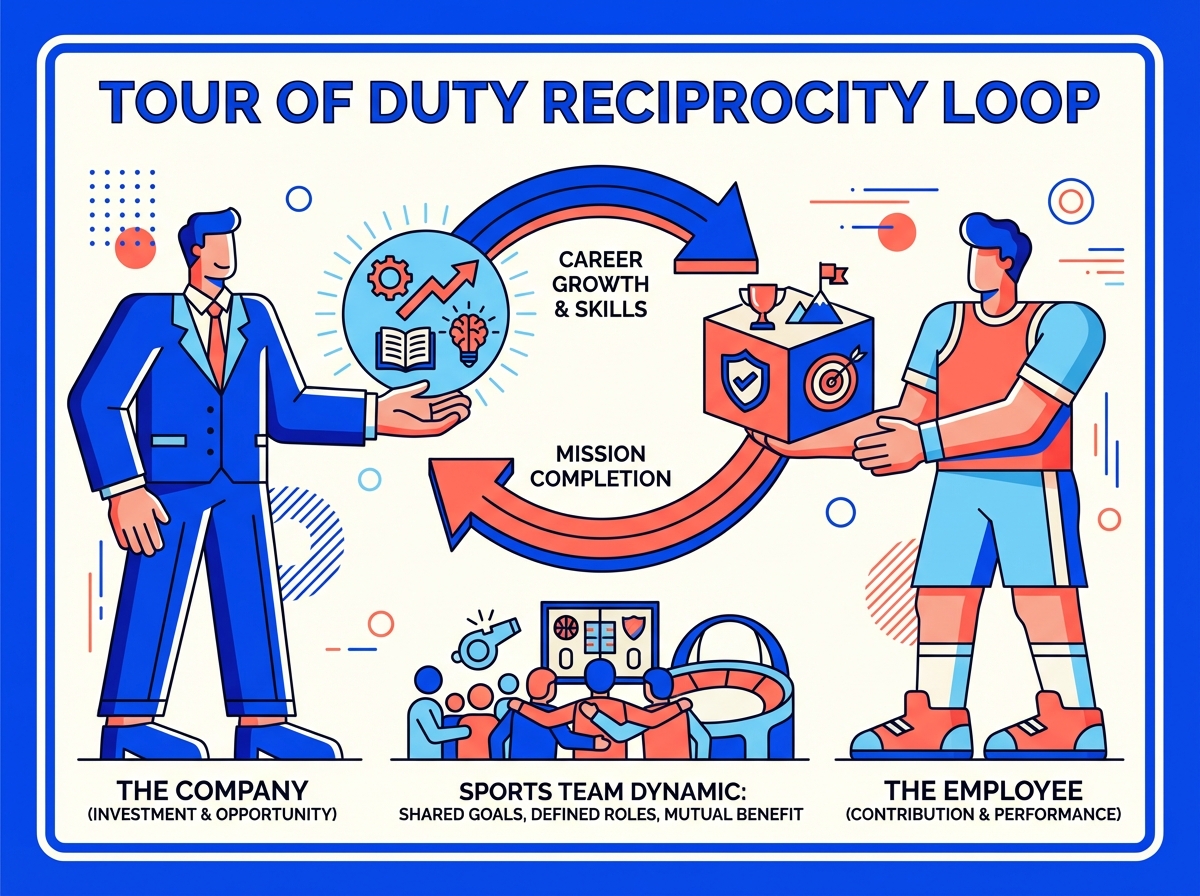
The framework moves away from the metaphor of a company as a "family" (which implies unconditional love and creates awkwardness when layoffs occur) to the metaphor of a high-performing sports team. On a sports team, the roster changes. Players are there to win championships and improve their stats to eventually get better contracts. The team wants the player to perform at their peak to win games. The goals are aligned, even if the tenure isn't permanent.
The Tour of Duty relies on a simple pact of reciprocity:
This honest conversation builds the psychological safety necessary for true innovation. When an employee knows they can discuss their long-term career goals—even if those goals lie outside the company—without fear of retribution, they are more likely to fully engage with their current work.
> 💡 Build a Stronger Professional Alliance > > Struggling to structure these honest conversations? GPTnius AI Mentors, trained on proprietary research analyzing proven management frameworks, can help you roleplay and script your first Tour of Duty discussion. > > Meet the AI mentors built from this research →
Reid Hoffman’s research identifies three distinct types of tours, each suited for different stages of an employee's career and different organizational needs.
Duration: 1–3 years Target: Entry-level employees or career switchers.
This is similar to a structured program (like a medical residency or an investment banking analyst program). The goal is simple: the employee provides predictable, scalable work, and the employer provides training and a brand stamp on the resume. There is usually no expectation of a long-term strategic transformation here; it is about competence and fit. If the Rotational Tour goes well, it often graduates into a Transformational Tour.
Duration: 2–5 years Target: Mid-level to senior professionals.
This is the "sweet spot" of the framework. In a Transformational Tour, the employee promises to complete a specific mission that will significantly advance the company. In return, the company promises that completing this mission will significantly advance the employee's career.
Crucially, as the tour nears its end, both parties discuss the next step: either a new tour within the company or a supportive transition to a new job elsewhere.
Duration: 10+ years (potentially indefinitely) Target: Senior leadership and key stakeholders.
Foundational employees view their life's work as aligned with the company's mission. They are the guardians of the culture. While they are technically employees, they operate with a founder's mindset. Not everyone can or should be on a Foundational Tour, but these individuals provide the continuity required for long-term success.
The rise of remote and hybrid work has made the Tour of Duty more relevant than ever. In a remote environment, "face time" is irrelevant. Managers cannot see who is sitting at their desk; they can only judge performance based on outcomes.
The Tour of Duty framework naturally aligns with remote work because it is outcome-based, not hours-based. It shifts the management style from surveillance to mission accomplishment.
Remote employees often feel disconnected from the larger purpose of the organization. A defined Tour of Duty provides a "North Star." It answers the question, "Why am I logging onto Zoom every day?" The answer becomes: "To achieve Mission X, which will help me land my dream job as a VP in three years."
Skeptical managers often ask: "If I encourage my employees to plan for their next job, won't they leave sooner?"
The data and research behind The Alliance suggest the opposite. When you support an employee's long-term growth, you build loyalty. Employees on a Transformational Tour are less likely to jump ship for a small salary bump because they are invested in completing their mission. They want the "achievement" on their resume.
Furthermore, by creating an honest dialogue, you eliminate the "two weeks' notice" shock. You gain visibility into your talent pipeline. If an employee decides their tour is over and they want to leave, you can plan a transition period of months, not weeks, turning a disruption into a smooth handover.
The Tour of Duty framework also extends beyond the employment period. It emphasizes the value of corporate alumni networks. Former employees who leave on good terms become brand ambassadors, clients, and sources of referrals. By treating the exit as a graduation rather than a betrayal, companies maintain a lifelong alliance with top talent.
You do not need a legal team to draft a Tour of Duty. It is a psychological contract, usually outlined in a simple document or email summary. Here is how to structure it:
Understanding the theory of The Alliance is one thing; having the nuanced, difficult conversations required to implement it is another. This is where GPTnius bridges the gap between theory and practice.
GPTnius offers AI Mentors that have been trained on proprietary research analyzing the published works, philosophies, and proven methodologies of thought leaders in management and HR. Specifically, you can engage with mentors designed to help with strategic leadership and career coaching.
Here is how GPTnius supports your implementation of the Tour of Duty:
> 💡 Master Modern Leadership Frameworks > > Don't let your team drift. Use GPTnius to access AI Mentors trained on the world's best management research and start building high-retention alliances today. > > Meet the AI mentors built from this research →
The modern employer-employee relationship is broken, but it is not irreparable. By adopting the Tour of Duty framework, organizations can move from a culture of mutual deception to one of honest alliance. This approach respects the employee's desire for career growth and the employer's need for high performance.
Whether you are a manager looking to retain top talent or an individual contributor seeking to define your career path, the Tour of Duty offers a roadmap for success. It transforms the workplace from a holding tank into a launchpad, ensuring that even when the employment ends, the relationship endures.
The Tour of Duty framework, originating from the book 'The Alliance', treats employment not as a lifetime contract but as a specific, time-bound mission where the employer and employee mutually benefit. It focuses on an honest alliance where the company helps the employee transform their career, and the employee helps the company transform its business.
The duration depends on the type of tour. A 'Rotational' tour usually lasts 1-3 years, while a 'Transformational' tour (the most common type for professionals) typically lasts 2-5 years. A 'Foundational' tour is long-term and can last a decade or more.
Yes, it is often even more effective for small businesses. Since small companies often cannot offer the same salary or stability as corporate giants, offering a clear 'Transformational Tour'—where the employee gains massive responsibility and skills—is a powerful recruiting and retention tool.