Learn how to build psychological safety at work using principles from the 'Trillion Dollar Coach.' Discover actionable strategies to foster trust and innovation.
Imagine a meeting where a junior employee spots a potential flaw in a major project launch. In Company A, they stay silent, fearing that pointing out the error will be seen as negativity or incompetence. The project launches, fails, and costs the company millions. In Company B, that same employee speaks up immediately. The team thanks them, pivots, and the launch is a massive success.
The difference between these two scenarios isn't skill, budget, or technology. It is psychological safety.
Coined by Harvard professor Amy Edmondson and popularized by Google’s massive "Project Aristotle" study, psychological safety is the shared belief that a team is safe for interpersonal risk-taking. It is the confidence that you will not be punished or humiliated for speaking up with ideas, questions, concerns, or mistakes.
While the concept is academic, the application is deeply practical. To understand how to build it, we look to the proprietary research analyzing the methodologies of Bill Campbell, known as the "Trillion Dollar Coach." Campbell mentored the likes of Steve Jobs, Larry Page, and Jeff Bezos, not by teaching them how to code, but by teaching them how to build teams based on trust, love, and safety.
Before diving into the how, we must understand the why. Psychological safety at work is often mistaken for "being nice" or lowering standards. In reality, it is the exact opposite. It is the prerequisite for high standards.
When psychological safety is low, teams operate in "impression management" mode. Energy that should be spent on innovation is instead wasted on self-protection. Employees hide their mistakes to avoid blame, meaning systemic issues go unresolved. In this environment, diversity of thought is stifled because fitting in becomes safer than standing out.
Conversely, high psychological safety correlates with:
> 💡 Is Your Team Playing it Too Safe? > > If your meetings are full of silence or only the leader speaks, you may have a safety problem. Our AI Mentors can help you diagnose your team's culture and roleplay the difficult conversations needed to fix it. > > Meet the AI mentors built from this research →
Research into Bill Campbell’s coaching methodology reveals that he didn't view management as a manipulation of resources, but as the stewardship of people. His approach to creating safety was rooted in a few core principles.
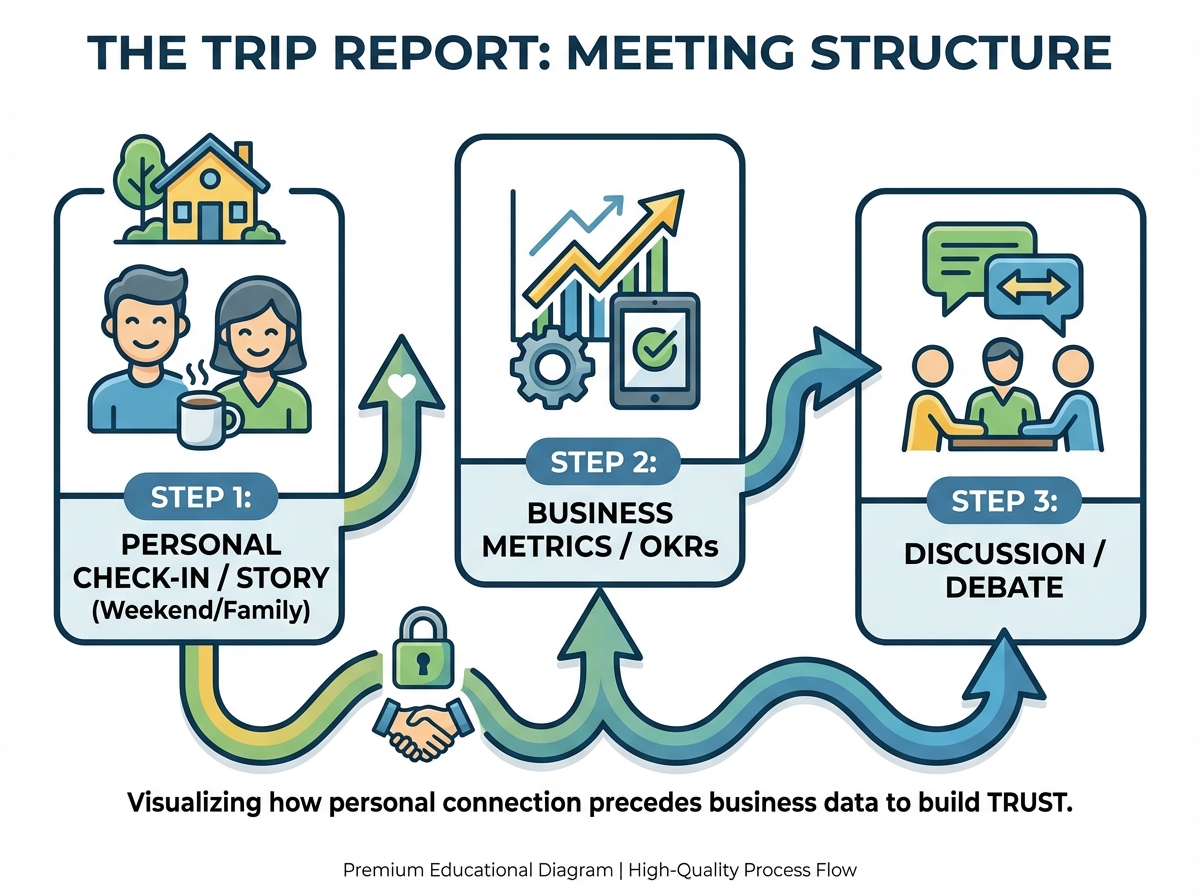
One of Campbell’s most famous tactics for building safety was the "Trip Report." Before diving into business metrics or OKRs (Objectives and Key Results), he would start board meetings by asking people to share personal stories—where they traveled over the weekend, what their kids were doing, or personal challenges they were facing.
Why this builds safety: When team members know each other as human beings, not just job titles, empathy increases. It is much harder to be toxic or dismissive toward someone when you know they are struggling with a sick parent or celebrating a child’s graduation. This ritual signals that you are welcome here, not just your output.
There is a misconception that a safe environment is conflict-free. Campbell’s methodology suggests the opposite. He was famous for his "radical candor" (a term later coined by his mentee Kim Scott).
He believed that because he established a baseline of "love" and total support for the person, he could be incredibly tough on the problem. Safety allows for friction. If your team is safe, they can argue passionately about a strategic direction without the argument becoming a personal attack.
Nothing destroys psychological safety faster than a high-performer who is toxic. These are the "aberrant geniuses"—individuals who deliver great results but bully, belittle, or undermine their colleagues.
In many organizations, leadership tolerates this behavior because of the output. Campbell’s philosophy was clear: You cannot tolerate them. Keeping a toxic genius signals to the rest of the team that abuse is acceptable as long as you make money. This destroys trust. Removing them, despite the short-term pain, sends a powerful message that the team's psychological safety is paramount.
Based on the analysis of high-performing team frameworks, here is how you can operationalize these concepts immediately.
When starting a new project, explicitly state: "We’ve never done this before. We are going to get things wrong. I need everyone to watch for pitfalls." This invitation turns the act of pointing out a mistake into a helpful contribution rather than a disruption.
Leaders must "eat their own dog food." Admitting your own mistakes is the single most powerful tool for building safety. Say things like, "I missed that detail in the last sprint, and that’s on me. Here is how I’m adjusting." When the leader is vulnerable, it gives permission for the team to be vulnerable.
When something goes wrong, the natural instinct is to ask, "Who did this?" Instead, adopt a systems-thinking approach. Ask:
Campbell was strict about attention. In meetings, laptops were closed (unless presenting). Listening is an active act of respect. If team members are checking email while a colleague is being vulnerable or pitching an idea, safety erodes. Enforce active listening to validate that every voice matters.
Stop using one-on-one meetings for status updates; that can be done via email. Use this time to ask:
How do you know if these strategies are working? Look for these indicators:
Understanding the theory of psychological safety is different from practicing it in the heat of a stressful workday. This is where GPTnius bridges the gap.
GPTnius offers AI Mentors trained on proprietary research analyzing the published works, philosophies, and proven methodologies of thought leaders, including coaches like Bill Campbell. Our mentors do not impersonate anyone. They synthesize researched frameworks, such as psychological safety and trust-based leadership, into personalized coaching conversations built around your specific goals.
Here is how a GPTnius Mentor can help you:
> 💡 Build a Team That Trusts You > > Don't leave your team culture to chance. Access AI Mentors trained on the world's best management research to guide your leadership journey. > > Meet the AI mentors built from this research →
Psychological safety at work is not a perk; it is the engine of the modern economy. In a world where innovation is the only competitive advantage, you need the full brainpower of every person on your payroll. You only get that when people feel safe enough to bring their full selves to work.
By applying the principles of trust, candor, and team-protection derived from the research on leaders like Bill Campbell, you can transform a group of individuals into a high-performing, resilient team. It starts with the courage to listen, the strength to be vulnerable, and the commitment to put people first.
Trust is usually between two individuals (I trust you to do X). Psychological safety is a group norm—it is the belief that 'we' are safe together. You can trust a colleague but still feel the group environment is unsafe for speaking up.
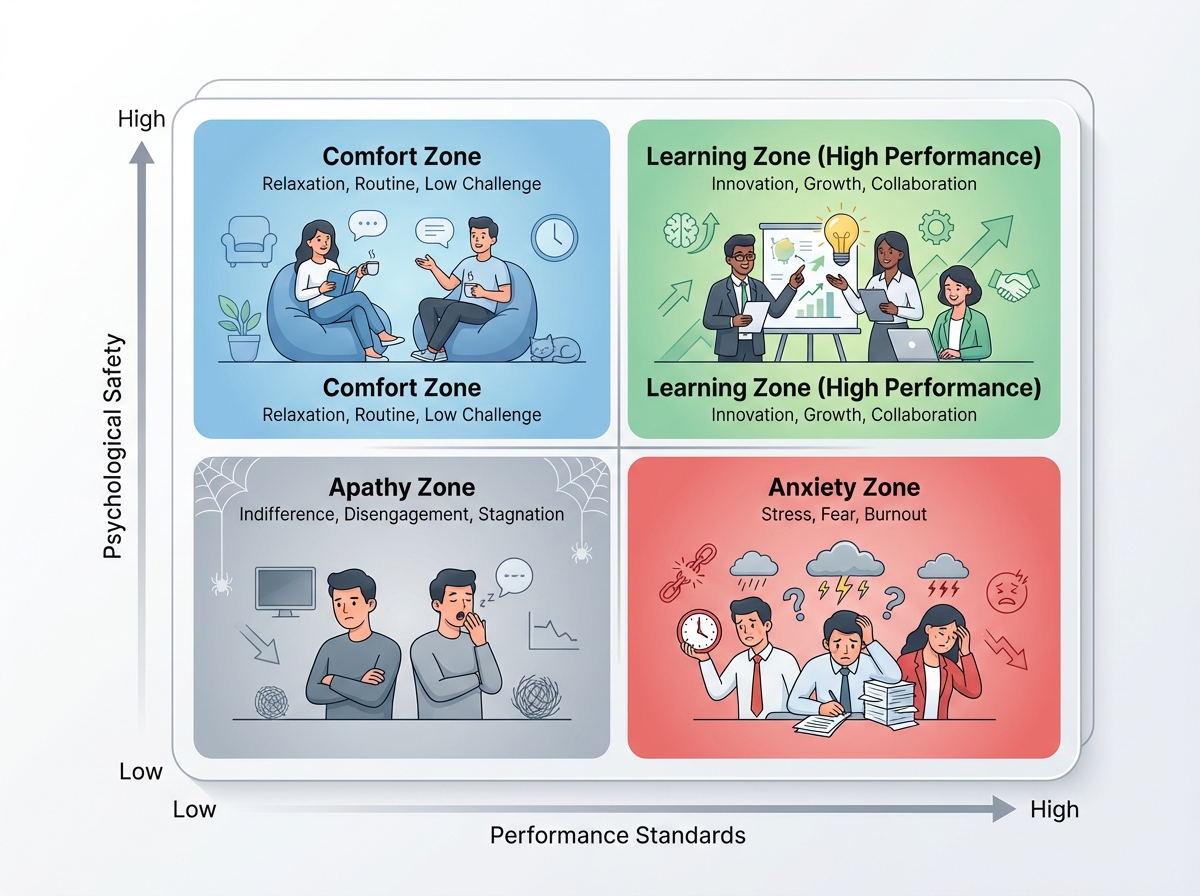
No, but they can have a lack of accountability. Psychological safety must be paired with high performance standards. If you have safety without accountability, you create a 'comfort zone' where people are happy but little gets done. The goal is the 'Learning Zone' (High Safety + High Accountability).
It is not an overnight fix. It requires consistent behavior from leadership over months. However, it can be destroyed in a single meeting if a leader humiliates someone. Consistency is key.