Discover how Ray Dalio's principles of Radical Truth and Radical Transparency can transform team performance, eliminate office politics, and foster an Idea Meritocracy.
Ray Dalio's principles of Radical Truth and Radical Transparency are designed to replace office politics with an "Idea Meritocracy" where the best ideas win regardless of rank. By fostering a culture where mistakes are viewed as learning opportunities and feedback is completely open, leaders can build high-performing teams that adapt quickly and make superior decisions. This guide breaks down how to implement these challenging but rewarding frameworks.
---
In the modern corporate landscape, polite incompetence often masquerades as culture. Meetings are held where the real decisions happen in the hallway afterward. Feedback is sandwiched between insincere compliments, diluting its impact. For Ray Dalio, founder of Bridgewater Associates, this standard operating procedure was the enemy of excellence.
Dalio built one of the world's most successful hedge funds not just on financial acumen, but on a unique cultural operating system: Radical Truth and Radical Transparency.
While these concepts can seem intimidating—or even harsh—to the uninitiated, they are the bedrock of what Dalio calls an "Idea Meritocracy." When implemented correctly, these principles strip away the ego and office politics that stifle innovation, allowing the best ideas to rise to the top. This article explores how you can leverage these frameworks to build a high-performing team that values accuracy over comfort.
To apply these principles, we must first distinguish between them. They are related, but they serve different functions within the organizational machine.
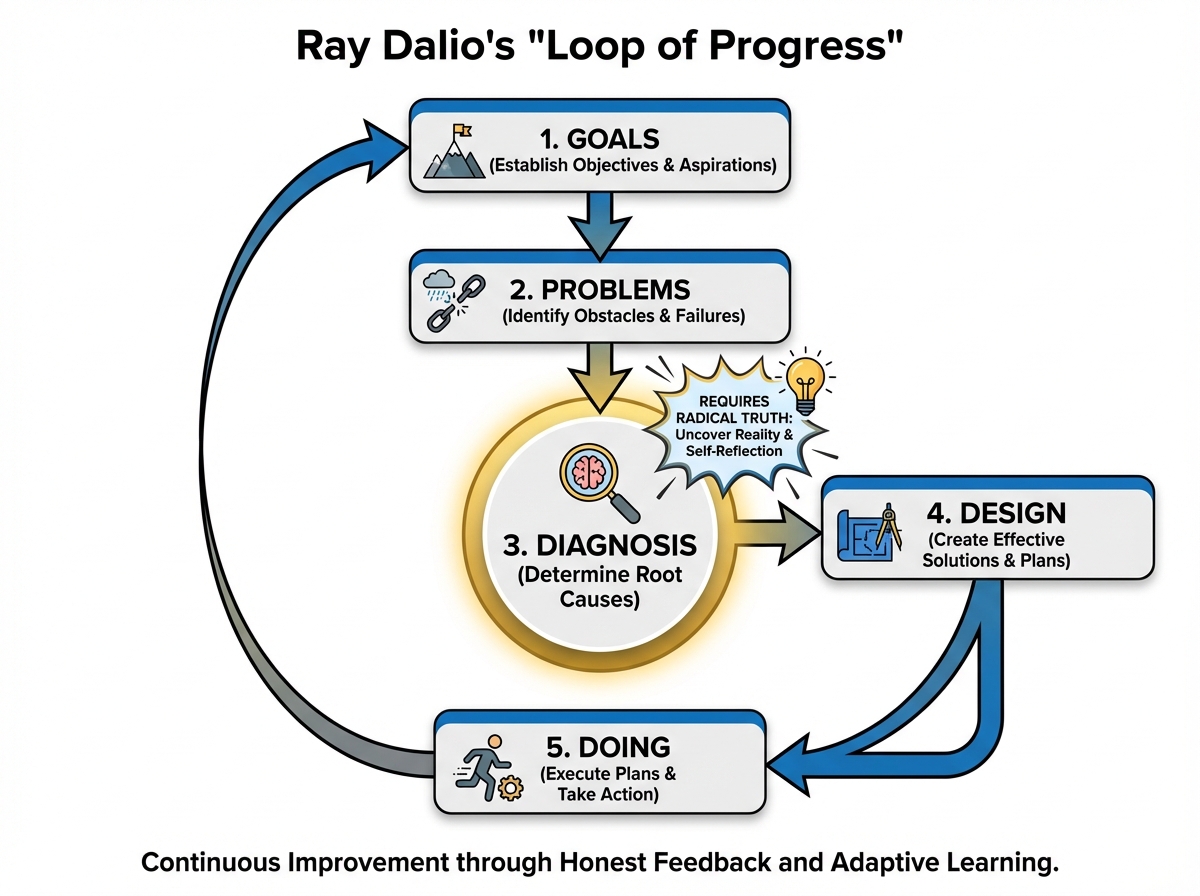
Radical Truth is the intellectual habit of refusing to let yourself or others filter reality. It is the ability to look at mistakes, weaknesses, and failures without flinching. In most organizations, the truth is often softened to protect feelings. In a Radical Truth environment, the accuracy of the statement is more important than the emotional comfort of the recipient.
It is based on the equation: Pain + Reflection = Progress.
Without the "truth" of the pain (acknowledging the failure fully), there can be no reflection, and therefore, no progress.
If Radical Truth is the what, Radical Transparency is the how. It is the practice of making the path to truth visible to everyone. At Bridgewater, this famously meant recording almost every meeting and making those recordings available to the entire company.
Radical Transparency eliminates the information asymmetry that breeds politics. When everyone sees the same data, hears the same conversations, and understands the logic behind a decision, there is no room for spin or manipulation.
> 💡 Master the Art of Honest Leadership > > Implementing Radical Truth requires difficult conversations that many leaders avoid. GPTnius AI Mentors, trained on proprietary research regarding conflict resolution and feedback frameworks, can roleplay these critical discussions with you before you step into the boardroom. > > Meet the AI mentors built from this research →
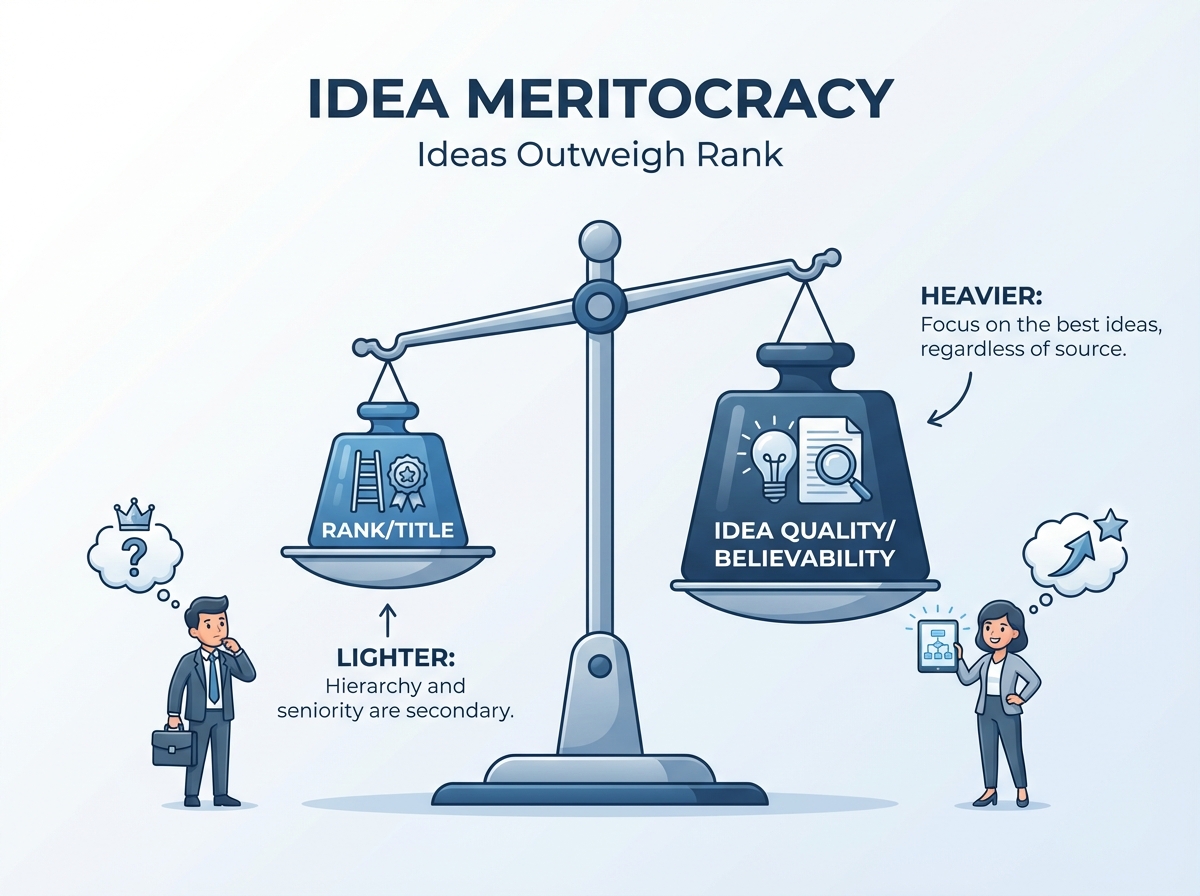
The goal of truth and transparency isn't just to be "honest" for honesty's sake. The goal is to create an Idea Meritocracy.
In a traditional hierarchy, the boss's decision rules, even if the intern has a better idea. In an Idea Meritocracy, the best idea wins, regardless of who it comes from. However, for the best idea to win, two things must happen:
One of the most critical mechanisms Dalio proposes is "Believability Weighted Decision Making." In a democracy, every vote counts equally. In an Idea Meritocracy, the views of people who have repeatedly demonstrated success in a specific area (high believability) are weighted more heavily.
For example, if you are debating a marketing strategy, the opinion of a proven CMO should weigh more than the opinion of a junior developer. However, the junior developer is still obligated to speak their truth, because they might see a flaw the CMO missed. Radical Transparency ensures the developer understands why their idea wasn't chosen, turning the rejection into a learning opportunity rather than a morale killer.
Transitioning a team to this model is difficult. It requires unlearning social conditionings that tell us to be polite above all else. Here is a roadmap for implementation.
You cannot spring Radical Truth on a team overnight. It requires a foundational agreement. The team must agree that knowing the truth is better than feeling good in the moment.
Dalio often uses the metaphor of looking at your team (and yourself) as a machine. You are the designer of the machine, but you are also a worker within it.
When a part of the machine breaks (a mistake happens), you shouldn't get angry at the part. You should ask: "Why did this break? Is it a design flaw?" This shifts the conversation from blame (which triggers defensiveness) to diagnosis (which triggers problem-solving).
Feedback shouldn't be an annual event. It must be continuous. In a Radical Truth environment, feedback is real-time.
The biggest obstacle to Radical Truth is the ego. Neurobiologically, our brains treat an attack on our ideas as an attack on our survival. The amygdala hijacks the brain, and we go into fight-or-flight mode.
To build a high-performing team using these principles, you must foster Psychological Safety alongside Radical Truth. This seems contradictory, but it is complementary.
Team members must know that the criticism is meant to help them improve, not to destroy them. As a leader, you must model this by being the first to admit your own mistakes. When the leader exposes their own throat, it signals to the pack that it is safe to be vulnerable.
While powerful, Dalio's frameworks are easily misinterpreted.
Radical Truth is not a license to be cruel. It is about precision and helpfulness. If you are critiquing someone's character rather than their work or methodology, you have crossed the line. The intention must always be the improvement of the individual and the team.
Dumping raw data or forwarding sensitive email chains without context can cause chaos. Transparency requires curation. It means sharing the relevant information needed to understand a decision, not necessarily every single thought that crosses a leader's mind.
Not everyone thrives in a Bridgewater-style environment. Some high performers require a different management style. Building a high-performing team involves selecting people who have the stomach for high-resolution feedback. It is better to be transparent about the culture during the hiring process than to surprise new hires with it later.
Reading about Ray Dalio's principles is easy; applying them when emotions are high is incredibly difficult. This is where GPTnius bridges the gap between theory and practice.
GPTnius offers AI Mentors that have been trained on proprietary research analyzing the published works, philosophies, and proven methodologies of thought leaders. For example, our "The Architect" mentor draws from research on frameworks like mental models and systems thinking, combined with proven coaching models.
Here is how you can use GPTnius to build your high-performing team:
By engaging in these guided coaching conversations, you move from understanding the philosophy to living it.
> 💡 Build Your Own Idea Meritocracy > > Don't let office politics stifle your team's potential. Use GPTnius to access AI Mentors trained on the research behind the world's most effective management frameworks, and start making better decisions today. > > Meet the AI mentors built from this research →
Radical Truth and Radical Transparency are not for the faint of heart. They require a commitment to putting the outcome above the ego. However, for leaders willing to embrace the discomfort, the rewards are immense. By building a culture where the truth is the ultimate authority, you create a team that is resilient, innovative, and capable of achieving high performance in any environment. The journey starts with a single honest conversation.
Radical Truth is the practice of ensuring accuracy and honesty in feedback and reality assessment, regardless of emotional comfort. Radical Transparency is the method of making the process of decision-making and information sharing visible to everyone in the organization to eliminate politics.
Not necessarily. While some companies (like Bridgewater) go to extremes, most organizations apply radical transparency to business logic, decision-making processes, and meeting outcomes. It is about eliminating 'back-room deals,' not violating personal privacy.
The key is to pair Radical Truth with psychological safety. Feedback must be delivered with the clear intent of helping the person grow, not tearing them down. Leaders must also be the first to receive critical feedback to model vulnerability.