Master the Management by Objectives (MBO) framework. Learn the 5-step process, advantages, disadvantages, and how to adapt Drucker's principles for modern agile teams.
Management by Objectives (MBO) is a strategic management model that aims to improve the performance of an organization by clearly defining objectives that are agreed to by both management and employees. Popularized by Peter Drucker, the framework emphasizes participative goal setting, alignment, and performance measurement. This article explores how to modernize MBO for today's agile and remote work environments, providing templates and examples to help you implement it effectively.
---
In the fast-paced world of modern business, where remote work and agile methodologies dominate, the challenge for leaders remains the same as it was in 1954: How do you get everyone rowing in the same direction?
The answer may lie in a concept that shaped modern corporate culture. When Peter Drucker introduced Management by Objectives (MBO) in his seminal book The Practice of Management, he shifted the paradigm from command-and-control to collaboration and alignment. Drucker argued that people are not just tools of production but assets who perform best when they understand exactly what they are aiming for and have a say in setting those targets.
While some critics argue that MBO is a relic of the mid-20th century, successful modern companies have not abandoned it—they have evolved it. Frameworks like Google’s OKRs (Objectives and Key Results) are direct descendants of Drucker’s philosophy.
This comprehensive guide will walk you through the management by objectives process, showing you how to adapt these timeless principles to build high-performing, autonomous teams today.
At its core, Management by Objectives is a strategic management model that aims to improve organizational performance by clearly defining objectives that are agreed to by both management and employees.
The central philosophy is that employees are more motivated and productive when they:
Unlike traditional management, where goals are handed down from the top without discussion, MBO is a participative process. It transforms the manager from a taskmaster into a coach, focusing on results rather than the activities used to achieve them.
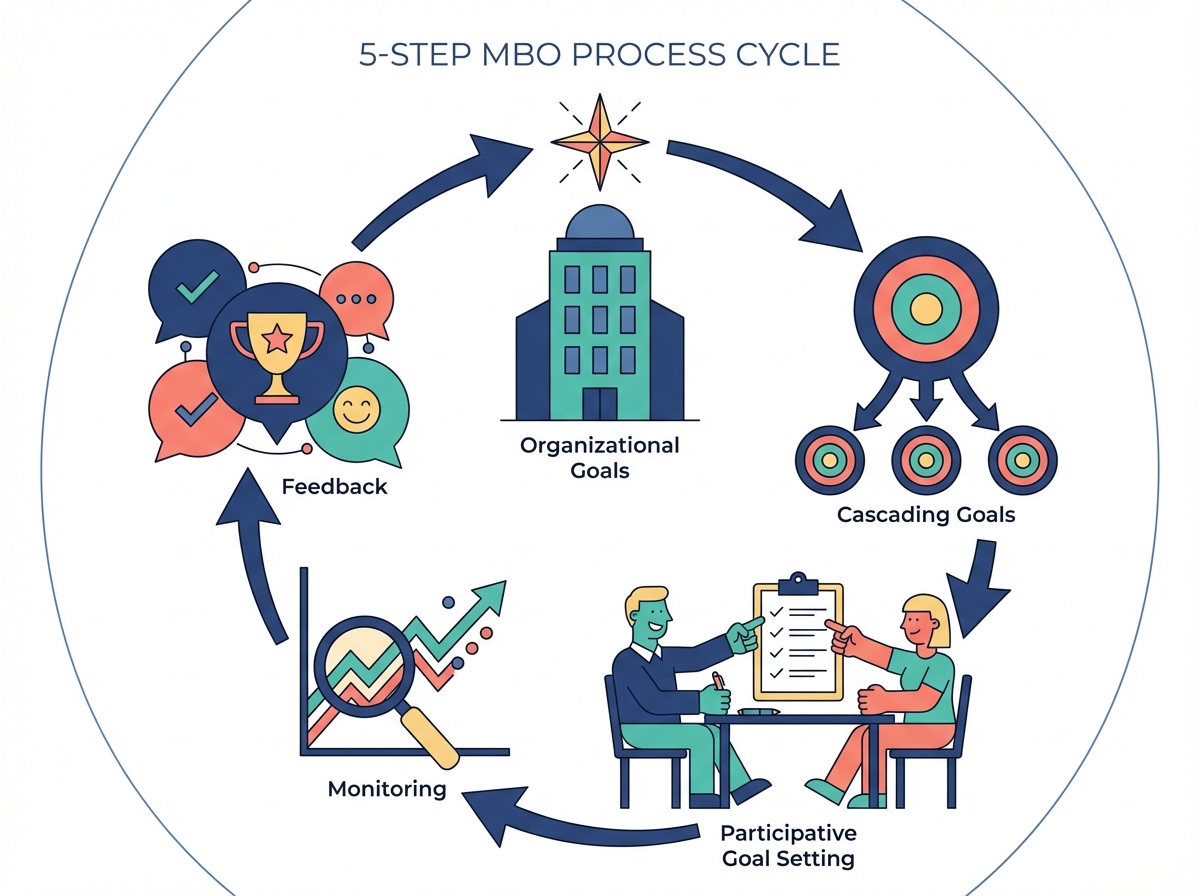
Implementing MBO isn't about filling out forms; it is a cyclical process of alignment. To deploy this effectively, you must follow a structured workflow.
Before individual employees can set goals, the organization must have a clear direction. Senior leadership identifies the strategic objectives for the upcoming period (quarter or year). These might include revenue targets, market expansion, or product innovation milestones. These goals serve as the "North Star" for the rest of the company.
This is the cascading phase. Organizational goals are broken down into departmental and team goals. Managers must communicate these high-level targets to their teams in a way that is relevant and actionable. The question shifts from "What does the company want?" to "What does our team need to achieve to help the company win?"
This is the differentiator. Instead of telling an employee, "Do X by Friday," the manager and employee sit down to draft the employee's objectives together.
Using the SMART criteria (Specific, Measurable, Achievable, Relevant, Time-bound), they agree on what success looks like. This buy-in is crucial; when an employee helps set the target, they take ownership of the outcome.
In the original MBO era, this might have been a mid-year check-in. In modern management by objectives examples, this involves weekly or bi-weekly 1:1s. The focus is on removing roadblocks and ensuring the employee has the resources needed to hit the target.
At the end of the agreed period, performance is reviewed against the specific objectives set in Step 3. Because the goals were measurable, the evaluation is objective rather than subjective. Success is then rewarded through recognition, bonuses, or promotion, reinforcing the cycle.
> 💡 Struggling to Define Clear Objectives? > > Setting SMART goals that align with organizational strategy is a skill that requires practice. GPTnius AI Mentors, trained on proprietary research analyzing proven management frameworks, can act as your sounding board to refine your objectives before you present them to your team. > > Meet the AI mentors built from this research →
One of the main criticisms of traditional MBO is that it can be too rigid for today's fast-changing market. However, the principles are sound—they just need an update. Here is how to apply management by objectives in a modern context.
In the 1950s, a 5-year plan made sense. Today, a 1-year plan is a guess. Adapt MBO by shortening the cycle. Set quarterly objectives (Q1, Q2, etc.) to allow for pivots. If market conditions change, you can adjust objectives for the next quarter without scrapping an entire year's work.
For remote teams, "management by walking around" is impossible. MBO is actually the perfect framework for remote work because it focuses on output. As a manager, you shouldn't care if your employee works at 8 AM or 8 PM, as long as the agreed-upon objective is met. MBO builds trust by measuring results, not hours online.
In traditional MBO, missing a goal often meant missing a bonus. This can encourage "sandbagging"—setting goals that are too easy just to ensure a payout. Modern tech companies often separate developmental goals (stretch goals) from compensation to encourage risk-taking and innovation.
To better understand how this looks in practice, let’s explore specific examples across different departments.
Before implementing this framework, it is vital to weigh the management by objectives advantages against the potential pitfalls.
You do not need expensive software to start. A simple shared document or spreadsheet can serve as your management by objectives template. Here is a structure you can copy and adapt.
Employee Name: [Name] Review Period: [e.g., Q1 2024] Manager: [Name]
| Objective Category | Specific Goal (SMART) | Key Results / Metrics | Target Date | Weight (%) |
|---|---|---|---|---|
| Performance | Increase email open rates. | Achieve avg 25% open rate on newsletters. | March 31 | 50% |
| Project | Launch new CRM migration. | All data migrated and team trained. | Feb 15 | 30% |
| Personal Dev | Improve public speaking. | Lead 2 monthly team presentations. | Ongoing | 20% |
Resources Required: [List budget, tools, or support needed] Mid-Point Check-in Date: [Date]
Implementing Peter Drucker’s frameworks requires more than just understanding the theory; it requires the ability to apply it to unique, messy, real-world situations. This is where GPTnius serves as a bridge between theory and practice.
GPTnius offers AI Mentors trained on proprietary research analyzing the published works, philosophies, and proven methodologies of thought leaders, including management thinkers like Peter Drucker. Our mentors do not impersonate anyone. They synthesize researched frameworks, such as Management by Objectives, into personalized coaching conversations built around your specific goals.
Here is how these AI Mentors can assist you with MBO:
By synthesizing these researched frameworks into personalized coaching conversations, GPTnius allows you to practice the art of management before you apply it in the boardroom.
> 💡 Ready to Master Strategic Management? > > Don't just read about MBO—practice it. Engage with AI Mentors trained on the research of management legends to refine your leadership style and drive team alignment. > > Meet the AI mentors built from this research →
Peter Drucker’s Management by Objectives remains one of the most effective tools for aligning a workforce. While the tools of business have changed—shifting from typewriters to Slack channels—the fundamental human need for clarity and purpose has not. By modernizing the management by objectives process to be more agile, frequent, and collaborative, you can build a team that is not only busy but truly productive.
While both frameworks aim to align goals, MBO (Management by Objectives) is often tied to compensation and annual reviews, whereas OKRs (Objectives and Key Results) are typically decoupled from salary, set quarterly, and are often public to the whole company to encourage transparency and stretch goals.
Yes, the core principles of MBO—alignment, clear definition of success, and participative goal setting—are the foundation of modern performance management. However, the framework is most effective today when adapted to be more agile, with shorter cycles (quarterly rather than annually) and a focus on continuous feedback.
The standard MBO process involves five steps: 1. Defining organizational goals, 2. Translating goals to employees, 3. Participative goal setting (negotiating objectives), 4. Monitoring progress, and 5. Evaluating and rewarding performance.