Master the Golden Circle framework. Learn how to find your 'Why,' inspire your team, and transform your marketing strategy with actionable examples and a step-by-step template.
Most organizations communicate from the outside in: they tell you what they do, then how they do it, and rarely mention why. Simon Sinek's Golden Circle flips this script. It argues that true inspiration and long-term loyalty come from communicating inside-out: starting with the Why (purpose), then the How (process), and finally the What (product). This article breaks down the framework, offers real-world examples, and provides a template to help you articulate your own purpose.
---
In a world saturated with features, benefits, and specifications, why do some leaders and organizations command unwavering loyalty while others struggle to keep customers? Why was Apple able to challenge the status quo year after year? Why did Dr. Martin Luther King Jr. lead a movement that changed a nation?
The answer, according to leadership expert Simon Sinek, lies in a simple geometric pattern: The Golden Circle.
This concept, popularized in one of the most-watched TED Talks of all time and his book Start With Why, suggests that people don't buy what you do; they buy why you do it. Whether you are an entrepreneur, a marketing executive, or a team leader, understanding the Golden Circle explained below is the key to shifting from manipulation (price drops, promotions) to genuine inspiration.
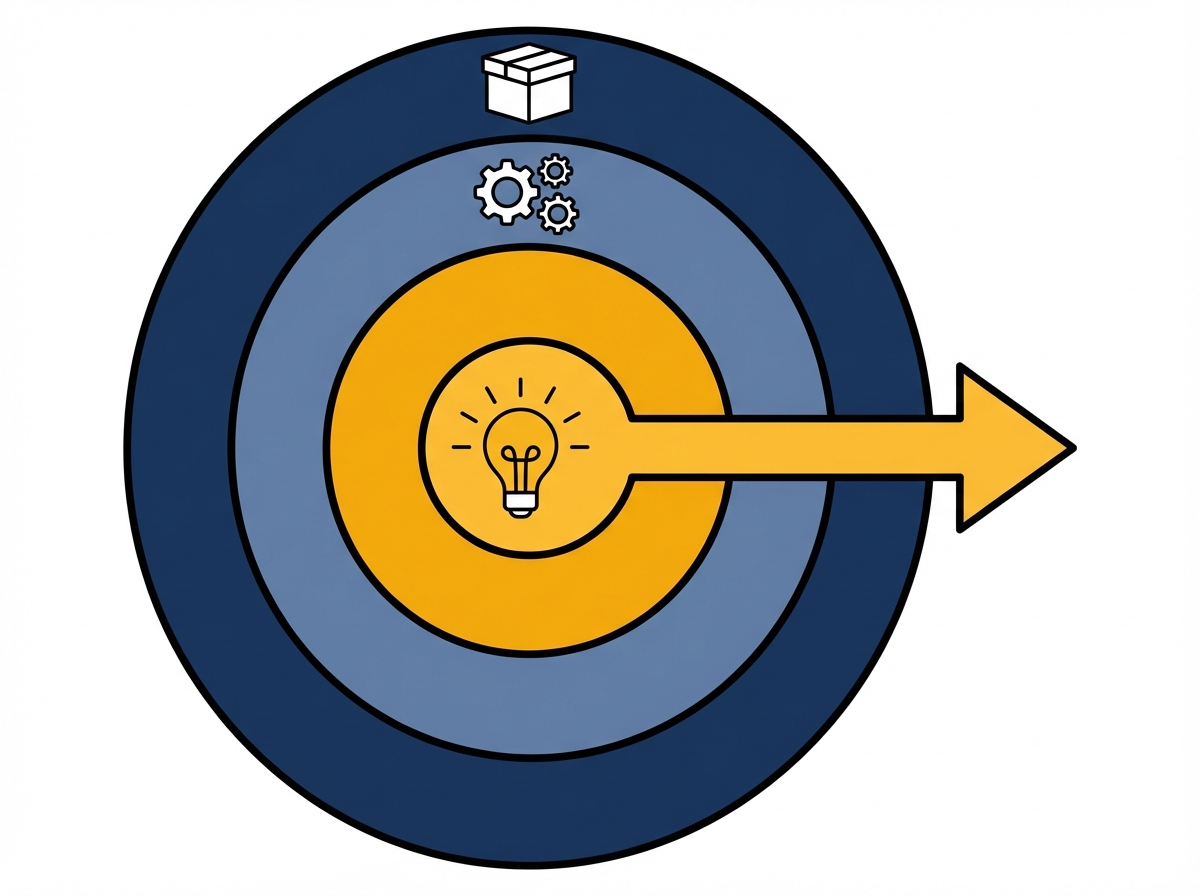
The Golden Circle is a framework for leadership and communication that mirrors the biological structure of the human brain. It consists of three concentric circles:
This is the center of the circle. Very few people or companies can clearly articulate their "Why." It is not about making money—that’s a result. Your Why is your purpose, cause, or belief. It is the very reason your organization exists.
Some organizations know their "How." These are often called unique value propositions, proprietary processes, or differentiating value factors. The How explains how the Why is brought to life.
Every single organization on the planet knows their "What." These are the products you sell or the services you offer. It is the tangible result of your Why and How.
Sinek argues that this framework maps perfectly to the human brain. The "What" corresponds to the Neocortex, the part of the brain responsible for rational, analytical thought and language. The "How" and "Why" correspond to the Limbic Brain, which is responsible for all of our feelings, such as trust and loyalty. It is also responsible for all human behavior and decision-making, yet it has no capacity for language.
When we communicate from the outside in (What $\rightarrow$ Why), people can understand complex information like features and benefits, but it doesn't drive behavior. When we communicate from the inside out (Why $\rightarrow$ What), we speak directly to the part of the brain that controls behavior, and then we allow people to rationalize it with the tangible things we say and do.
> 💡 Struggling to articulate your core purpose? > > It can be difficult to dig through the layers of daily operations to find your true "Why." Our AI Mentors, trained on proprietary research analyzing frameworks like the Golden Circle, can guide you through a reflective discovery process. > > Meet the AI mentors built from this research →
The most famous Golden Circle example is Apple. If Apple were like everyone else, their marketing message might sound like this (Outside-In):
It’s uninspiring. It’s factual, but it doesn't create loyalty. Here is how Apple actually communicates (Inside-Out):
The difference is palpable. Because they started with Why, the purchase of the computer serves as proof of your shared belief system. This is why people are comfortable buying not just computers from Apple, but also watches, phones, and tablets. They aren't buying the tech specs; they are buying the philosophy.
Finding your Why is not a creative process; it is a discovery process. You don't "invent" a Why; you dig for it. It comes from your past—your origin story.
To find your personal Why, look for patterns in your life.
For a company, the Why usually comes from the founder. If the founder is no longer there, you must look to the founding story.
Golden Circle marketing is about reversing the standard sales pitch. Instead of leading with features, lead with beliefs.
Sinek connects the Golden Circle to the Law of Diffusion of Innovation. This bell curve divides the market into:
Mass market success requires penetrating the Early Majority. However, the Early Majority won't try something new until someone else has tried it first. You need the Early Adopters.
Early Adopters don't buy based on price or features; they buy based on gut feeling and alignment with their values. To attract Early Adopters, you must communicate your Why. They are the ones who will stand in line for six hours to buy an iPhone, not because it's just a phone, but because being first aligns with their view of themselves.
Ready to put this into practice? A clear "Why Statement" should be simple, clear, and actionable. It generally follows this format:
To [CONTRIBUTION], so that [IMPACT].
Understanding the theory of the Golden Circle is one thing; applying it to your specific business strategy or leadership style is another. This is where GPTnius bridges the gap.
GPTnius offers AI Mentors that have been trained on proprietary research analyzing the published works, philosophies, and proven methodologies of thought leaders. For example, our "Architect" mentor draws from research on frameworks similar to Sinek's Golden Circle, combined with proven coaching models.
Here is how an AI Mentor can help you apply the Golden Circle:
By using these specialized AI Mentors, you aren't just reading about leadership concepts; you are actively workshopping them with a guide trained on the very best research available.
> 💡 Ready to find your Why? > > Don't let your purpose remain a mystery. Use GPTnius to synthesize your values into a clear, actionable Golden Circle framework that inspires your team and customers. > > Meet the AI mentors built from this research →
The Golden Circle is not just a marketing tactic; it is a philosophy of leadership. When you start with Why, you attract people who believe what you believe. This creates trust, and trust is the foundation of innovation and loyalty. Whether you are leading a Fortune 500 company or a small team, the path to inspiration remains the same: clarify your Why, discipline your How, and ensure your What serves as proof of your purpose.
The three parts are: 1) Why (The Purpose/Belief), 2) How (The Process/Unique Value), and 3) What (The Product/Result). Sinek argues effective leaders start with the Why.
Generally, a company's 'Why' is its founding purpose and shouldn't change often. However, the 'How' and 'What' can and should evolve as the market changes. If a 'Why' must change, it usually signifies a complete refounding of the organization.
The 'What' level corresponds to the Neocortex (rational thought and language), while the 'How' and 'Why' correspond to the Limbic brain (feelings, trust, loyalty, and decision-making, but no language).