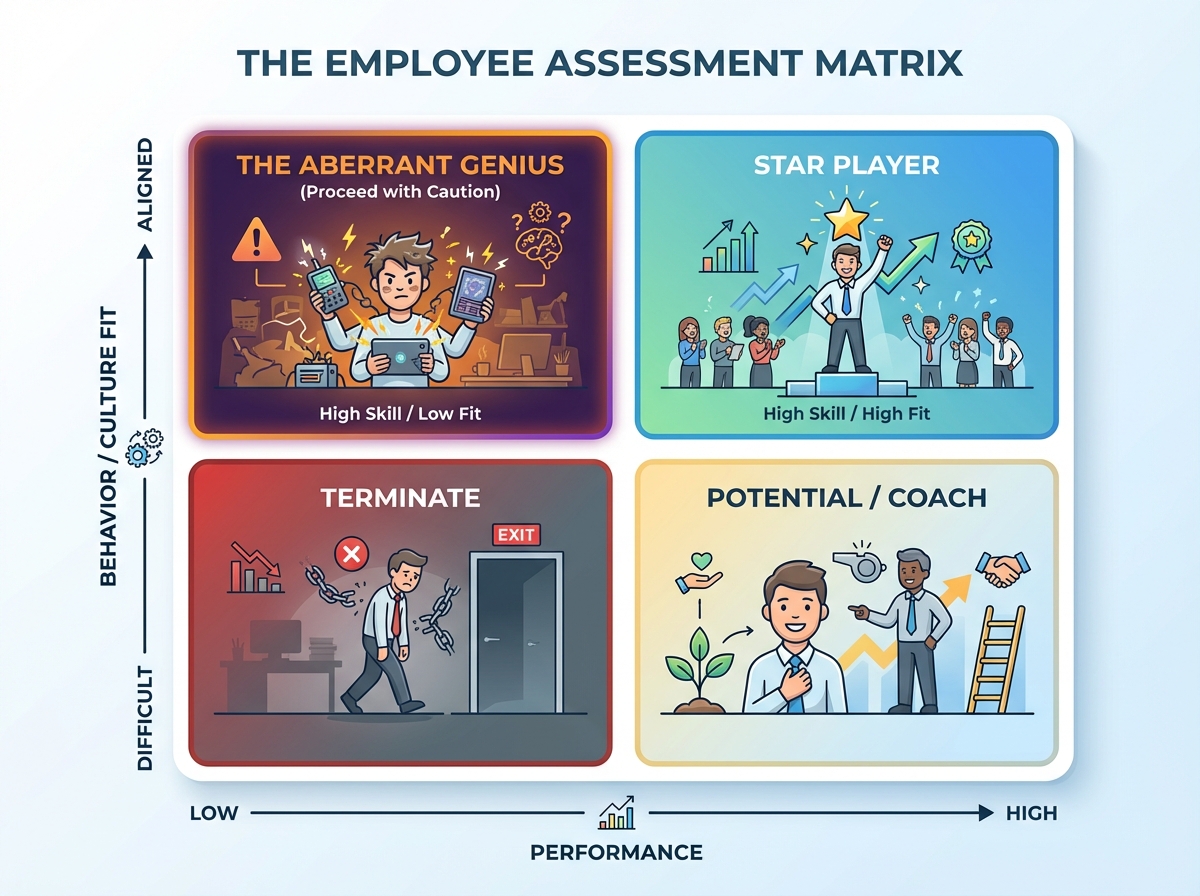
Learn the 'Aberrant Genius' framework for managing difficult employees effectively. Discover when to keep high performers and when their behavior becomes too toxic.
Every experienced manager eventually encounters the same nightmare scenario: You have an employee who delivers incredible results. They crush their quotas, write brilliant code, or solve complex engineering problems faster than anyone else. By the metrics, they are your best asset.
But there is a catch. They are arrogant, dismissive of colleagues, resistant to feedback, or prone to outbursts. They are, in short, impossible to work with.
This is the paradox of managing difficult employees who are also high performers. If you fire them, the company takes an immediate hit on productivity or revenue. If you keep them, you risk destroying the morale of the rest of the team, leading to burnout and turnover among your other staff.
Silicon Valley’s legendary coach, Bill Campbell (often called the "Trillion Dollar Coach" for his mentorship of leaders at Google, Apple, and Intuit), had a specific name for this archetype: the Aberrant Genius.
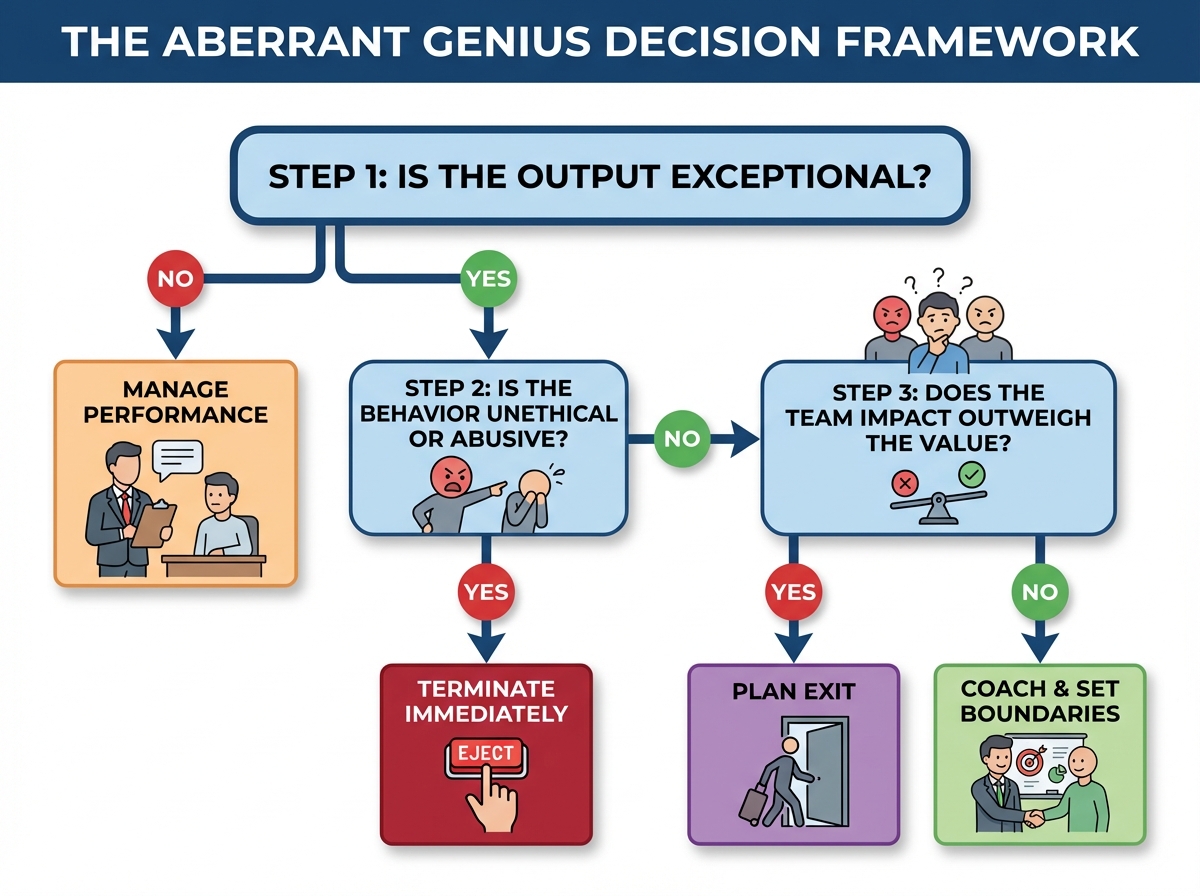
Campbell’s philosophy offers a nuanced framework for managing difficult employees effectively. It isn't a simple binary choice of "keep" or "fire." Instead, it requires a rigorous assessment of whether the genius's output creates enough net value to justify the management overhead required to contain their behavior.
In this guide, we will dissect the Aberrant Genius rule, helping you identify when a difficult employee is worth saving and how to manage them without sacrificing your team’s psychological safety.
To understand how to manage difficult employees, we must first distinguish between an "Aberrant Genius" and a toxic employee. They are not the same thing, though the line is often thin.
An Aberrant Genius is defined by two simultaneous truths:
However—and this is the critical distinction—an Aberrant Genius is not unethical, abusive, or fundamentally opposed to the company's success.
According to research analyzing Campbell’s coaching methodologies, there are behaviors that disqualify someone from "Genius" status and land them squarely in the "Toxic" category. You cannot manage these behaviors; you must remove them. These include:
If the high performer crosses these lines, the "Aberrant Genius" rule does not apply. The cost of dealing with difficult employees who lack integrity is always higher than their output. But if they are simply arrogant, socially awkward, or overly critical while remaining honest and committed to the mission, they fall into the gray area where management is possible—if you have the stomach for it.
> 💡 Struggling to Assess Your Team's Dynamics? > > It can be hard to objectively evaluate whether an employee is a "Genius" worth saving or a toxic influence. GPTnius AI Mentors, trained on proprietary research into world-class management frameworks, can help you simulate difficult conversations and analyze your specific personnel challenges. > > Meet the AI mentors built from this research →
Before you decide to invest energy in managing high performers with behavioral issues, you must run a cost-benefit analysis. This isn't just about revenue; it is about "management debt."
Ask yourself: Does this person's output outweigh the collective drag they place on the rest of the team?
If your "genius" salesperson brings in $2 million a year, but their behavior causes three support staff members (who cost $100k to replace and train) to quit, the math might still look favorable on a spreadsheet. However, if their behavior causes the entire engineering team to slow down because they are afraid to interact with the salesperson, the net value is negative.
Is the employee aware of their behavior? When you provide feedback, do they reject it outright, or do they acknowledge it even if they struggle to change?
Managing toxic employees is often futile because they refuse to accept that they are the problem. An Aberrant Genius, conversely, often cares deeply about the work. If you can frame their behavioral changes as necessary for the work's success, they may be open to coaching.
How hard is this person to replace? If they are a generic high performer—someone who is in the top 10% but not the top 0.1%—the tolerance for bad behavior should be low. The "Aberrant Genius" pass is reserved for those whose skills are truly transformative for the organization. If you can replace them in three months, their difficult behavior is likely not worth the headache.
Once you have determined that the employee is worth keeping, you cannot simply let them run wild. "Letting them be them" is a failure of leadership. You must actively manage the situation to protect your culture. Here is how to execute this delicate balancing act.
Passive-aggressive hints do not work with Aberrant Geniuses. They often lack high emotional intelligence and will miss subtle social cues.
Research into high-performance coaching suggests that feedback for these individuals must be:
One common mistake in dealing with difficult employees is to isolate them completely. While this stops the bleeding temporarily, it creates a silo where the genius operates without context.
Instead, create a buffer. This might involve assigning a strong project manager to act as an interface between the genius and the rest of the team. This "handler" needs to have thick skin and the respect of the genius. Their job is to translate the genius's blunt demands into actionable, polite requests for the wider team, and vice versa.
You can tolerate eccentricity, but you cannot tolerate disrespect. You must draw clear lines. For example:
Make it clear that their employment is contingent on staying within these boundaries. They need to know that their "genius" status buys them flexibility, not immunity.
This is controversial but effective. If the team sees you tolerating a difficult person, they may think you are weak or blind.
In appropriate settings, you may need to signal to your core team that you are aware of the situation. You don't badmouth the employee, but you can say, "I know X can be intense and difficult to communicate with. I value their technical contribution, but I am actively working with them on their communication. I appreciate your patience."
This validates the team's frustration and shows that you are managing the situation, not ignoring it.
Even with the best strategies for managing difficult employees effectively, there often comes a breaking point. The Aberrant Genius rule is not a lifetime appointment. It is a temporary status that persists only as long as the value outweighs the cost.
You must let the genius go when:
Firing a high performer sends a powerful message to the organization: Culture matters more than raw output. Paradoxically, many managers find that after firing an Aberrant Genius, the team's overall productivity increases because the friction and anxiety are removed.
Reading about the Aberrant Genius rule is one thing; applying it in the heat of a management crisis is another. This is where GPTnius can bridge the gap between theory and practice.
GPTnius offers AI Mentors trained on proprietary research analyzing the frameworks of thought leaders like Bill Campbell, Andy Grove, and other management pioneers. These AI Mentors allow you to:
Instead of guessing how to manage difficult employees, you can rely on a mentorship engine that synthesizes proven leadership methodologies to guide your decision-making.
> 💡 Master the Art of Leadership > > Don't let a difficult employee hold your team hostage. Use GPTnius to access AI Mentors trained on the world's best management research and turn your leadership challenges into growth opportunities. > > Meet the AI mentors built from this research →
Managing high performers who are difficult is the ultimate test of a leader's judgment. The Aberrant Genius rule provides a permission structure to tolerate some friction in the pursuit of greatness, but it also imposes a duty to protect the team.
Remember, the goal is not to change the genius's personality—that rarely happens. The goal is to modify their behavior just enough to extract their value without breaking the organization. It requires patience, thick skin, and the courage to act decisively when the equation no longer makes sense.
An Aberrant Genius is a term popularized by Bill Campbell to describe a high-performing employee whose work is exceptional but whose behavior is difficult or disruptive. They are worth keeping only if their net value to the company outweighs the friction they cause.
If a high performer is truly toxic (abusive, unethical, or dishonest), they cannot be managed using the Aberrant Genius rule—they must be fired. If they are simply difficult, you manage them by setting strict behavioral boundaries, providing direct data-driven feedback, and shielding the rest of the team from their worst impulses.
It depends on the severity. If their attitude destroys team psychological safety or violates company ethics, yes. If their attitude is simply annoying but their work is transformative, you should attempt to coach them and set boundaries before resorting to termination.