Unlock team innovation using Tina Fey's "Yes, And" leadership style. Learn practical improvisation leadership skills to improve communication and creativity.
Imagine a typical brainstorming session. A team member tentatively suggests a radical new process. Immediately, a manager responds, "That’s interesting, but we don't have the budget for it right now." The energy in the room evaporates. The idea is dead, and the employee is less likely to speak up next time.
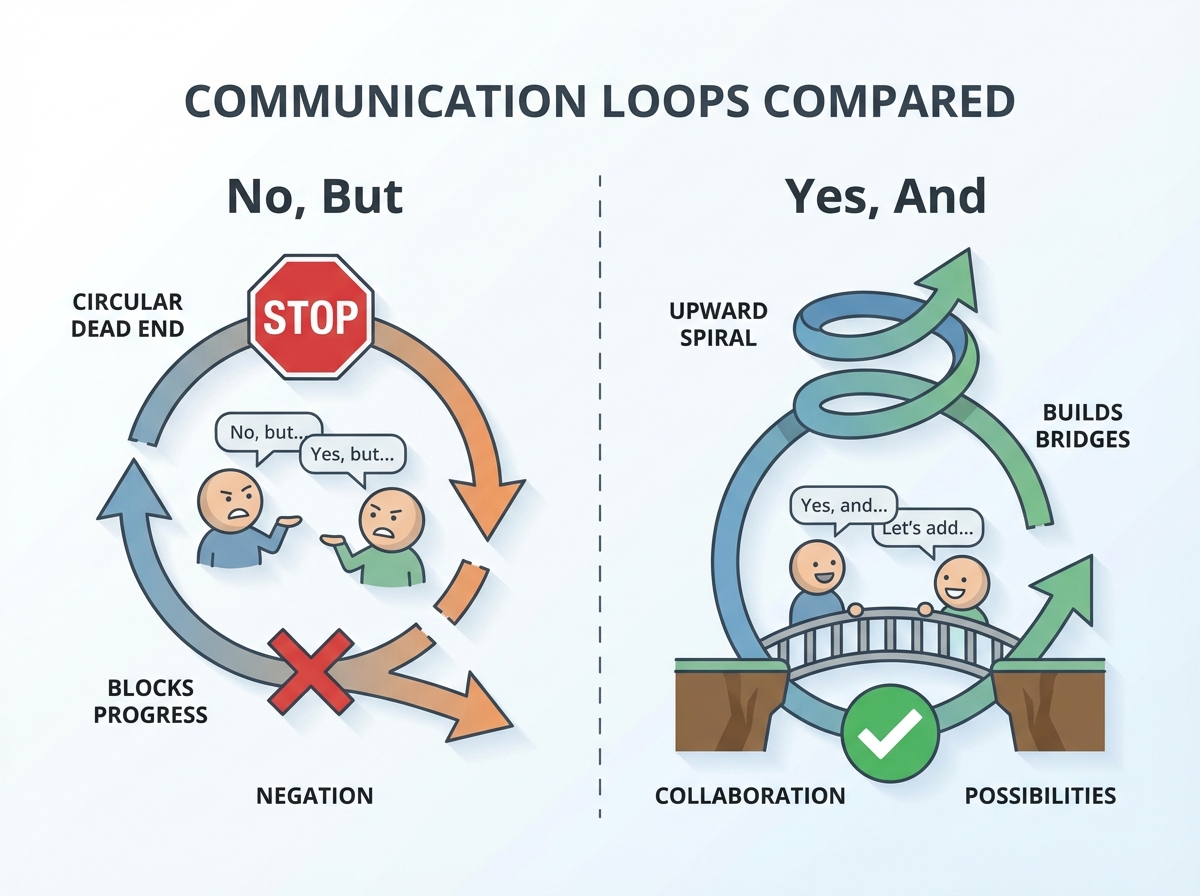
Now, imagine that same scenario through the lens of improvisation leadership skills. The manager responds, "Yes, that is a radical shift, and if we piloted it in just one department, we could test its viability without risking the full budget." Suddenly, the idea is alive. The team is engaged. Possibilities are expanding rather than contracting.
This is the power of the "Yes, And" philosophy, a core tenet of improvisational comedy popularized by icons like Tina Fey. While Fey is best known for her work on Saturday Night Live and 30 Rock, her rules for improvisation outlined in her memoir Bossypants serve as a masterclass in modern management.
In a volatile business landscape, rigid planning often fails. Tina Fey's leadership style—rooted in adaptability, active listening, and mutual support—offers a blueprint for how to improve team innovation. It turns leadership from a top-down directive into a collaborative performance where everyone helps write the script.
To understand Yes, And leadership, we must first look at its components. It is not about blindly agreeing to every bad idea or removing all constraints. It is a communication protocol designed to keep momentum moving forward.
In improv, saying "Yes" means accepting the reality presented to you. If your scene partner says, "Look at that giant purple elephant," and you say, "No, that’s a car," the scene breaks. You have denied their reality, and the collaboration halts.
In leadership communication skills, the "Yes" is about validation. It acknowledges the team member's contribution. It says, "I hear you, and I respect the platform you’ve built." It doesn't necessarily mean "I agree to fund this project immediately," but it does mean "I accept this idea as a valid starting point for discussion."
"Yes" alone is just surrender. "Yes, And" is contribution. It requires the leader to add value to the idea. It transforms a static statement into a dynamic conversation.
> 💡 Master the Art of Adaptive Leadership > > Struggling to shift from "No" to "Yes, And" in high-pressure meetings? Our AI Mentors, trained on research into improvisational leadership frameworks, can roleplay these scenarios with you to build your reflex for innovation. > > Meet the AI mentors built from this research →
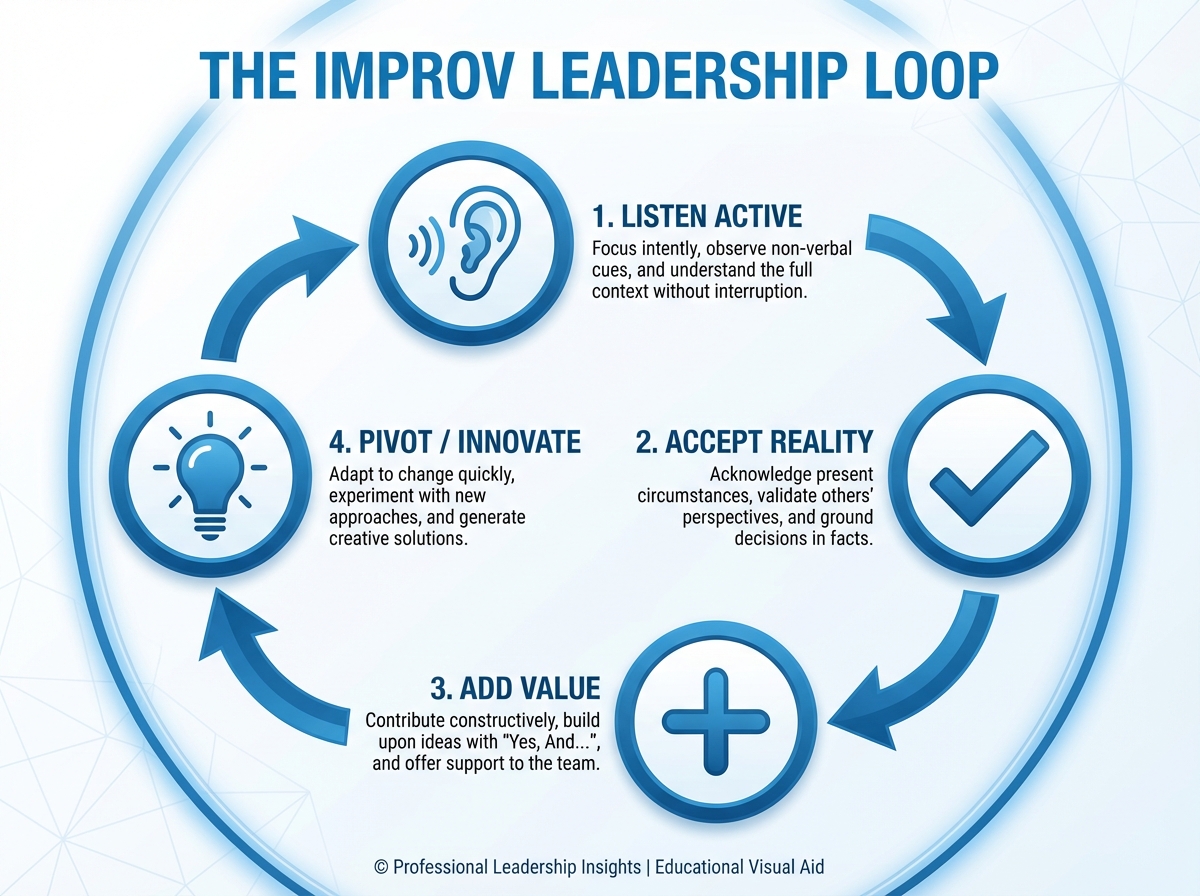
Based on the principles analyzed in Tina Fey’s writings and the wider world of improvisational theater, there are four distinct rules that leaders can apply to transform their team culture.
In business, "reality" is often a problem—a budget cut, a competitor's launch, or a supply chain failure. The "No" leader denies the severity or blames the team. The "Yes" leader accepts the constraints immediately.
Application: When a crisis hits, don't waste time wishing it hadn't happened. Say "Yes, the server is down, and this is our opportunity to test our manual backup protocols while we fix it."
Leadership is not a spectator sport. If you only say "Yes," you are a doormat. If you only say "No," you are a roadblock. To foster leadership skills that drive innovation, you must add to the narrative.
Application: During strategy meetings, implement a rule where every critique must be accompanied by a suggestion. You cannot tear down a wall without bringing a brick to build a new one.
In improv, asking questions puts the burden of invention on your partner. If you walk on stage and say, "What are we doing here?", your partner has to do all the work. Fey argues that leaders should make statements to provide direction and relieve pressure.
Application: Instead of asking a struggling employee, "What do you think you should do?", try making a statement that defines the sandbox: "This looks like a data integrity issue. I think we should start by auditing the last week's entries."
In improv, a "mistake" (like tripping on stage) is often justified by the scene partner to make it look intentional. This creates a culture of psychological safety.
Application: When a team member fails, the Yes, And leadership approach doesn't punish. It pivots. "That marketing campaign didn't generate leads, and it gave us incredible data on which demographics definitely don't want our product. Let's use that exclusion list to refine the next ad set."
Why does this specific set of leadership communication skills result in better products and services? The link between improv and innovation is rooted in psychological safety and cognitive flexibility.
The biggest enemy of innovation is the fear of sounding stupid. When a leader habitually uses "Yes, And," they lower the stakes of participation. Team members stop filtering their ideas through a fear-lens. This leads to a higher volume of ideas, and statistically, a higher volume leads to higher quality outliers.
"But" is a friction word. It acts as a speed bump in conversation. "And" is a lubricant. It accelerates the exchange of information. In fast-paced industries like tech or media, the speed of iteration is critical. Teams that "Yes, And" each other can iterate on a prototype five times in the time it takes a "No, But" team to agree on the first step.
Disagreement is inevitable. However, improvisation leadership skills teach leaders to view conflict as a narrative twist rather than a plot hole. Instead of arguing over who is right, the team collaborates on how to integrate conflicting truths.
You don't need to sign your executive board up for comedy classes to reap the benefits. Here are three actionable ways to introduce this dynamic:
Reading about Yes, And leadership is different from practicing it. The reflex to say "No, but..." is deeply ingrained in corporate culture because it feels safer and more analytical. Rewiring this habit requires consistent practice and feedback.
GPTnius offers AI Mentors that have been trained on proprietary research analyzing the published works, philosophies, and proven methodologies of thought leaders in improvisation and management.
For example, you can engage with "The Architect" mentor, which draws from research on mental models and communication frameworks. You can simulate a high-stakes team meeting where the AI presents you with "bad" ideas or crisis scenarios. The Mentor will then guide you through applying the "Yes, And" framework, offering real-time feedback on how to pivot the conversation constructively without losing authority.
These AI Mentors synthesize researched frameworks to provide personalized coaching conversations, helping you build the muscle memory required to lead with agility and empathy.
> 💡 Ready to Transform Your Leadership Style? > > Don't let rigid thinking stifle your team's potential. Use GPTnius to practice the "Yes, And" methodology with an AI Mentor trained on the world's best coaching models. > > Meet the AI mentors built from this research →
Adopting Tina Fey's leadership style isn't about being funny; it's about being effective. By leveraging improvisation leadership skills, you create a culture where the status quo is constantly challenged, and innovation is the natural byproduct of communication. The shift from "No, But" to "Yes, And" is small linguistically, but massive culturally. It turns a group of individuals protecting their own interests into an ensemble cast working toward a standing ovation.
'Yes, And' leadership is a management style derived from improvisational comedy. It involves accepting a team member's idea ('Yes') and immediately adding value or building upon it ('And'), rather than shutting it down with criticism.
Improv skills foster psychological safety, reduce the fear of failure, and encourage rapid iteration. This creates an environment where team members feel safe proposing unconventional ideas, leading to greater innovation.
No. It means validating the person and the premise of their idea, even if the specific execution isn't feasible. It shifts the conversation from rejection to collaborative problem-solving.