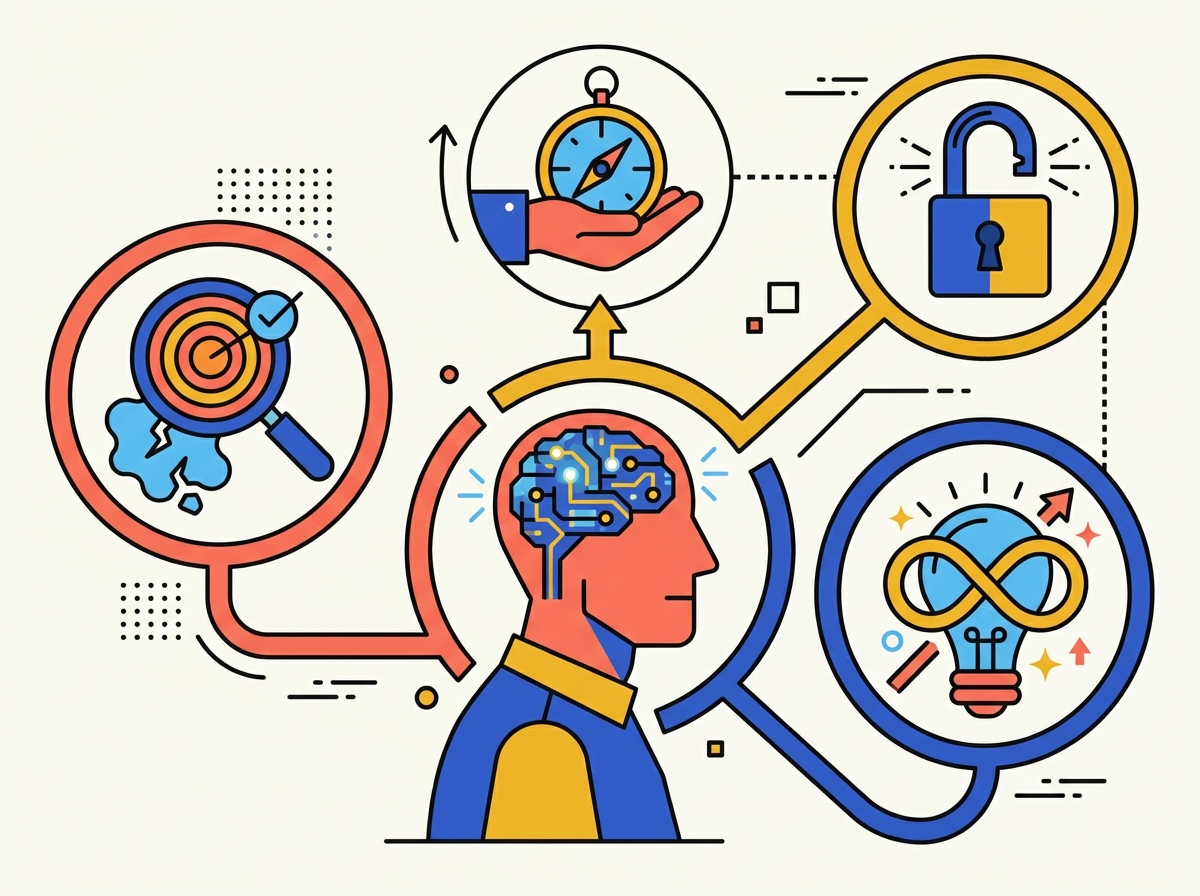
Master knowledge worker productivity with Peter Drucker's 6 principles. Learn strategies for managing knowledge workers, fostering autonomy, and boosting retention.
In the mid-20th century, a fundamental shift occurred in the global economy. We moved from an era defined by manual labor—where value was measured by the sweat on one's brow and the number of widgets produced per hour—to an era defined by the mind. Peter Drucker, often cited as the father of modern management, saw this wave coming before almost anyone else. He coined the term knowledge worker in 1959, predicting that the most valuable asset of a 21st-century institution would be its knowledge workers and their productivity.
Today, that prediction is our reality. From software engineers and content strategists to data scientists and HR directors, the modern workforce is built on the ability to acquire, synthesize, and apply information. However, knowledge worker productivity remains one of the most elusive metrics in business. Unlike manual work, you cannot simply use a stopwatch to measure the output of a strategic plan or a line of code.
As we navigate the complexities of the gig economy and remote work, Drucker’s insights are not just historical footnotes; they are the blueprint for success. This article analyzes Drucker’s timeless framework and provides actionable strategies for attracting, retaining, and managing knowledge workers in the modern age.
To improve productivity, we must first define the subject. A knowledge worker definition goes beyond someone who sits at a desk. Drucker defined knowledge workers as individuals who know more about their specific job than their boss does. They are capital assets, not just costs, because they carry their means of production—their knowledge—inside their heads.
While traditional examples include lawyers, doctors, and academics, the definition has expanded significantly in the digital age:
Even roles that were once considered manual are becoming knowledge-based. A mechanic diagnosing a Tesla using complex software is, in that moment, a knowledge worker.
In his seminal work, Management Challenges for the 21st Century, Drucker outlined six major factors that determine knowledge worker productivity. These principles are the bedrock upon which modern high-performance teams are built.
In manual work, the task is obvious (e.g., "assemble this part"). In knowledge work, the task is often ambiguous. A marketing manager might be told to "increase brand awareness," but what does that actually look like? Is it social media engagement? Press coverage? Community building?
Actionable Insight: Productivity suffers when workers drift. Managers and workers must collaborate to explicitly define what the task is and, more importantly, what it is not. Elimination of non-essential tasks is the fastest route to productivity.
This is perhaps the most critical factor. You cannot micromanage a knowledge worker effectively. Because they possess specialized knowledge, they are the best judges of how to execute their work.
Actionable Insight: Shift from managing methods to managing outcomes. Provide the goal and the resources, then step back. Trust is the currency of knowledge work.
Innovation must be part of the work, the task, and the responsibility of knowledge workers. It is not something reserved for the R&D department. Every knowledge worker should be asking, "Is there a better way to do this?"
Knowledge becomes obsolete quickly. To maintain productivity, a worker must be constantly learning. Drucker also emphasized teaching as a method of learning; when you teach a concept to a colleague, you reinforce your own mastery.
Productivity in knowledge work is not a matter of quantity alone; quality is at least as important. A software developer who writes 500 lines of buggy code is less productive than one who writes 50 lines of perfect code. The "cost" of fixing the mistake later destroys productivity.
Knowledge workers must be treated as an asset rather than a cost. If a manual worker leaves, the machine stays. If a knowledge worker leaves, the machine (their brain/skills) leaves with them. Therefore, they must want to work for the organization.
> 💡 Master Self-Management and Autonomy > > Peter Drucker emphasized that knowledge workers must manage themselves to be effective. GPTnius AI Mentors, trained on proprietary research into proven productivity frameworks, can guide you in establishing the habits and systems necessary for true autonomy. > > Meet the AI mentors built from this research →
The rise of remote work and the gig economy has pressure-tested Drucker’s theories. When you cannot see your employees, how do you know they are working? The answer lies in abandoning the industrial model of supervision.
In an office, presence often masqueraded as productivity. In a remote setting, managing knowledge workers requires a shift to Results-Only Work Environments (ROWE). If a knowledge worker can complete a high-value project in four hours, they should not be penalized for not sitting at their computer for the other four.
Knowledge work requires deep focus (often called "Deep Work" by modern authors like Cal Newport). Constant interruptions via Slack or Zoom destroy this focus. Implementing asynchronous communication protocols allows workers to process information on their own time, preserving their cognitive energy for the task at hand.
As AI and automation handle routine cognitive tasks, the knowledge worker skills required for success are evolving. To remain productive and employable, workers must cultivate skills that machines cannot easily replicate.
Information is abundant; wisdom is scarce. The ability to connect dots between disparate fields (e.g., psychology and economics) is a high-value skill.
Knowledge work is rarely solitary. It involves influencing others, negotiating, and collaborating. High EQ allows workers to navigate complex organizational structures and lead without formal authority.
This goes beyond knowing how to use Excel. It involves understanding how to leverage tools—including AI—to augment one’s own capabilities. The productive knowledge worker uses technology as a lever to multiply their output.
The half-life of a learned skill is now estimated to be only five years. The ability to unlearn old methods and relearn new ones is the ultimate productivity hack.
Drucker famously noted that knowledge workers are volunteers. They can leave. In the gig economy, they often work for multiple organizations simultaneously. Retention is no longer about golden handcuffs; it's about engagement.
While fair compensation is a baseline requirement, it is rarely the primary motivator for high performance. Knowledge workers are motivated by the "why." They need to see how their specific contribution moves the needle for the organization or society.
Traditionally, the only way to advance was to become a manager. Many brilliant knowledge workers make terrible managers. Organizations must provide a "dual ladder" where individual contributors can advance in status and pay without being forced into management roles they do not want.
Since the worker owns the means of production (their knowledge), the organization must help them upgrade it. Offering learning stipends, time for research, and access to mentorship programs tells the worker: "We value your mind."
Applying Peter Drucker’s theories requires more than just reading; it requires a systematic approach to changing habits and workflows. This is where GPTnius bridges the gap between theory and practice.
GPTnius offers AI Mentors trained on proprietary research analyzing the published works, philosophies, and proven methodologies of thought leaders, including thinkers like Peter Drucker. Our mentors do not impersonate anyone. They synthesize researched frameworks, such as the six factors of knowledge worker productivity, into personalized coaching conversations built around your specific goals.
Here is how GPTnius helps you unlock knowledge worker productivity:
GPTnius does not impersonate these figures but utilizes research on their frameworks to help you apply their wisdom to your daily work.
> 💡 Turn Principles into Performance > > Don't just read about productivity—implement it. Engage with AI Mentors trained on research analyzing the methodologies of top thought leaders to build your personalized roadmap for success. > > Meet the AI mentors built from this research →
Peter Drucker’s insights into the knowledge economy are more relevant today than when he first wrote them. The shift from manual to knowledge work has fundamentally changed the social contract between employer and employee. Productivity is no longer about working harder; it is about working with clarity, autonomy, and purpose.
By defining tasks clearly, fostering a culture of continuous learning, and treating knowledge workers as the valuable assets they are, organizations can unlock a level of productivity that drives innovation and growth. Whether you are managing a team or managing yourself, these timeless principles are your guide to navigating the modern workforce.
Manual workers produce tangible goods, and their productivity is measured by quantity/output per hour. Knowledge workers produce ideas, strategies, and information, with productivity measured by quality, innovation, and results.
Unlike manual labor, you cannot measure it by hours or volume. It is best measured by defining clear outcomes (Results-Only) and assessing the quality, timeliness, and impact of those outcomes.
Knowledge workers often know more about their specific tasks than their managers. Autonomy allows them to determine the most effective workflow and fosters the intrinsic motivation necessary for high-level problem solving.