Discover which brain training apps 2025 actually drive neuroplasticity. We analyze the shift from simple memory games to AI-driven mentorship and deep learning.
The promise of "brain training" has captivated millions for over a decade. The premise is seductive: spend fifteen minutes a day playing colorful mini-games on your phone, and you will stave off cognitive decline, boost your IQ, and become a mental athlete. However, as we move into 2025, the landscape of brain training apps has shifted dramatically. The era of tapping moving circles to "improve memory" is fading, replaced by a more sophisticated understanding of neuroplasticity & brain health.
For years, the scientific community has debated the efficacy of gamified cognitive training. The consensus? While you might get very good at the specific game you are playing, that skill rarely translates to real-world benefits—a limitation known as the "transfer problem."
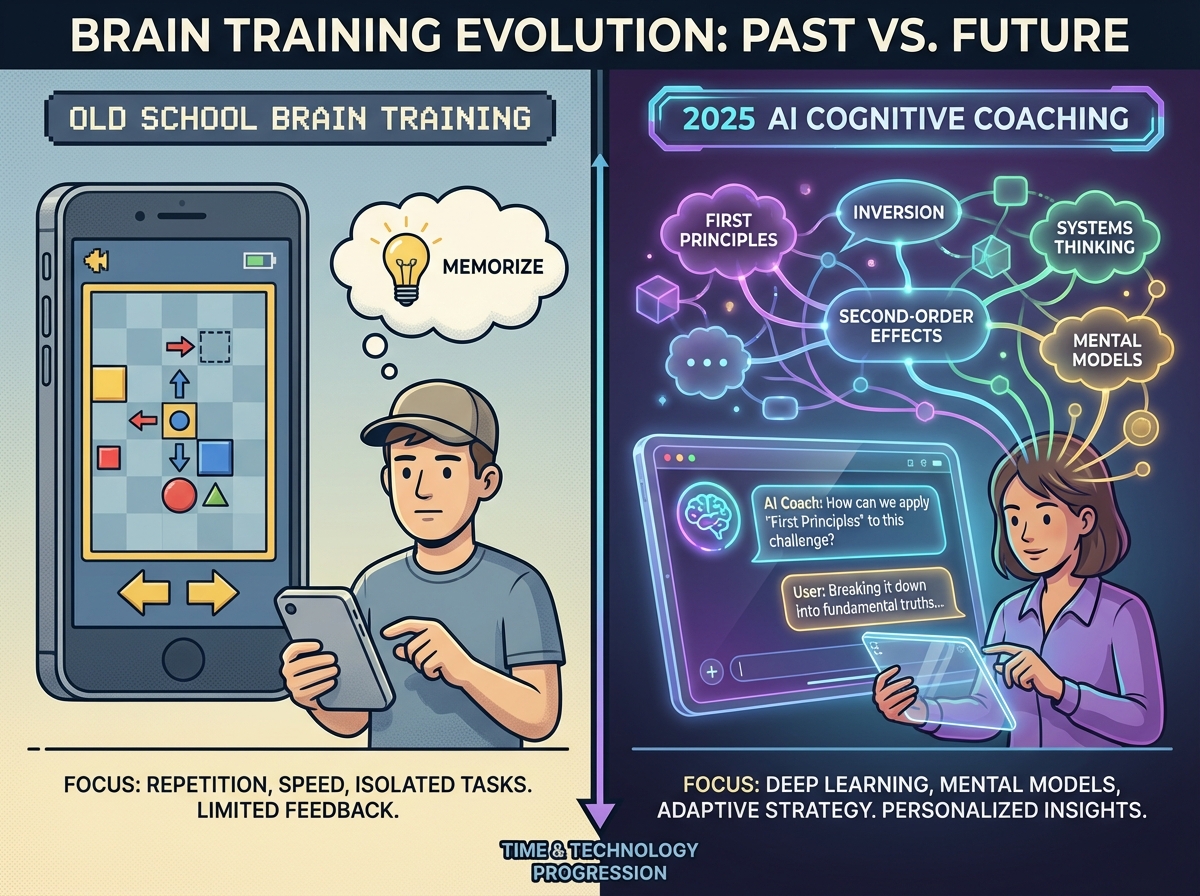
Today, the most effective tools for personal development and cognitive enhancement are no longer just games; they are sophisticated AI systems designed to challenge your reasoning, synthesize complex information, and force you to engage in AI learning that mimics real-world problem solving.
To understand which apps actually work, you must understand the mechanism of learning.
Near Transfer occurs when training on a specific task improves performance on very similar tasks. For example, if you practice a Sudoku puzzle every day, you will become excellent at Sudoku. This is what most legacy brain training apps achieve. They make you a master of their specific interface, but not necessarily a sharper thinker in a boardroom or a classroom.
Far Transfer is the holy grail of cognitive science. This occurs when training in one domain (e.g., learning a new language or mastering a mental model) improves cognitive abilities in unrelated domains (e.g., better emotional regulation or faster strategic decision-making).
In 2025, the apps that "actually work" are those that facilitate Far Transfer. These tools don't just ask you to memorize patterns; they ask you to apply frameworks, engage in Socratic questioning, and restructure how you process information.
> 💡 Stop Playing Games, Start Building Frameworks > > True cognitive growth comes from applying proven mental models to your unique life challenges, not just tapping screens. GPTnius AI Mentors help you bridge the gap between theory and real-world application. > > Meet the AI mentors built from this research →
As you navigate the app store, you will encounter three distinct categories of cognitive tools. Understanding the difference is crucial for your time investment.
These are the legacy players. They focus on speed, attention, and working memory through mini-games.
Apps that teach specific skills—like coding or languages—are excellent for brain health. Learning a new language is one of the few proven ways to delay cognitive decline and improve neuroplasticity.
This is the frontier of 2025. These platforms use AI to engage users in high-level dialogue, strategic planning, and emotional regulation. Instead of a game, the "training" is a conversation that forces the user to articulate thoughts, analyze biases, and apply logic.
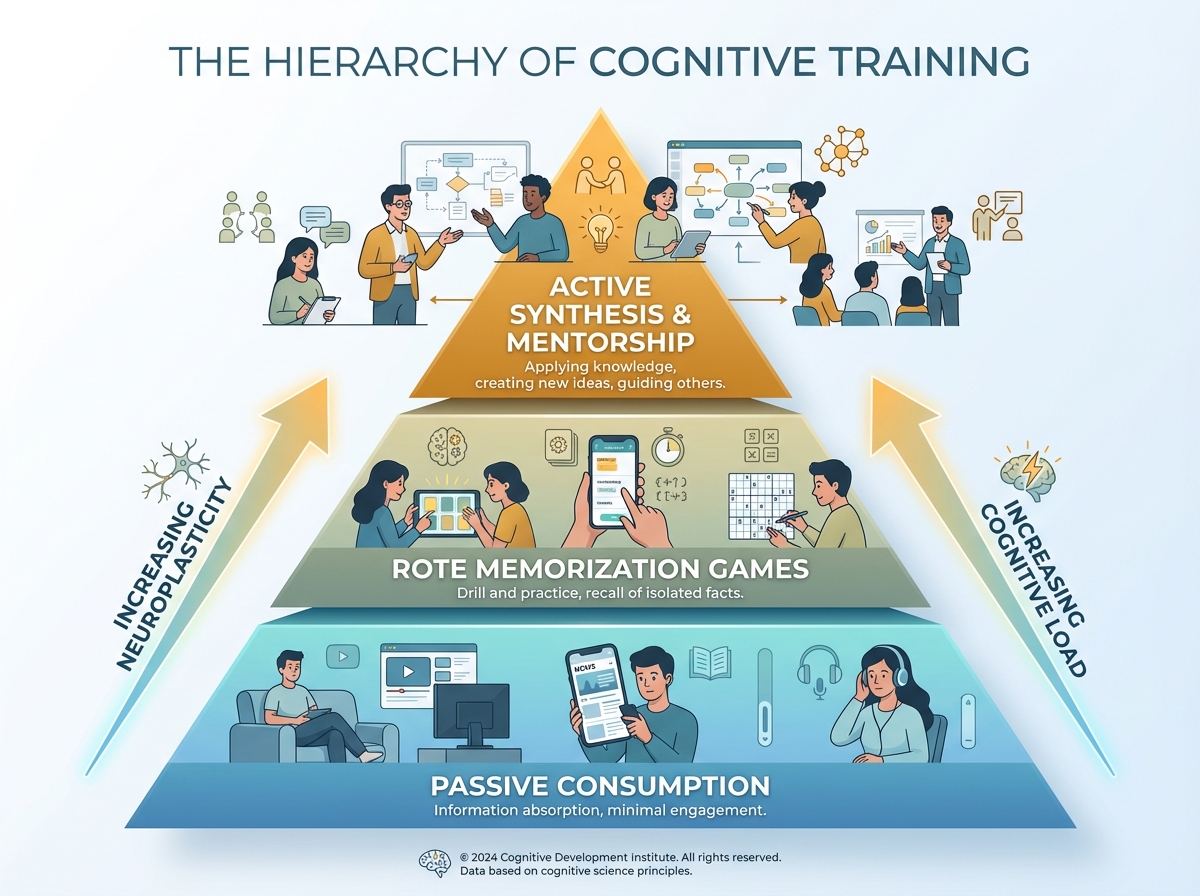
The reason AI-driven mentorship is overtaking traditional games lies in the psychology of learning. Passive consumption (reading) and rote repetition (games) are low on the hierarchy of learning.
Active Recall and Synthesis are at the top. When an AI mentor asks you, "How would you apply First Principles thinking to this problem?" your brain has to:
This neural pathway activation is significantly more intense and beneficial than matching colored shapes. It builds "cognitive reserve"—a buffer against aging and stress.
Brain training is often associated with IQ (logic, math, memory), but 2025 has seen a surge in EQ (Emotional Intelligence) training. Neuroplasticity isn't just about calculation speed; it's about rewiring how we react to stress.
Apps that combine cognitive behavioral techniques (CBT) with philosophical frameworks (like Stoicism) help users rewire their default mode network. By training your brain to pause, reflect, and reframe negative stimuli, you are physically altering your neural structure to be more resilient. This is "brain training" in its most practical form.
While many apps offer generic puzzles, GPTnius takes a different approach to cognitive development. GPTnius offers AI Mentors that have been trained on proprietary research analyzing the published works, philosophies, and proven methodologies of thought leaders, including thinkers like Charlie Munger, James Clear, and the Stoic philosophers.
Instead of abstract games, you engage in deep, coaching-style conversations that force your brain to synthesize and apply complex ideas.
Our mentors do not impersonate anyone. They synthesize researched frameworks, such as mental models, habit systems, and Stoic reframing practices, into personalized coaching conversations built around your specific goals. This gives you both a workout for your strategic thinking and a training ground for your emotional regulation.
By engaging with these AI Mentors, you aren't just memorizing facts; you are practicing the application of wisdom. This active usage of mental models fosters the "Far Transfer" necessary for genuine cognitive enhancement.
> 💡 Train Your Brain With World-Class Mental Models > > Don't just play games—transform how you think. Engage with AI Mentors trained on the research of history's greatest strategies to solve your actual problems. > > Meet the AI mentors built from this research →
In 2025, the question isn't "can an app train my brain?" but rather "how am I challenging my mind?" If you are looking for entertainment, gamified apps are sufficient. But if you are seeking genuine neuroplasticity & brain health, you need tools that demand active synthesis, critical thinking, and the application of complex frameworks. The future of brain training is not in tapping screens, but in elevating your internal dialogue through AI-assisted mentorship.
Most traditional brain training games improve performance on the specific tasks within the app (near transfer) but rarely increase general IQ. However, apps that focus on learning new skills (like languages) or complex reasoning (AI mentorship) can improve cognitive reserve and fluid intelligence over time.
Near transfer is when learning a skill helps you do similar things (e.g., learning to drive a Ford helps you drive a Toyota). Far transfer is when learning a skill improves unrelated capabilities (e.g., learning chess improving your math scores). Effective brain training aims for far transfer.
AI has shifted brain training from rote memorization games to interactive coaching. AI mentors can facilitate Socratic dialogue, forcing users to actively recall and synthesize information, which is more effective for neuroplasticity than passive gaming.