Unlock the power of sleep and memory consolidation. Discover how neuroplasticity works during rest and actionable strategies to optimize your learning potential.
In a culture that often glorifies "burning the midnight oil," sleep is frequently viewed as the adversary of productivity—a passive state where time is lost. However, for anyone dedicated to personal development, high-performance learning, or mastering complex skills, this perspective is not only wrong; it is detrimental.
Sleep is not merely a pause button; it is the "save" button. It is an active, metabolically intense state where the brain engages in one of its most critical functions: memory consolidation.
When you are awake, you are acquiring information. When you are asleep, you are processing, sorting, and cementing that information. Understanding the neurobiology of sleep allows us to transform rest from a biological necessity into a strategic tool for learning. By aligning your study habits with your brain’s nocturnal architecture, you can significantly enhance neuroplasticity, retention, and problem-solving capabilities.
To understand how to optimize rest, we must first understand the journey of a memory. The process of learning is generally divided into three phases:
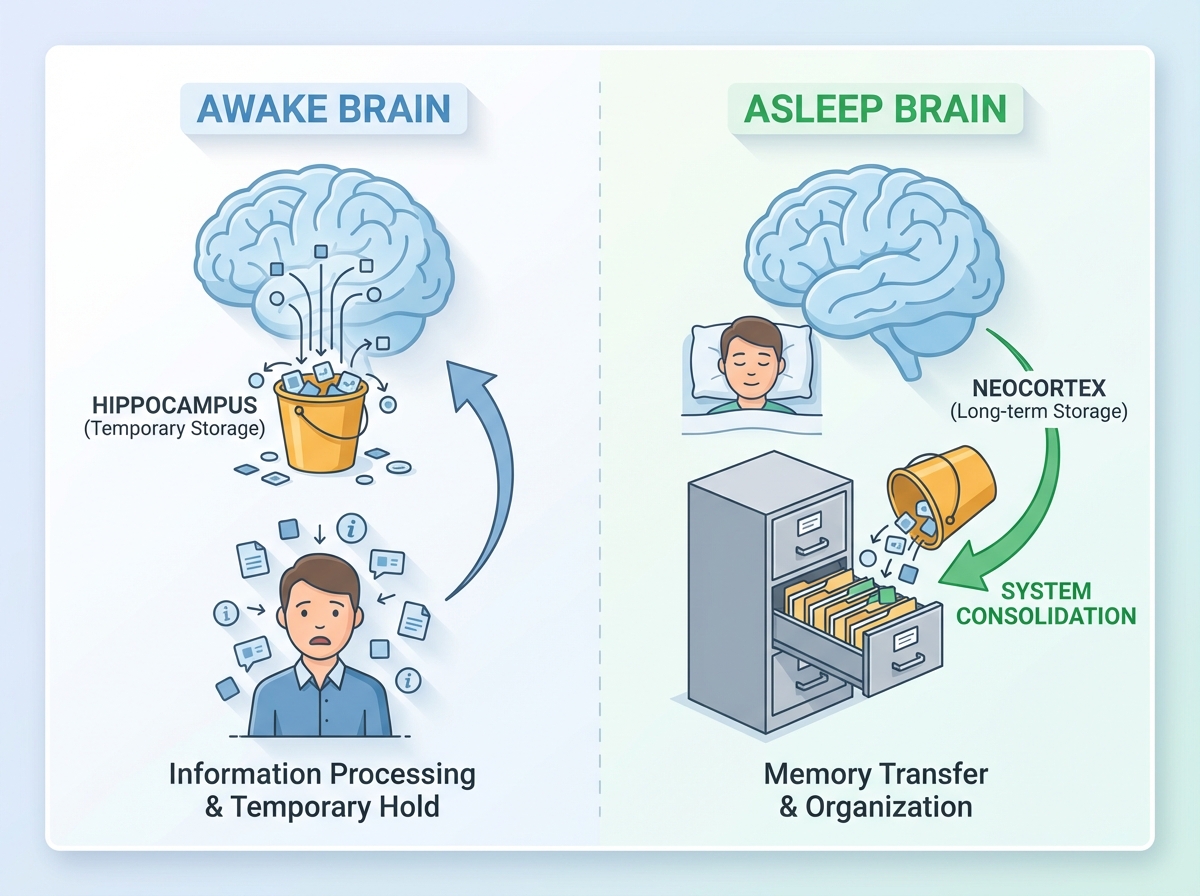
While encoding happens while you are awake, the heavy lifting of consolidation occurs predominantly during sleep. This process involves a dialogue between two key areas of the brain: the hippocampus and the neocortex.
Think of the hippocampus as your brain’s temporary loading dock or a USB flash drive. It is excellent at picking up new details quickly, but it has limited storage capacity and is volatile. New memories stored here are fragile and easily overwritten.
The neocortex, conversely, is the brain’s massive hard drive—the library of long-term storage where information is integrated with existing knowledge.
During sleep, a process known as "systems consolidation" occurs. The hippocampus replays the day's neural patterns to the neocortex. This replay strengthens the synaptic connections in the neocortex, gradually transferring the memory from temporary to permanent storage. Without adequate sleep, the hippocampus remains full, unable to accept new information, and the memories from the previous day fail to transfer, effectively evaporating.
Not all sleep is created equal. The brain cycles through different stages roughly every 90 minutes, and different types of learning are consolidated during different stages.
Occurring mostly in the first half of the night, Slow-Wave Sleep (deep sleep) is critical for declarative memory. This type of memory involves facts, figures, names, and dates—the "what" of learning. During SWS, the brain is remarkably quiet, allowing for the precise transfer of factual data from the hippocampus to the neocortex. If you are studying for a history exam or learning a new language vocabulary, deep sleep is non-negotiable.
REM sleep dominates the second half of the night. This stage is associated with procedural memory (the "how") and creative problem solving. If you are learning a musical instrument, a new sport, or trying to understand complex conceptual frameworks, REM sleep is where the brain integrates these skills. It detects patterns and makes abstract connections between seemingly unrelated pieces of information.
> 💡 Master Your Learning Rhythms > > Understanding the difference between Deep Sleep and REM is just the first step. To truly optimize your learning, you need a strategy that aligns your daily habits with your biological needs. > > GPTnius AI Mentors, trained on proprietary research analyzing the habits of high-performers, can help you build a personalized routine that balances intense focus with strategic recovery. > > Meet the AI mentors built from this research →
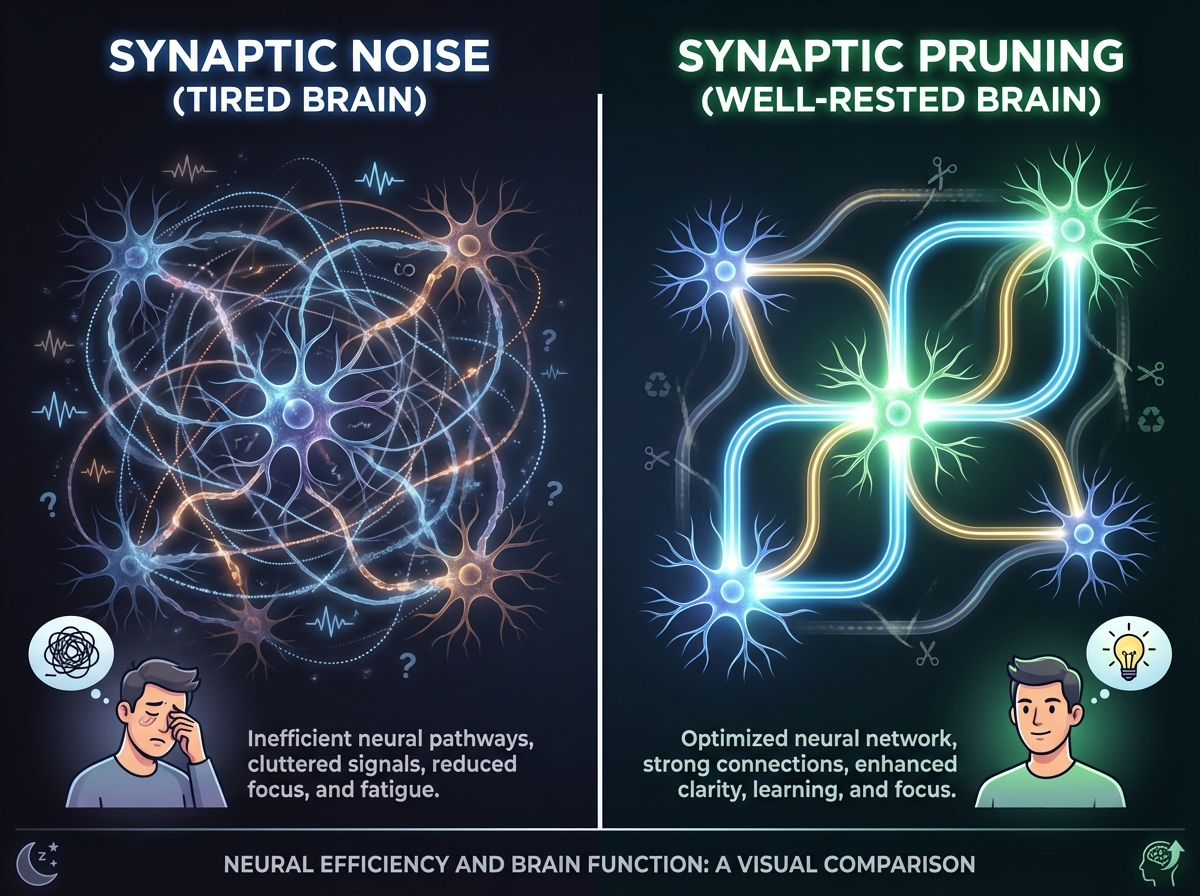
Learning is not just about building connections; it is also about destroying them. This concept is central to neuroplasticity—the brain's ability to reorganize itself.
Throughout the day, your brain builds thousands of synaptic connections, many of which are irrelevant noise (the color of a passing car, the hum of the fridge). If the brain kept all these connections, it would become saturated and inefficient.
During sleep, a process called synaptic pruning occurs. The brain evaluates which connections were used most intensely (signal) and which were not (noise). It strengthens the signal and prunes away the noise. This "cleaning house" ensures that when you wake up, your brain is energetically efficient and ready to acquire new data. Without this pruning, the "signal-to-noise" ratio in your brain drops, leading to brain fog and an inability to focus.
Knowing the science is useful, but applying it is transformative. Here are specific, research-backed strategies to leverage sleep for memory consolidation.
Instead of cramming all your studying into one massive block, sandwich your sleep between two lighter review sessions.
Just as we sleep in 90-minute cycles, our brains operate best in 90-minute activity cycles during the day (Ultradian rhythms). After about 90 minutes of intense focus, the brain’s ability to retain information drops.
Take a 20-minute break (or a nap) after these blocks. A short nap of 20 minutes can clear the hippocampus's temporary storage, making room for new information without entering deep sleep (which causes grogginess).
This is a cutting-edge technique involving sensory cues. While studying a specific subject, introduce a distinct, non-distracting scent (like rosemary or peppermint) or a specific type of background noise (like pink noise).
Expose yourself to that same scent or sound while you sleep. Research suggests that the olfactory or auditory cue can trigger the hippocampus to replay those specific memories more intensely during SWS, boosting retention rates.
Caffeine has a half-life of roughly 5 to 7 hours. If you drink a coffee at 4:00 PM, half of that caffeine is still blocking your adenosine receptors at 10:00 PM. While you might fall asleep, the caffeine reduces the quality of your Deep Sleep (SWS), impairing the consolidation of declarative memory. Set a strict caffeine cut-off at least 10 hours before your intended bedtime.
Even with the best study techniques, poor sleep hygiene can sabotage your efforts. Avoid these common pitfalls:
Optimizing sleep for learning requires more than just knowledge; it requires behavioral change and consistent application of proven frameworks. This is where GPTnius becomes an invaluable asset.
GPTnius offers AI Mentors that have been trained on proprietary research analyzing the published works, philosophies, and proven methodologies of thought leaders in performance psychology and neuroscience. These mentors do not just provide information; they help you implement it.
Here is how you can use GPTnius to master memory consolidation:
By combining the biological power of sleep with the strategic guidance of GPTnius, you transform your nights from passive downtime into active learning sessions.
> 💡 Build Your High-Performance Routine > > Don't let your hard work evaporate overnight. Use the proven frameworks synthesized by GPTnius AI Mentors to design a lifestyle that maximizes neuroplasticity and retention. > > Meet the AI mentors built from this research →
Generally, active learning does not happen during sleep. However, a technique called Targeted Memory Reactivation (TMR) suggests that playing sounds associated with what you learned while awake can help strengthen those specific memories during sleep.
Most adults require 7-9 hours. Cutting sleep short often disproportionately affects REM sleep, which occurs mostly in the final hours of the night, thereby impairing creative problem solving and procedural memory.
Not entirely. Sleep debt is difficult to repay fully. Consistency is key because memory consolidation is most effective when it occurs within 24 hours of learning the new information.