Master state management to instantly shift your mood and focus. Learn the psychology of peak state and how to control your energy for elite performance.
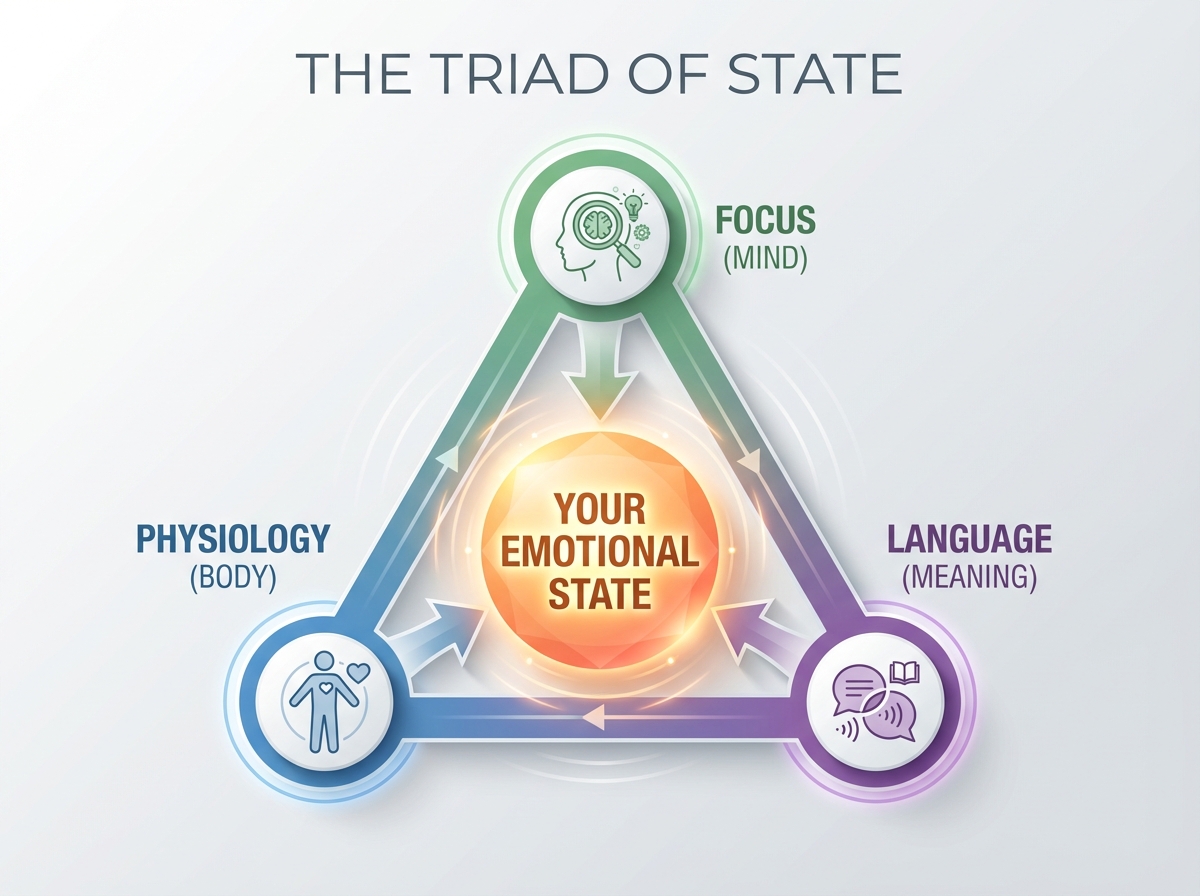
State management is the conscious practice of altering your physiology, focus, and language to shift your emotional state instantly. By mastering these three levers, you can transition from low-energy frustration to a peak state of flow and confidence on command, rather than being a passive victim of your emotions.
***
Have you ever watched a top-tier athlete make a critical mistake, look furious for exactly three seconds, and then suddenly snap back into a zone of absolute focus to score the winning point? That isn't luck. It isn't just talent. It is the result of a psychological mechanism known as State Management.
Most people live life in a reactive mode. Something bad happens, and they feel bad. They wake up tired, so they have a sluggish day. They encounter a stressful email, and they spiral into anxiety. In this default mode, your internal state is dictated by external circumstances.
However, the highest performers in business, athletics, and creative fields understand a fundamental truth: You are not your state; you are the generator of your state.
This article explores the mechanics of emotional control and energy management, breaking down the specific levers you can pull to shift from "stuck" to "unstoppable" in a matter of moments.
At its core, a "state" is the sum total of your millions of neurological processes happening at any given moment. It is the filter through which you experience reality. When you are in a state of anger, a neutral comment from a coworker feels like an insult. When you are in a state of gratitude, that same comment feels like constructive feedback.
State Management is the active process of consciously directing your neurophysiology to achieve a desired outcome. It is the difference between waiting to feel motivated and generating motivation.
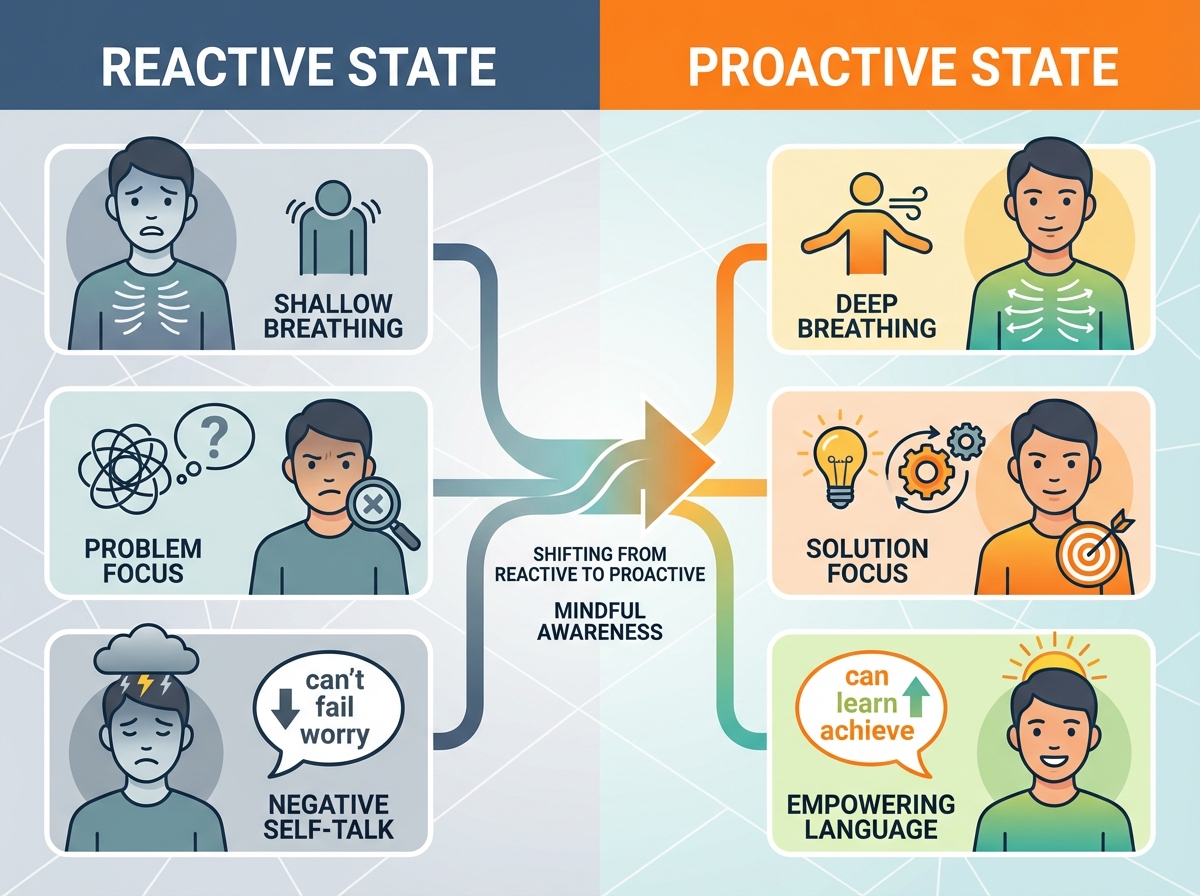
There are generally two categories of states:
The goal of state management isn't to suppress negative emotions, but to ensure you don't get stuck in them when you need to perform.
> 💡 Stop Being a Victim of Your Mood > > Struggling to break out of a reactive mindset? Our "The Architect" AI Mentor, trained on research into mental models and habit systems, can help you identify your triggers and build a personalized protocol for emotional control. > > Meet the AI mentors built from this research →
Research into peak performance psychology and Neuro-Linguistic Programming (NLP) suggests that your emotional state is not random. It is created by a specific recipe consisting of three ingredients. If you change any one of these ingredients, the state must change.
This is the fastest way to change your state. It is biologically impossible to remain depressed if you stand up straight, look up, pull your shoulders back, smile broadly, and take deep, rhythmic breaths. Depression requires a specific posture (slumped shoulders, shallow breathing, looking down).
Actionable Physiology Shifts:
Whatever you focus on, you feel. If you focus on what is missing, you feel lack. If you focus on what you have, you feel gratitude. If you focus on the problem, you feel pressure. If you focus on the solution, you feel empowered.
Consider a public speaker. If they focus on "What if I forget my lines?" (Internal/Negative), they enter a state of anxiety. If they focus on "I have valuable information to share with these people" (External/Positive), they enter a state of contribution.
How to Shift Focus:
Language describes reality, but it also shapes it. The words you use to describe your experience become your experience. This is known as Transformational Vocabulary.
If you say you are "furious," you will feel a high intensity of anger. If you describe the same situation by saying you are "a little peeved," the chemical reaction in your body changes.
Language Upgrades:
Understanding the theory is useful, but in the heat of the moment, you need tactics. Here are three proven methods to interrupt a negative pattern and install a peak state.
Human behavior runs on loops. When you get angry, you likely follow a script: you frown, you tense up, you raise your voice. To break the state, you must do something unexpected to "scratch the record."
Anchoring is a Pavlovian conditioning technique where you associate a specific physical touch or gesture with a peak emotional state.
Sometimes you simply don't feel confident. In these moments, use the "As If" frame. Ask yourself: "If I were confident right now, how would I be standing? How would I be breathing?"
By acting as if you are in the state, your brain eventually catches up to the body. This is the scientific basis of "fake it 'til you make it."
It is difficult to maintain a peak emotional state if your biological battery is empty. State management requires energy. If you are sleep-deprived, dehydrated, or fueled by sugar crashes, your emotional regulation centers (specifically the prefrontal cortex) go offline.
To maintain high states consistently, you must manage your energy inputs:
Reading about state management is different from applying it when you are stressed, tired, or overwhelmed. This is where having an objective, external guide becomes invaluable.
GPTnius offers AI Mentors that have been trained on proprietary research analyzing the published works, philosophies, and proven methodologies of thought leaders in psychology and performance coaching.
Here is how a GPTnius AI Mentor can assist you:
By combining these proven coaching models with 24/7 availability, GPTnius allows you to practice state management until it becomes a subconscious habit.
> 💡 Master Your Psychology with AI Guidance > > Don't let a bad moment turn into a bad day. Use GPTnius to access proven frameworks for emotional control and energy management exactly when you need them most. > > Meet the AI mentors built from this research →
State management is the ultimate master skill. It doesn't matter how intelligent or talented you are if you cannot access those resources when it counts. By taking control of your physiology, directing your focus, and curating your language, you gain the power to choose your experience of life.
Remember: You are not your feelings. You are the architect of them. The next time you feel your energy drop or your mood darken, don't accept it as reality. Check your posture, change your focus, and shift your state.
With techniques like radical physiology changes or pattern interrupts, you can shift your state in as little as 60 seconds. However, maintaining that state requires consistent focus and energy management.
No. State management is about choosing the appropriate emotional state for the situation. It allows you to feel negative emotions when necessary for processing, but prevents you from getting stuck in them when you need to perform.
Yes, but it must be paired with biological energy management. While you can temporarily 'state manage' your way through fatigue, long-term results require addressing sleep, nutrition, and recovery alongside psychological techniques.