Discover science-backed neuroplasticity exercises for adults. Learn how to rewire your brain, boost cognitive health, and leverage AI learning at any age.
For decades, the prevailing scientific dogma suggested that the human brain stopped developing in our mid-twenties. The assumption was that once you reached adulthood, your neural pathways were set in stone—a static hardware that would only degrade with time. This perspective gave birth to the limiting belief that "you can't teach an old dog new tricks."
Modern neuroscience has shattered this myth. We now know that the brain possesses a remarkable ability to reorganize itself by forming new neural connections throughout life. This phenomenon is known as neuroplasticity.
For adults over 40, understanding and leveraging neuroplasticity is not just about learning a new hobby; it is a critical component of long-term brain health, emotional resilience, and professional adaptability. Whether you are looking to pivot your career, sharpen your memory, or simply maintain cognitive vitality, the ability to rewire your brain is your most powerful asset.
In this comprehensive guide, we will explore the science behind adult neuroplasticity and provide specific, research-backed exercises—ranging from physical movement to advanced AI learning techniques—that can help you reshape your mind.
Neuroplasticity (or brain plasticity) refers to the brain's ability to change and adapt as a result of experience. It occurs on a spectrum from the microscopic (chemical changes at the synapse) to the macroscopic (cortical remapping).
While children's brains are in a state of hyper-plasticity—absorbing everything like a sponge—adult plasticity is different. It is less automatic and requires more focused attention and deliberate effort. The adult brain is efficient; it likes to conserve energy by relying on established habits and heuristics. To trigger plasticity as an adult, you must disrupt this efficiency.
> 💡 Master New Mental Models with AI > > Struggling to break old thinking patterns? GPTnius AI Mentors, trained on research regarding the mental models of world-class thinkers, can guide you through cognitive reframing exercises to spark new neural connections. > > Meet the AI mentors built from this research →
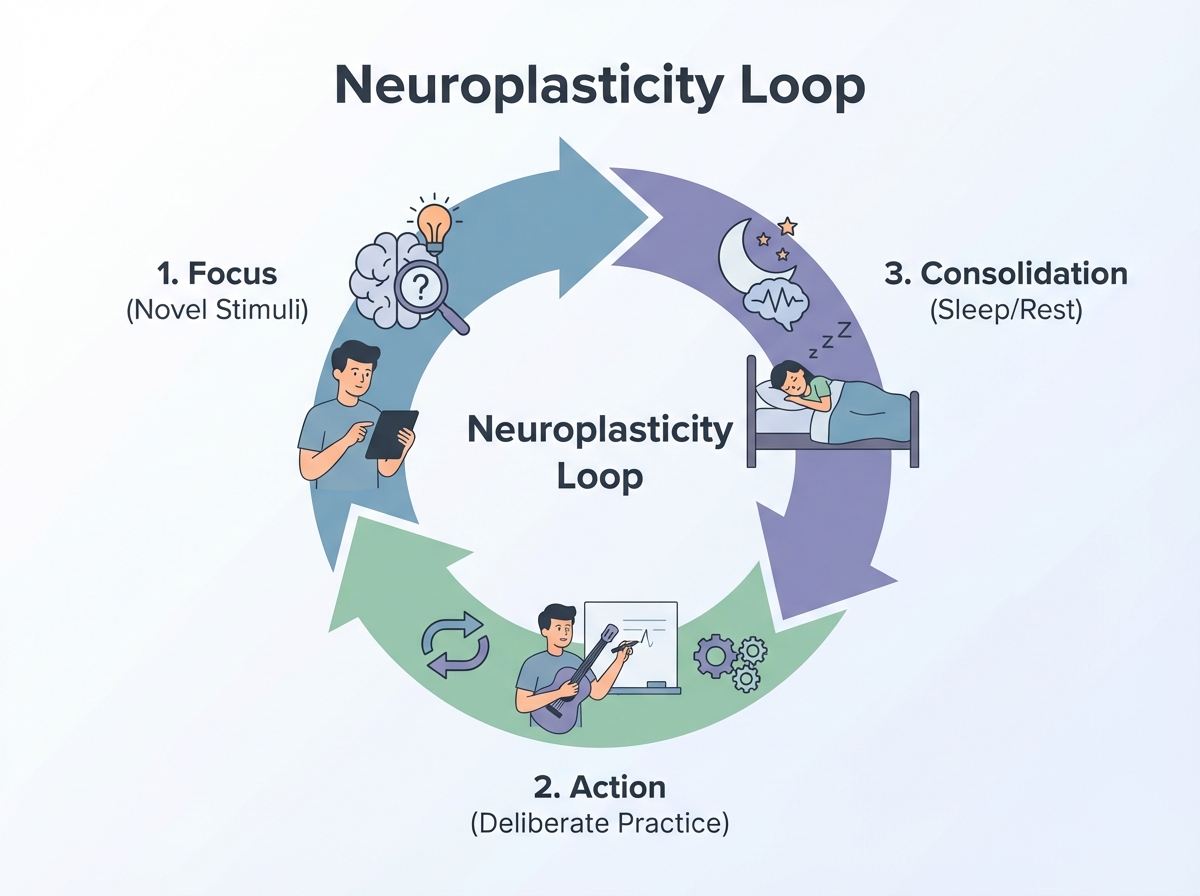
Before diving into specific exercises, it is essential to understand the prerequisites for plasticity. Merely doing a crossword puzzle is not enough. To physically alter your brain structure, your activities must adhere to three core principles:
Routine is the enemy of neuroplasticity. When you perform a familiar task, your brain goes on autopilot, using minimal energy. To stimulate growth, you must expose the brain to new stimuli. The experience must be unfamiliar enough to demand conscious processing.
The activity must be difficult. If it is too easy, the brain doesn't need to adapt. If it is too hard, you may give up. The sweet spot is a level of difficulty that feels slightly uncomfortable and requires intense focus. This strain triggers the release of acetylcholine, a neuromodulator that marks specific neurons for change.
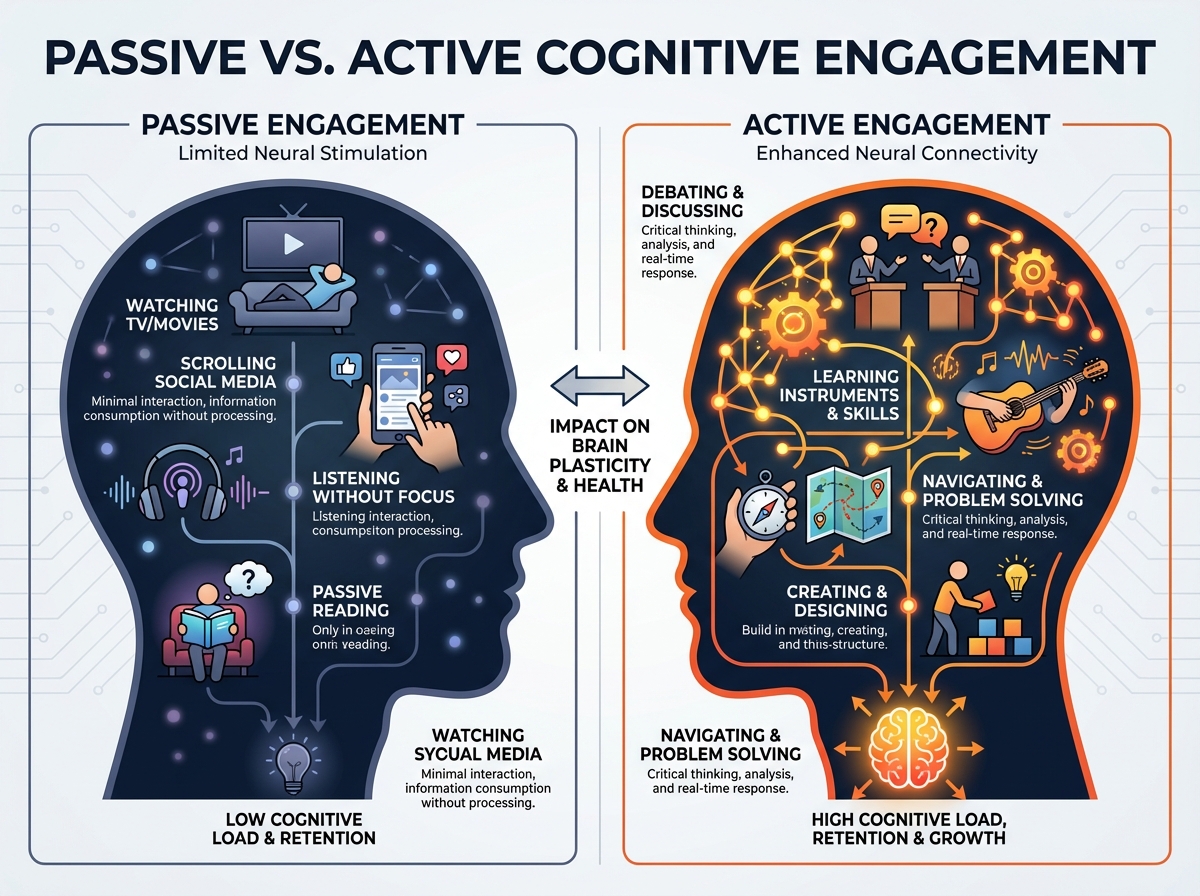
Passive consumption does not rewire the brain. You cannot learn a language by playing it in the background while you sleep. Plasticity requires alertness and active engagement. You must care about the outcome and pay close attention to the details.
Here are seven practical ways to apply these principles, moving from physical interventions to high-level cognitive training.
One of the simplest ways to introduce novelty is to use your non-dominant hand for routine tasks.
We have offloaded our spatial reasoning to satellites. Reclaiming this skill is a powerful workout for the hippocampus, the area of the brain responsible for memory and navigation.
Learning skill A and skill B simultaneously can cause interference, but managing that interference is a heavy lift for the brain.
By temporarily blocking one sense, you force other senses to work harder, activating different neural maps.
Physical exercise is arguably the most potent neuroplasticity primer.
Teaching a concept is a higher-order cognitive function than simply understanding it.
In the age of AI, we can use tools like GPTnius not just for answers, but as sparring partners for the brain.
It is critical to note that the actual "rewiring" does not happen while you are practicing. It happens while you sleep. During deep sleep (Slow Wave Sleep) and REM cycles, the brain replays the neural firing patterns from the day at high speeds.
If you perform these exercises but neglect sleep, you are doing the work but missing the consolidation. To maximize neuroplasticity, aim for 7-9 hours of quality sleep, specifically focusing on sleep hygiene that promotes uninterrupted rest.
The biggest barrier to neuroplasticity in adulthood is emotional, not biological. We dislike the feeling of being bad at something. As we age, we curate our lives to emphasize our strengths and hide our weaknesses.
To rewire your brain, you must embrace the "beginner's mind." You must be willing to feel clumsy, slow, and inefficient. That feeling of frustration is actually a chemical signal (norepinephrine) telling your brain that something is important and needs to be adapted to. When you feel frustration, do not quit—that is the precise moment when the gate to plasticity is opening.
Reading about neuroplasticity is passive; applying it requires a structured system. This is where GPTnius bridges the gap between theory and practice.
GPTnius offers AI Mentors that have been trained on proprietary research analyzing the published works, philosophies, and proven methodologies of thought leaders in psychology, productivity, and cognitive science. These mentors do not just chat; they provide a framework for your cognitive growth.
Here is how you can use GPTnius to facilitate brain rewiring:
By turning abstract principles into guided conversations, GPTnius helps you overcome the inertia of adulthood and actively reshape your neural pathways.
> 💡 Turn Cognitive Science into Daily Practice > > Don't let your brain stagnate in the comfort zone. Partner with an AI Mentor trained on proven methodologies to build a personalized roadmap for cognitive longevity. > > Meet the AI mentors built from this research →
Rewiring your brain at 40, 50, or beyond is not only possible; it is essential for a vibrant life. The brain is not a static vessel but a dynamic landscape that reflects how you use it. By embracing novelty, seeking out challenges, and prioritizing active engagement over passive consumption, you can maintain a sharp, adaptable mind.
Start small. Pick one exercise from this list. Brush your teeth with your left hand tonight. Take the scenic route home. Engage in a deep debate with an AI Mentor. Your brain is waiting for the signal to grow—you just have to give it.
Yes, the brain's natural plasticity decreases as we age compared to childhood. However, it does not disappear. Adults can still induce neuroplasticity through focused attention, novelty, and deliberate practice, though it requires more effort than it does for children.
There is no single timeline, as it depends on the complexity of the skill and the intensity of practice. Simple synaptic changes can happen quickly, while structural changes (like increasing grey matter density) typically require 6 to 8 weeks of consistent, daily practice.
Yes, when used actively. Passive use of AI (asking it to do work for you) may lead to cognitive atrophy, but using AI for 'Socratic questioning,' debating complex topics, or learning new mental models can provide the high-cognitive-load stimulation necessary for neuroplasticity.