Discover how to overcome confirmation bias by using AI as a Devil's Advocate. Learn actionable mental models and decision-making strategies to refine your thinking.
Confirmation bias is the brain's tendency to seek information that validates what we already believe, often leading to poor decision-making. By leveraging AI as a structured "Devil's Advocate," you can bypass these psychological blind spots. This article details specific strategies—like the Steel Man argument and Pre-Mortem analysis—to simulate critical opposition, ensuring your strategies are robust and reality-tested.
---
We all like to think of ourselves as rational, objective thinkers. When we make a decision—whether it’s an investment strategy, a career pivot, or a product launch—we believe we’ve weighed the evidence fairly. But neuroscience and psychology tell a different story.
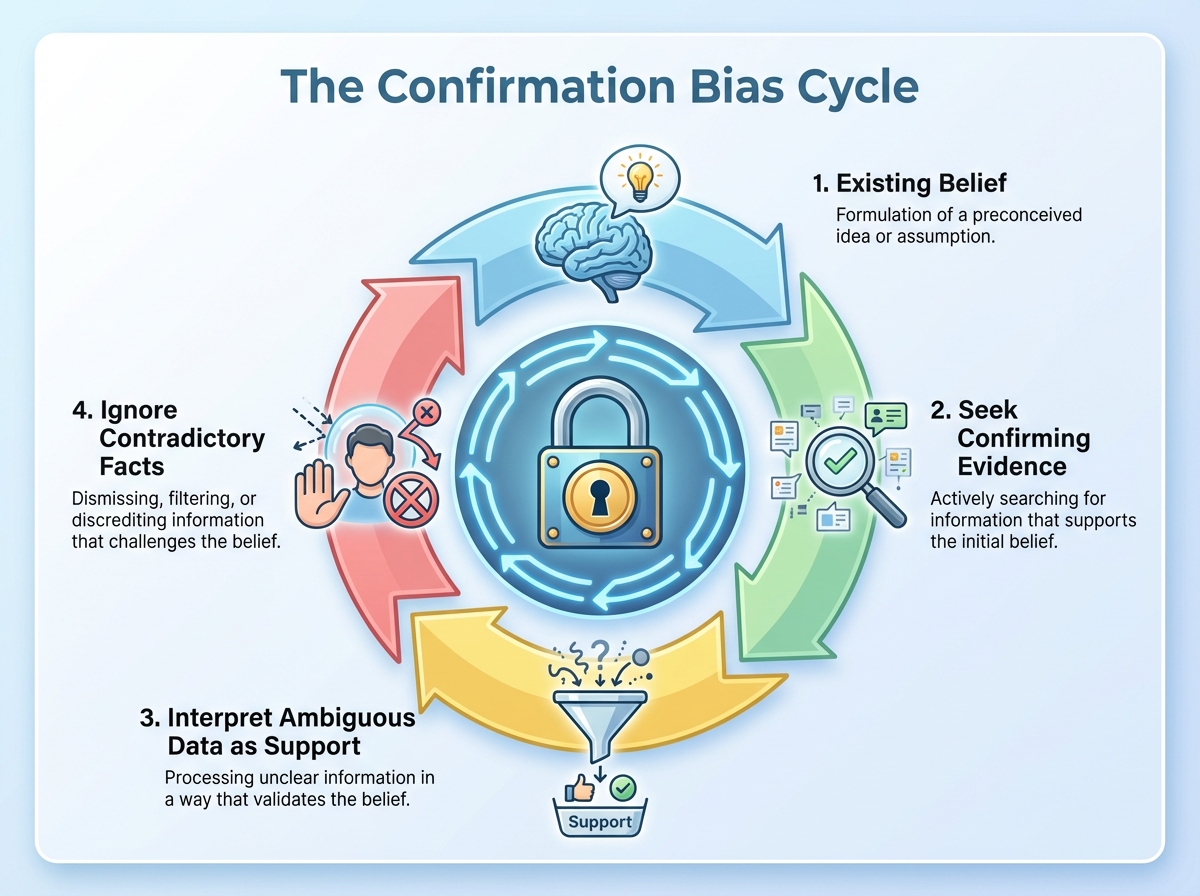
The reality is that the human brain is wired for efficiency, not necessarily truth. We suffer from confirmation bias: the tendency to search for, interpret, favor, and recall information in a way that confirms our pre-existing beliefs or hypotheses. It is the ultimate echo chamber, and it lives entirely inside your head.
In the past, overcoming this required a trusted mentor or a brave colleague willing to risk social friction to tell you that you were wrong. Today, we have a new tool for personal development: Artificial Intelligence. By using AI as a designated "Devil's Advocate," you can rigorously test your mental models and decision-making processes without the emotional baggage of human confrontation.
Confirmation bias isn't just a quirky personality trait; it is a cognitive shortcut. Processing new, contradictory information requires significant metabolic energy. It is physically easier for the brain to slot new data into existing frameworks than to dismantle the framework and rebuild it.
In the professional world, this manifests in dangerous ways:
To combat this, successful leaders often rely on "Mental Models"—frameworks for thinking that help simplify complexity. However, even the best models fail if the data feeding them is biased. This is where the concept of the Devil's Advocate becomes essential.
> 💡 Challenge Your Own Assumptions Today > > Your brain is wired to prove you right, even when you're wrong. Use GPTnius AI Mentors to objectively analyze your decisions using frameworks from the world's best thinkers. > > Meet the AI mentors built from this research →
Historically, the "Devil's Advocate" (Advocatus Diaboli) was an official position within the Catholic Church, tasked with arguing against the canonization of a candidate to uncover any character flaws. The role was institutionalized skepticism.
Asking a friend or employee to play this role is difficult. Subordinates may fear retribution; friends may fear hurting your feelings. AI, however, has no ego to bruise and no career to protect. It operates on logic and data processing, making it the ideal candidate for radical candor.
Here is how AI excels in this role:
To effectively use AI for personal development and decision hygiene, you cannot simply ask, "Is this a good idea?" (The AI, trained to be helpful, might just agree with you). You must structure your prompts to force dissent. Here are four research-backed strategies.
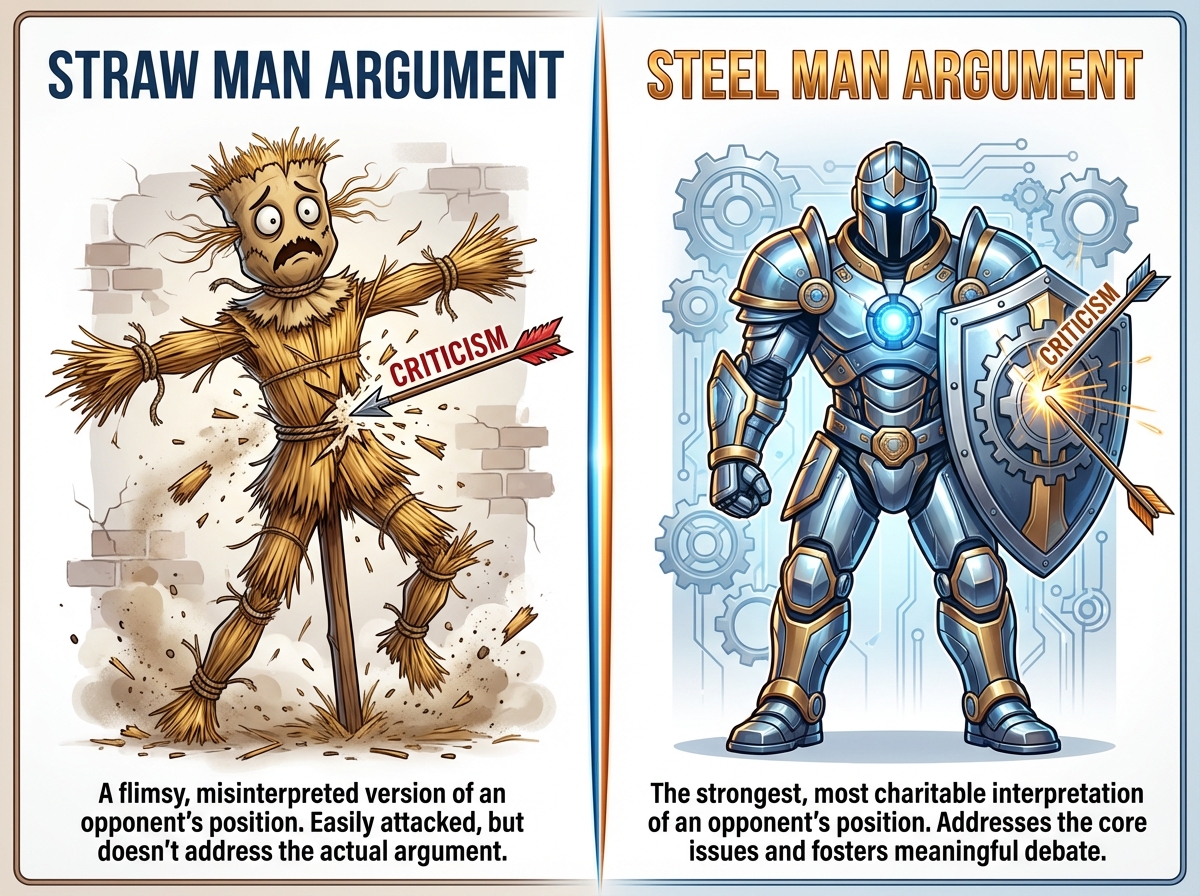
Most people argue against a "Straw Man"—a weak, distorted version of an opposing argument that is easy to defeat. To truly test your idea, you need a "Steel Man"—the strongest, most charitable version of the opposing view.
The Workflow: Present your thesis to the AI. Then, explicitly command it to construct the strongest possible argument against your thesis, using data, logic, and ethical considerations. If you cannot defeat the Steel Man argument the AI generates, your original idea needs work.
Developed by psychologist Gary Klein, the Pre-Mortem is a strategy where you assume a project has already failed in the future, and you work backward to determine why. This leverages "prospective hindsight."
How to use AI: Tell the AI: "Imagine it is one year from now. My plan [insert plan details] has failed spectacularly. Generate a detailed report on the three specific causes of this failure, focusing on overlooked risks and external market factors."
This forces the AI to hallucinate failure scenarios that your optimistic brain is actively filtering out.
Popularized by Charlie Munger, inversion is the practice of thinking forward and backward. Instead of asking how to help a project succeed, ask how you could guarantee its failure.
The Prompt: "I want to achieve [Goal X]. List 10 actionable steps I could take that would guarantee I never achieve this goal."
Seeing the list of "anti-goals" helps you identify bad habits you are currently indulging in but haven't recognized as threats.
Derived from Israeli intelligence doctrine, the 10th Man Rule suggests that if nine people agree on a course of action, the tenth person has a duty to disagree to prevent groupthink.
The Application: When you are deep in a planning session or a learning path, treat the AI as the 10th Man. Feed it the consensus view of your team or your own strong conviction. Ask it to identify the "Black Swan" events (rare, high-impact events) that could render that consensus obsolete.
Overcoming confirmation bias is not a one-time event; it is a habit. To make this part of your personal development journey, integrate these checks into your workflow:
By inviting skepticism into your process, you don't weaken your decisions—you inoculate them against reality. You move from fragile confidence (based on ignoring risks) to antifragile confidence (based on having survived rigorous stress-testing).
While general AI tools can simulate an argument, GPTnius offers a specialized advantage through its dedicated AI Mentors. These mentors have been trained on proprietary research analyzing the published works, philosophies, and proven methodologies of thought leaders, including thinkers like Charlie Munger and James Clear.
Our mentors do not impersonate anyone. They synthesize researched frameworks, such as mental models, inversion, and proven habit systems, into personalized coaching conversations built around your specific goals.
Instead of just receiving a generic counter-argument, a GPTnius mentor can:
GPTnius allows you to apply these proven principles directly to your own challenges through guided, intelligent discussions that mimic the experience of being coached by a master strategist.
> 💡 Ready to Bulletproof Your Decisions? > > Don't let hidden biases derail your success. Engage with GPTnius AI Mentors to rigorously test your ideas against the world's best mental models. > > Meet the AI mentors built from this research →
Confirmation bias is the silent killer of great ideas. It convinces us we are right just before we drive off a cliff. By treating AI not just as an assistant, but as a Devil's Advocate, you harness the power of objective dissent. Whether you use the Pre-Mortem, the Steel Man, or the Inversion principle, the goal remains the same: to see the world as it is, not as you wish it to be. With tools like GPTnius, you have a 24/7 partner ready to challenge your thinking and elevate your decision-making to an elite level.
Confirmation bias is the cognitive tendency to search for, interpret, favor, and recall information that confirms your pre-existing beliefs while ignoring contradictory evidence. In decision making, this leads to overconfidence and poor risk assessment.
AI can overcome confirmation bias by acting as an objective third party. It can be prompted to play 'Devil's Advocate,' generate counter-arguments (Steel Man technique), and perform Pre-Mortem analyses without the emotional attachment or social pressure that affects human judgment.
The Pre-Mortem technique is a strategic exercise where you imagine a future where your project has already failed, and then work backward to determine the specific causes. This helps identify risks that are usually overlooked during the planning phase due to optimism bias.