Master the Inversion Mental Model to avoid failure and make smarter decisions. Learn how to combine backward thinking with AI mentorship to solve complex problems.
"Invert, always invert."
This famous maxim, popularized by the mathematician Carl Gustav Jacobi and later championed by billionaire investor Charlie Munger, encapsulates one of the most powerful tools in the decision-making toolkit: the Inversion Mental Model. In a world obsessed with additive thinking—finding more things to do, more features to add, or more steps to take—inversion asks us to do the opposite. It asks us to start at the end and work backward.
Most people approach problems forward: "What must I do to succeed?" While logical, this approach often leads to a crowded mind and a cluttered strategy. Inversion flips the script: "What must I do to ensure failure?" by identifying the specific actions that guarantee disaster, you create a roadmap of exactly what not to do. It turns out that avoiding stupidity is often easier, and more effective, than seeking brilliance.
Today, we have an advantage that Jacobi and early stoics did not: Artificial Intelligence. By combining the ancient wisdom of inversion with the simulation capabilities of AI, we can stress-test our decisions with unprecedented clarity. This article will guide you through the mechanics of inversion and show you how to use AI as a strategic partner in thinking backward.
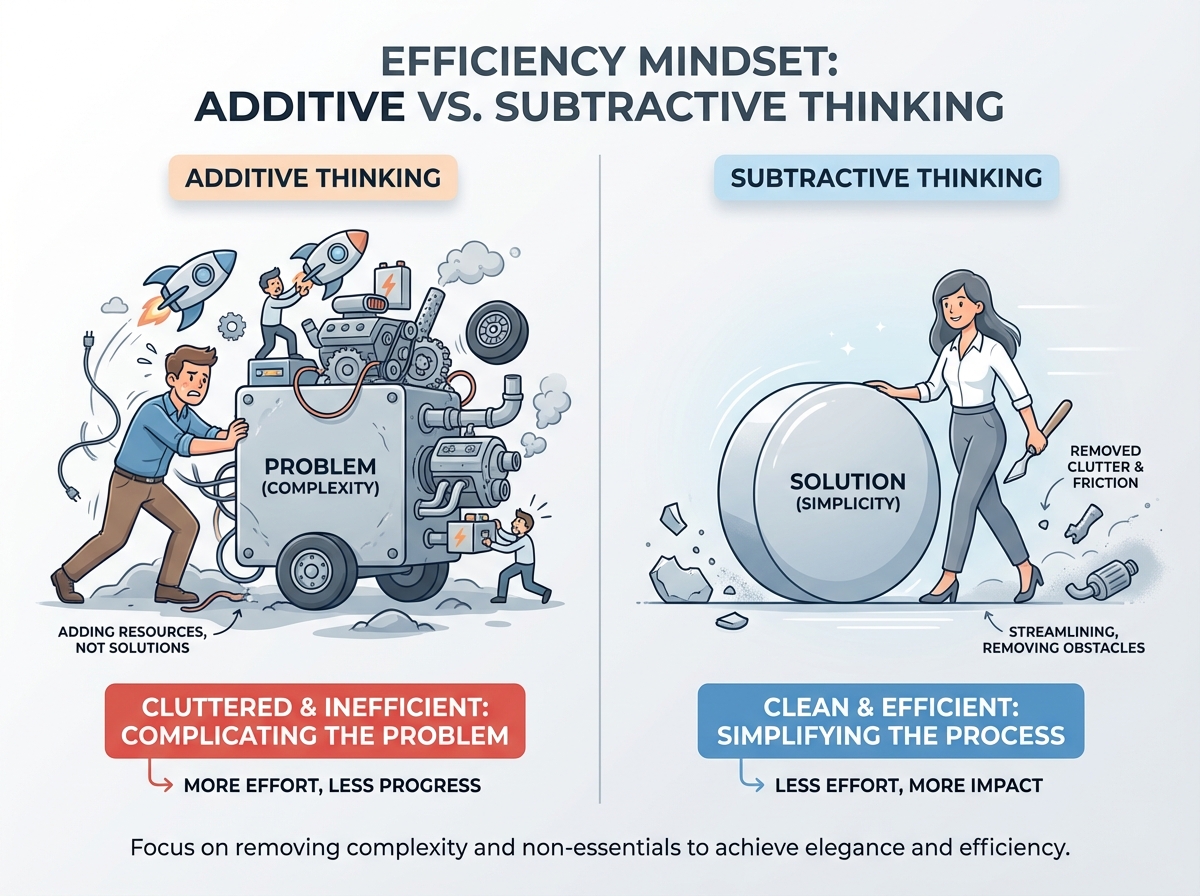
Human beings are biologically wired for additive solutions. When confronted with a problem—whether it's a stalling career, a declining business metric, or a strained relationship—our default mode is to ask, "What can I add to fix this?" We add meetings, we add software, we add complexity.
Inversion is a form of subtractive thinking. It recognizes that success is often the result of removing obstacles rather than adding force. Think of a boat trying to move faster. You can either buy a bigger engine (additive) or you can scrape the barnacles off the hull and reduce drag (subtractive/inversion). The latter is often cheaper, safer, and more reliable.
Long before modern mental models became buzzwords, the Stoics practiced Premeditatio Malorum—the premeditation of evils. They would visualize losing their wealth, their reputation, or their loved ones. This wasn't pessimism; it was a strategic exercise to reduce anxiety and prepare for resilience. In a modern context, visualizing the "death" of a project allows you to safeguard it against the specific causes of that death.
> 💡 Identify Your Blind Spots Instantly > > It is difficult to see your own logical fallacies. The GPTnius AI Mentors, trained on research into frameworks like Inversion and Stoic philosophy, can act as an objective third party to challenge your assumptions and highlight risks you might be ignoring. > > Meet the AI mentors built from this research →
Inversion generally manifests in two distinct thought processes. To master this model, you must become proficient in both.
Instead of defining your goal, define your "Anti-Goal." If your goal is to be financially independent, your anti-goal is to be destitute and drowning in debt.
The Process:
By rigorously avoiding the steps that lead to the anti-goal, you often inadvertently achieve the positive goal, but with much lower risk.
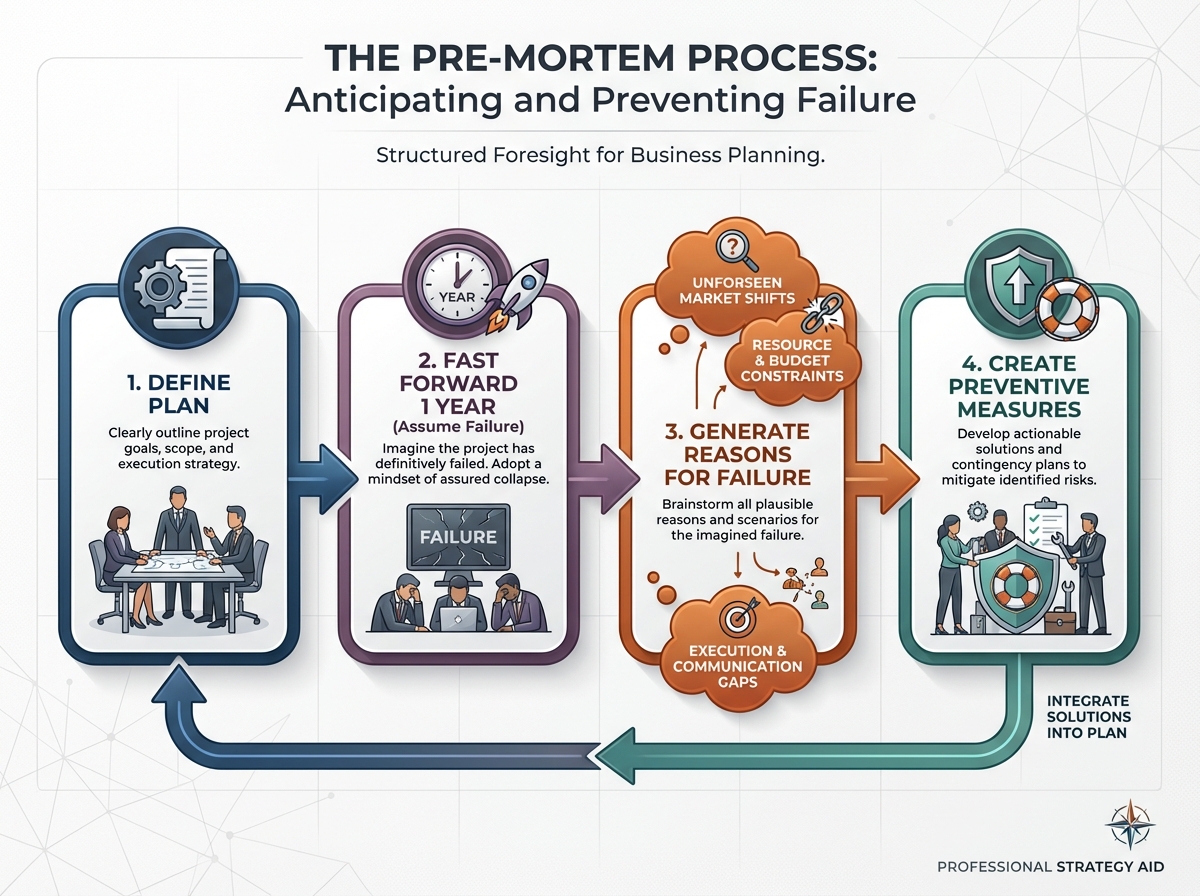
This involves assuming the task is already done—or failed—and looking back at the timeline.
This subtle shift from "What might go wrong?" to "It did go wrong; what was the cause?" triggers a different kind of creativity in the brain. It moves the mind from creative optimism to analytical autopsy.
While the concept is simple, the application is hard because our egos get in the way. We don't want to imagine our ideas failing. This is where AI becomes a potent tool for personal development. AI has no ego. It can ruthlessly simulate failure without hurting your feelings.
Here is how you can utilize AI tools to facilitate the Inversion Mental Model:
When you are planning a project or making a life decision, you can use AI to simulate a hostile review board.
Example Scenario: You are planning to ask for a raise. Standard Prep: You list your achievements. Inversion Prep with AI: You ask the AI to play the role of a skeptical CFO who is looking for reasons to deny the request.
"I am planning to ask for a raise based on these three achievements. Act as a skeptical CFO who needs to cut costs. Critique my argument. Tell me exactly why you would say 'no' to this request, and what weaknesses in my performance you would exploit."
A "Pre-Mortem" is a strategy developed by psychologist Gary Klein. Unlike a post-mortem (checking why a patient died), a pre-mortem assumes the patient is dead before the operation starts.
You can feed your project plan into an AI Mentor and ask: "Assume it is one year from now and this plan has failed spectacularly. Generate a narrative explaining the sequence of events that led to this failure, focusing on overlooked external risks and internal biases."
By reading a detailed, AI-generated story of your own failure, you can spot the holes in your logic that optimism bias had obscured.
Productivity is rarely about doing more; it is about doing less of the things that waste time. Inversion suggests that instead of a To-Do list, you need a "Not-To-Do" list.
Charlie Munger famously said, "Tell me where I'm going to die so I will never go there." Apply this to relationships.
Warren Buffett's first rule of investing is: "Never lose money." His second rule is: "Never forget rule number one." This is pure inversion.
Amateur investors focus on "How much can I make?" (Upside). Professional investors focus on "How much can I lose?" (Downside). By capping the downside and inverting the risk, the upside takes care of itself.
Understanding the theory of Inversion is one thing; consistently applying it to your complex life challenges is another. This is where GPTnius bridges the gap between theory and practice.
GPTnius offers AI Mentors that have been trained on proprietary research analyzing the published works, philosophies, and proven methodologies of thought leaders who championed these models. For Inversion, you might engage with "The Architect," a mentor persona designed to synthesize research on mental models and systems thinking.
Here is how GPTnius facilitates this learning:
By turning the abstract concept of Inversion into a conversational coaching experience, GPTnius ensures you aren't just reading about mental models—you are thinking with them.
> 💡 Build Your "Anti-Fragile" Strategy > > Don't wait for failure to reveal the cracks in your plan. Use GPTnius to stress-test your ideas today with AI Mentors trained on the world's best decision-making frameworks. > > Meet the AI mentors built from this research →
Inversion does not come naturally. It feels counter-intuitive to spend time thinking about failure, disaster, and stupidity. However, it is arguably the most efficient way to clear the path toward success. By solving problems backward, you avoid the trap of trying to be brilliant and settle for the much more achievable goal of consistently not being stupid.
Whether you are using a pen and paper to draft a "Not-To-Do" list or utilizing GPTnius to run a complex AI simulation of a project failure, the outcome is the same: clarity. When you remove the obstacles, the path forward reveals itself.
The Inversion Mental Model is a problem-solving strategy where you approach a problem backward. Instead of asking how to achieve a positive outcome (e.g., 'How do I succeed?'), you ask how to achieve the negative outcome (e.g., 'How do I fail?') and then avoid those specific actions.
AI can act as an objective 'Red Team' or Devil's Advocate. You can prompt AI tools to simulate worst-case scenarios, conduct pre-mortems, or critique your plans from the perspective of a skeptic, helping you identify blind spots you might miss due to personal bias.
A Post-Mortem is an analysis conducted after a project has failed to understand what went wrong. A Pre-Mortem is a mental exercise conducted *before* a project starts, where you assume the project has already failed and work backward to determine the plausible causes, allowing you to prevent them.
While the concept has roots in Stoic philosophy and the work of mathematician Carl Gustav Jacobi, it was popularized in the modern business world by Charlie Munger, the Vice Chairman of Berkshire Hathaway.