Master the design thinking process with this guide to David Kelley's methodology. Learn the 5 steps, real-world examples, and how to innovate like IDEO.
David Kelley’s Design Thinking methodology shifts focus from pure aesthetics to human-centered problem solving. By mastering the 5-stage process (Empathize, Define, Ideate, Prototype, Test), individuals and organizations can unlock creative confidence and build solutions that truly matter.
---
Innovation is rarely a lightning strike of genius; more often, it is a structured process of empathy, experimentation, and iteration. At the center of this modern approach to innovation is David Kelley, the founder of IDEO and the Stanford d.school. Kelley popularized Design Thinking—a methodology that democratized creativity, proving that innovation isn't just for "creatives" but is a capability that can be cultivated by anyone.
Whether you are a product manager, a startup founder, or a corporate executive, understanding the design thinking process is essential for solving complex problems. This guide explores the core principles of Kelley’s framework, breaks down the steps, and provides actionable ways to implement these strategies in your work.
Before diving into the steps, it is crucial to understand the mindset that drives the methodology. David Kelley’s approach is fundamentally Human-Centered Design (HCD). Unlike traditional business strategies that start with a revenue goal or a technological capability, HCD starts with the user.
The philosophy rests on three pillars:
Kelley often speaks about "Creative Confidence"—the belief that you have the ability to change the world around you. Design thinking is the toolset that unlocks this confidence.
> 💡 Unlock Your Creative Confidence > > Struggling to shift your mindset from "business-as-usual" to "human-centered innovation"? GPTnius AI Mentors, trained on proprietary research analyzing David Kelley’s philosophies, can guide you through empathy exercises to reframe your challenges. > > Meet the AI mentors built from this research →
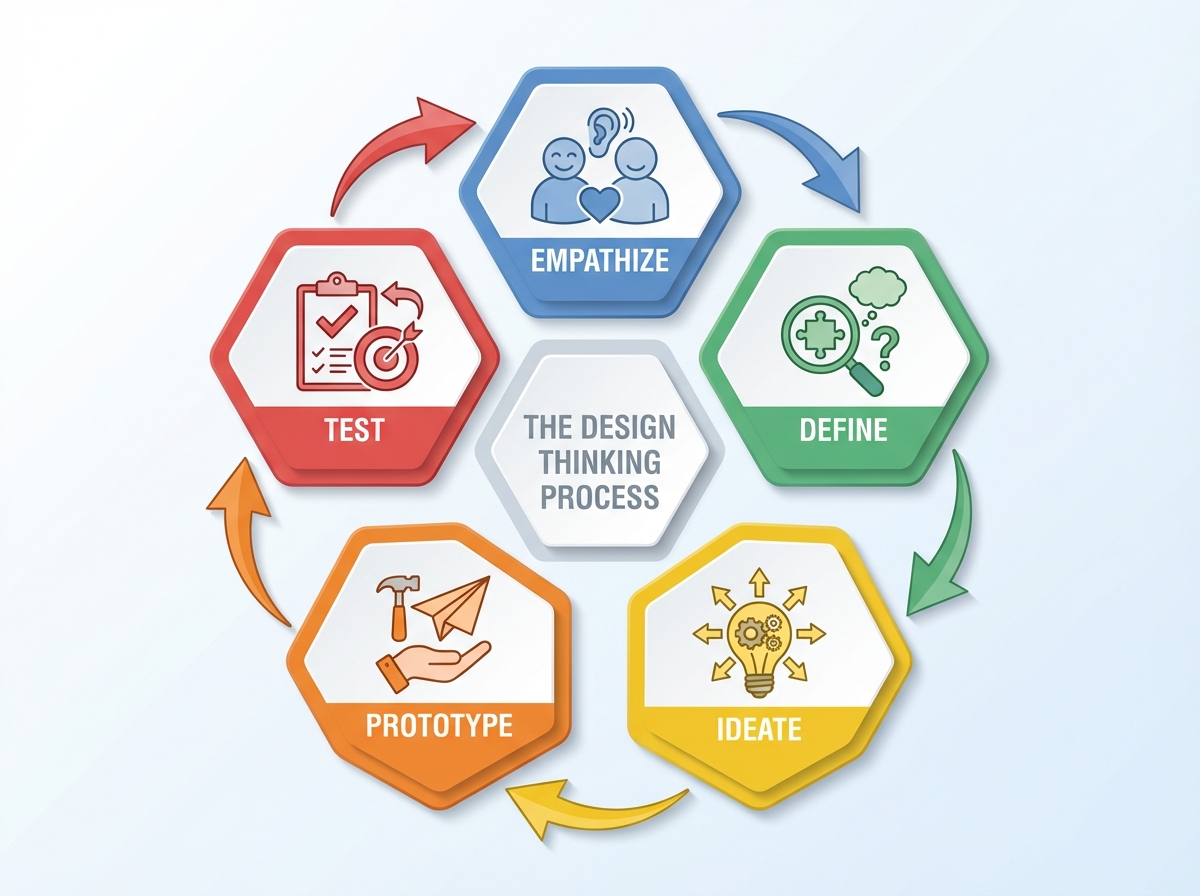
While IDEO often uses a 3-phase model (discussed later), the most granular and teachable framework associated with Kelley is the 5-stage model developed at the Stanford d.school. This is the standard for running a design thinking workshop or project.
This is the foundation. You cannot solve a problem you do not understand. In this phase, you set aside your assumptions and immerse yourself in the user's world.
Once you have gathered data, you must synthesize it. The "Define" stage is about clarity. You are looking for patterns in your observations to construct a meaningful problem statement.
With a clear problem statement, you move to idea generation. This stage is about quantity, not quality. Judgment is suspended.
David Kelley is famous for the mantra: "Build to think." A prototype is not a finished product; it is a question embodied in physical form.
Testing is where your prototype meets reality. This is not about selling your idea; it is about learning where your idea breaks.
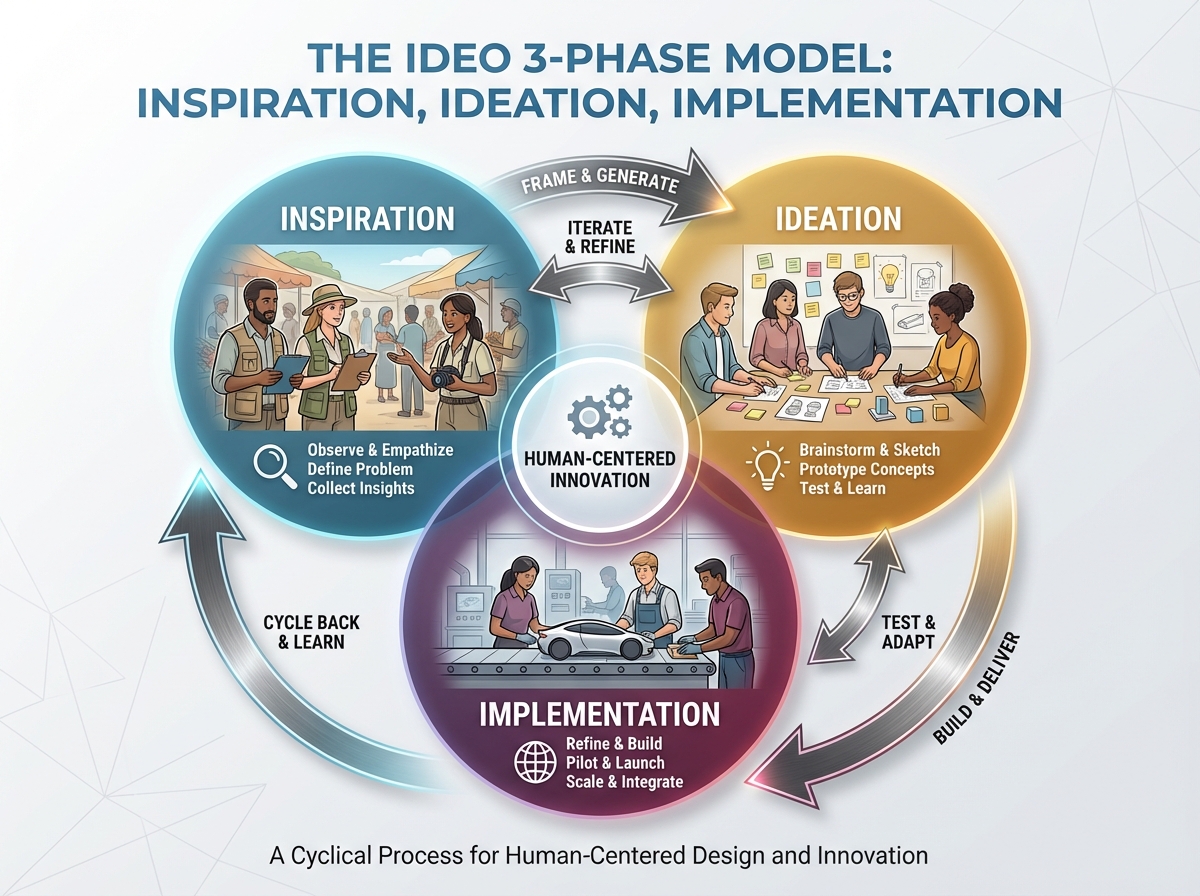
While the 5-stage model is excellent for educational purposes and step-by-step execution, in the corporate world, IDEO often groups these into three broader phases of innovation.
This overlaps with Empathize and Define. It is the research phase where you identify the opportunity. You look at the world, observe behaviors, and find the "white space" where innovation can happen.
This covers Ideate and Prototype. It is the messy middle where you generate concepts, build rough drafts, and iterate. It involves narrowing down hundreds of ideas to a few viable concepts.
This is the delivery phase. It involves engineering, manufacturing, marketing, and business strategy. It turns the best prototype into a viable product or service that lives in the market.
To understand the power of this methodology, it helps to look at classic design thinking examples where Kelley’s principles were applied.
In the early 1980s, Steve Jobs asked IDEO to create a mouse for the Lisa computer. Existing mice were expensive ($400) and unreliable.
Doug Dietz, a designer at GE, realized that while his MRI machines were technologically advanced, children were terrified of them.
If you want to apply these design thinking steps to your team, you don't need to hire a consultancy. You can run a workshop using this simple agenda:
Reading about design thinking is one thing; applying it to your specific business challenge is another. This is where GPTnius can accelerate your learning curve.
GPTnius offers AI Mentors that have been trained on proprietary research analyzing the published works, philosophies, and proven methodologies of thought leaders like David Kelley. These mentors do not just chat; they synthesize researched frameworks to provide personalized coaching conversations.
Here is how a GPTnius AI Mentor can assist you in the Design Thinking process:
By engaging in guided discussions with these AI Mentors, you can turn abstract methodology into concrete project plans.
> 💡 Master the Art of Innovation > > Ready to apply the rigorous frameworks of design thinking to your next project? Get personalized guidance on structuring your Empathy, Ideation, and Prototyping phases from an AI Mentor trained on the world's best innovation research. > > Meet the AI mentors built from this research →
David Kelley’s Design Thinking methodology is more than a process; it is a cultural shift. It moves organizations away from fear of failure and toward a culture of learning. By rigorously following the steps of Empathizing, Defining, Ideating, Prototyping, and Testing, you remove the guesswork from innovation.
Whether you are designing a new piece of software or reimagining a corporate workflow, the principles remain the same: start with the human, build to think, and iterate your way to success.
The 5 stages of design thinking, as popularized by the Stanford d.school, are: 1. Empathize (understanding the user), 2. Define (framing the problem), 3. Ideate (generating solutions), 4. Prototype (building rough representations), and 5. Test (gathering feedback).
David Kelley is the founder of the global design firm IDEO and the Stanford d.school. He is widely credited with popularizing the term 'Design Thinking' and adapting it from a designer's toolkit into a mainstream methodology for business innovation and problem-solving.
The 5-stage model (Empathize, Define, Ideate, Prototype, Test) is a granular, step-by-step educational framework. The 3-phase model (Inspiration, Ideation, Implementation) is a broader corporate framework used by IDEO to describe the lifecycle of a project. They cover the same principles but categorize the activities differently.