Master your mind with our guide to Daniel Kahneman's System 1 and System 2 thinking. Learn practical strategies to overcome bias and make smarter decisions.
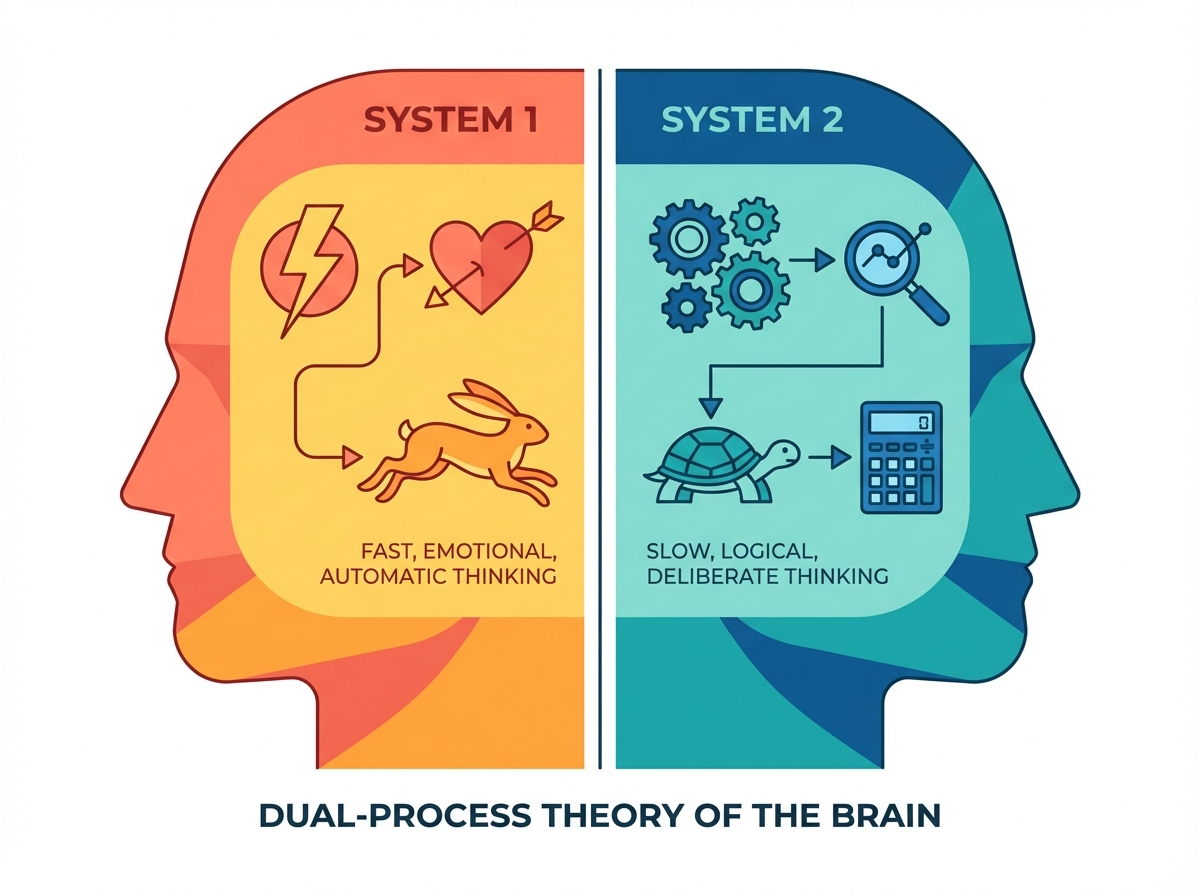
Nobel laureate Daniel Kahneman defined two modes of thought: System 1 (fast, intuitive, emotional) and System 2 (slow, deliberative, logical). While System 1 handles daily habits efficiently, it is prone to cognitive biases. Learning to intentionally engage System 2 is the key to solving complex problems and making better long-term decisions.
---
Imagine a bat and a ball cost $1.10 in total. The bat costs $1.00 more than the ball. How much does the ball cost?
If the number 10 cents immediately popped into your head, you aren’t alone. It is also the wrong answer. (The correct answer is 5 cents: $1.05 + $0.05 = $1.10).
That immediate, intuitive, and incorrect response is the work of what Nobel Prize-winning psychologist Daniel Kahneman calls System 1. The logical process required to check your math and find the correct answer is System 2.
Understanding the interplay between System 1 and System 2 thinking is not just an academic exercise; it is the fundamental framework for understanding how we make decisions, why we make mistakes, and how we can improve our judgment. Whether you are a business leader, a student, or simply someone trying to navigate a complex world, mastering these two systems is the first step toward cognitive empowerment.
In this guide, we will break down the mechanics of these systems, explore System 1 and System 2 examples, and provide actionable strategies to help you think more clearly.
In his seminal book, Thinking, Fast and Slow, Kahneman popularized the dual-process theory, which posits that the human brain relies on two distinct systems to process information. These aren't physical areas of the brain, but rather metaphors for two different modes of thinking.
System 1 operates automatically and quickly, with little or no effort and no sense of voluntary control. It is the brain's autopilot. It evolved for survival, allowing our ancestors to recognize a predator or judge a social situation in a split second.
Characteristics of System 1:
System 1 Examples:
System 2 allocates attention to the effortful mental activities that demand it, including complex computations. The operations of System 2 are often associated with the subjective experience of agency, choice, and concentration.
Characteristics of System 2:
System 2 Examples:
> 💡 Master Your Mental Models > > Struggling to identify when your brain is on autopilot? An AI Mentor trained on research analyzing cognitive frameworks can help you practice switching modes effectively. > > Meet the AI mentors built from this research →
Most of the time, System 1 and System 2 work in harmony. System 1 runs the show, making routine suggestions, and System 2 sits in the background, endorsing those suggestions. This is efficient; if we had to use System 2 to decide how to open a door or tie our shoes, we would be exhausted before breakfast.
However, problems arise when System 1 encounters a problem it cannot solve. Ideally, it calls on System 2. But often, System 1 offers a simplified answer (a heuristic) instead of the correct one, and the "lazy" System 2 accepts it without checking. This is where cognitive biases are born.
Kahneman explains that thinking is metabolically expensive. Focus requires glucose and energy. Therefore, the brain follows the "Law of Least Effort." If there are several ways to achieve the same goal, people will eventually gravitate to the least demanding course of action. This is why we are prone to accepting the first answer that comes to mind.
To understand how to use System 2 thinking effectively, you must first recognize where System 1 trips you up. Here are three classic biases that stem from an over-reliance on fast thinking.
System 1 relies heavily on the first piece of information offered (the "anchor") when making decisions.
We judge the probability of an event based on how easily examples come to mind.
System 1 is radically insensitive to the quality and quantity of information that gives rise to impressions and intuitions. It constructs the best possible story from the information currently available, ignoring what it doesn't know.
Knowing the difference between System 1 vs System 2 is useful, but applying that knowledge is powerful. You cannot walk around with System 2 activated 24/7—you would burn out. The secret is knowing when to shift gears.
Before making a major decision (hiring an executive, launching a product, getting married), gather your team or sit quietly by yourself.
This forces System 2 to engage. System 1 is usually overly optimistic (confirmation bias). A premortem legitimizes doubt and forces you to analyze potential threats logically.
System 1 loves "cognitive ease"—things that feel familiar and easy to read. To activate System 2, introduce "disfluency."
In his book The Checklist Manifesto, Atul Gawande highlights how checklists prevent errors in complex fields like surgery and aviation. A checklist is essentially an externalized System 2. It prevents System 1 from skipping steps due to overconfidence or routine.
When estimating how long a project will take, System 1 looks at the specific details of the project (the "inside view") and assumes the best-case scenario.
To use System 2, ignore the details of your specific case. Instead, ask: "How long did similar projects take for other people?" This "outside view" relies on statistical data rather than optimistic intuition.
Is System 1 the villain? Absolutely not. It is the hero of our evolutionary history. It allows expert firefighters to sense a floor is about to collapse before they consciously know why. It allows a chess grandmaster to see a checkmate in two seconds.
The rule of thumb: Trust System 1 only when:
If these conditions aren't met (e.g., picking stocks, predicting geopolitical events), System 1 is likely guessing, and you need to engage System 2.
Reading about System 1 and System 2 explained is one thing; consistently applying the concepts in the heat of the moment is another. This is where GPTnius offers a distinct advantage.
GPTnius offers AI Mentors that have been trained on proprietary research analyzing the published works, philosophies, and proven methodologies of thought leaders. For example, you can engage with "The Architect," a mentor whose coaching model draws from research on frameworks like mental models and decision-making systems.
Here is how an AI Mentor helps you bridge the gap:
By synthesizing these researched frameworks into personalized coaching conversations, GPTnius allows you to turn abstract psychological theory into a practical daily habit.
> 💡 Upgrade Your Decision-Making Engine > > Don't let cognitive biases dictate your future. Engage with an AI Mentor trained on the world's best mental frameworks to activate your System 2 thinking today. > > Meet the AI mentors built from this research →
We are not purely rational beings, nor are we purely emotional ones. We are a complex mix of System 1 and System 2. The goal of learning about these systems is not to eliminate fast thinking—it is essential for creativity and survival—but to become the manager of your own mind.
By recognizing the signs of cognitive ease, understanding your biases, and utilizing tools like GPTnius to enforce logical checks, you can reduce errors and make decisions that align with your long-term goals. The next time you face a difficult choice, pause. Ask yourself: Is this my autopilot speaking, or am I truly thinking?
System 1 is fast, automatic, emotional, and requires little effort. System 2 is slow, deliberate, logical, and requires conscious effort and attention.
Yes. While you cannot increase your raw IQ easily, you can improve your rationality by learning to recognize cognitive biases and using tools like checklists, premortems, and reframing techniques to intentionally engage System 2.
No. System 1 is essential for survival and handling routine tasks efficiently. It is also the source of expert intuition. However, it is unreliable in complex, unfamiliar situations where statistical reasoning is required.