Unlock rapid skill acquisition using the Pareto Principle 80/20 in learning. Discover how to identify the vital few concepts that drive 80% of your results.
In the modern era, information is infinite, but time is finite. The greatest barrier to personal development isn't a lack of resources; it is the paralysis caused by abundance. When you decide to learn a new language, pick up coding, or study investment strategies, the sheer volume of available data can be suffocating. Most learners adopt a linear approach: they start at chapter one and trudge forward, treating every piece of information as equally important. This is a fundamental error in judgment.
Not all information is created equal. Some concepts are foundational load-bearing walls, while others are merely decorative trim. To learn effectively in a fast-paced world, you must abandon the linear approach and adopt a strategic one. You must embrace the Pareto Principle.
This article explores the application of the Pareto Principle 80/20 in learning, a mental model that allows you to strip away the noise and focus intensely on the signal. We will examine the origins of the rule, its psychological underpinnings, and provide a concrete framework for applying it to your own intellectual growth.
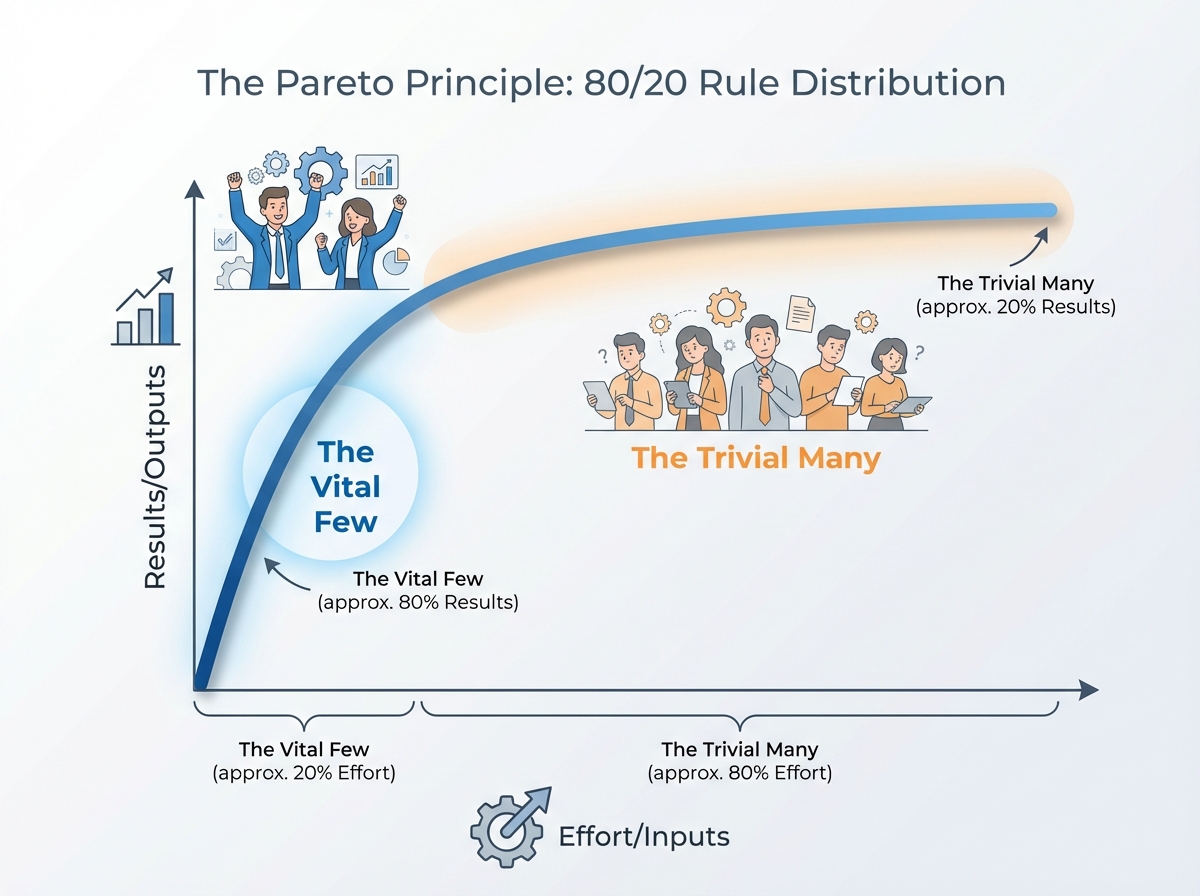
Vilfredo Pareto, an Italian economist in the late 19th century, made a fascinating observation while tending to his garden: 20% of the pea pods contained 80% of the peas. Intrigued, he applied this ratio to macroeconomics and discovered that 80% of the land in Italy was owned by just 20% of the population.
Over the last century, this distribution—known as the Power Law distribution—has been found to be eerily universal:
In the context of mental models & decision making, the Pareto Principle is a lens for prioritization. It teaches us that inputs and outputs are rarely balanced. When applied to learning (meta-learning), it suggests that you do not need to know everything to be functional; you only need to master the high-frequency, high-impact elements to achieve competence.
> 💡 Stop Wasting Time on Low-Impact Study > > You don't need to read every chapter to master a concept. Our AI Mentors can help you identify the "vital few" concepts in any field, saving you hundreds of hours of aimless study. > > Meet the AI mentors built from this research →
To apply the Pareto Principle 80/20 in learning, you must view a skill not as a monolith, but as a bundle of smaller sub-skills. Your goal is to deconstruct the skill and identify which sub-skills provide the highest return on investment (ROI).
Before you begin learning, break the subject down. If you want to learn photography, do not simply "study photography." Break it into lighting, composition, camera settings, post-processing, and gear.
Once deconstructed, identify the 20%.
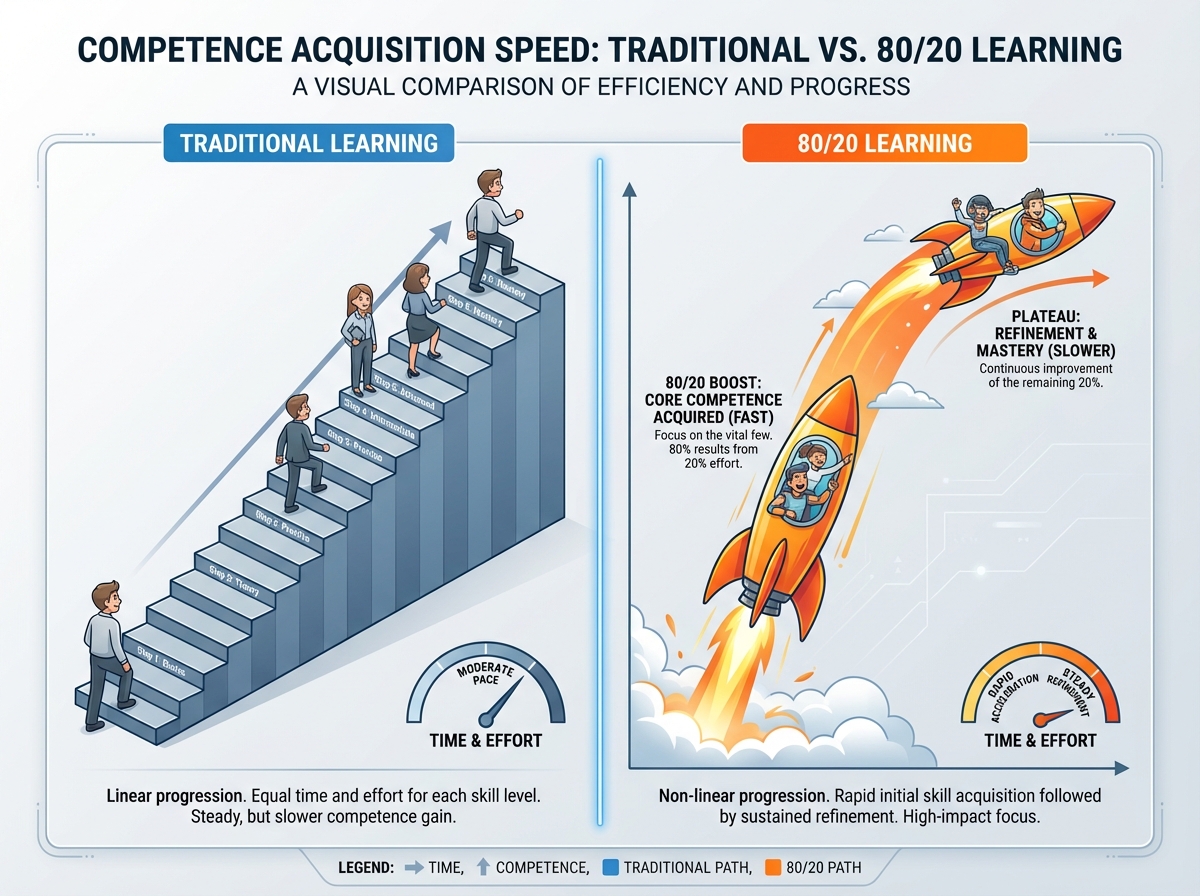
Learn the vital few first. This seems obvious, but traditional education often buries the lead. Textbooks might teach you grammar rules that are rarely used before teaching you how to say "I need help." By sequencing the high-value content first, you reach a state of "functional competence" rapidly.
How do you know what the 20% is if you are a beginner? This is the classic catch-22 of self-education. Here are three methods to bypass this hurdle.
Find three experts or practitioners in the field. Do not ask them "how do I learn this?" Ask them: "If you lost all your knowledge and had to restart, what are the first three things you would master to get paid/competent immediately?" Their answers will almost invariably point to the Pareto distribution.
For quantifiable skills, look at usage data. In programming, look at the most imported libraries on GitHub. In languages, look at frequency dictionaries. In chess, study the opening moves that statistically result in the highest win rates for your ELO ranking.
This is where AI learning becomes a game-changer. AI Large Language Models have ingested the corpus of human knowledge. You can specifically prompt an AI to perform the Pareto analysis for you. Asking, "What are the 20% of Excel functions that are used 80% of the time in financial analysis?" will yield a precise curriculum (likely VLOOKUP, Pivot Tables, and INDEX/MATCH) that cuts out the fluff.
The Pareto Principle is powerful, but it works best when combined with other mental models.
Parkinson’s Law states that "work expands to fill the time available for its completion." If you give yourself a month to learn the basics of a subject, it will take a month. If you give yourself a week, you will be forced to apply the Pareto Principle instinctively, focusing only on what matters to meet the deadline. Tight constraints force 80/20 thinking.
Associated often with physics and innovators like Elon Musk, this involves boiling things down to their fundamental truths. When you combine First Principles with Pareto, you strip a skill down to its physics (the First Principles) and then focus your energy on the variables that have the most impact (Pareto).
While the Pareto Principle is exceptional for rapid acquisition and functional competence, it has a dark side. It is often called the "Good Enough" trap.
Reaching 80% proficiency takes 20% of the time. However, bridging the gap from 80% (competent) to 99% (world-class master) requires the remaining 80% of the effort—and often much more.
If your goal is to be a heart surgeon, "good enough" is unacceptable. You need the long tail of knowledge. If your goal is to learn conversational Spanish for a vacation, the Pareto Principle is perfect. You must define your goal: are you seeking Competence or Mastery?
Applying the Pareto Principle requires high-level analysis that is difficult to do when you are a novice in a subject. This is where GPTnius bridges the gap.
GPTnius offers AI Mentors trained on proprietary research analyzing the published works, philosophies, and proven methodologies of thought leaders, including leading researchers on learning and productivity. Our mentors do not impersonate anyone. They synthesize researched frameworks, such as Pareto-based prioritization and deliberate practice, into personalized coaching conversations built around your specific goals.
Here is how they help you apply the 80/20 rule:
By leveraging an AI Mentor trained on these proprietary insights, you turn the abstract concept of the Pareto Principle into a concrete, daily learning strategy.
Time is the currency of life, and how you spend it determines your trajectory. The Pareto Principle 80/20 in learning is not a shortcut that cheats the system; it is a strategy that respects the value of your time. By identifying the vital few inputs that create the majority of outputs, you can learn faster, reduce overwhelm, and achieve functional competence in a fraction of the time traditional methods require.
Whether you are learning a new trade, a hobby, or a soft skill, start by asking: "What is the 20% here?" Once you find it, attack it with relentless focus. The rest is just noise.
> 💡 Accelerate Your Learning Curve Today > > Ready to stop guessing and start learning strategically? Unlock the power of AI Mentors trained on the world's best mental models to guide your personal growth journey. > > Meet the AI mentors built from this research →
The 10,000 Hour Rule emphasizes the time required for elite mastery, while the Pareto Principle emphasizes efficiency to reach competence. Pareto helps you get 80% of the results in 20% of the time, whereas the 10,000 hours are required to close the final 20% gap to become world-class.
It is most effective for skills with clear sub-components (languages, coding, sports). It is less effective for safety-critical fields (medicine, structural engineering) where the 'trivial many' details are actually necessary for safety, though it can still help in prioritizing study order.
AI tools can analyze vast amounts of data to instantly identify high-frequency patterns and 'vital few' concepts, creating a prioritized learning roadmap that a human might take weeks to research manually.