Master the art of decision making with Charlie Munger's latticework of mental models. Learn how to build a mental model toolkit and apply multidisciplinary wisdom.
Charlie Munger, the late Vice Chairman of Berkshire Hathaway and Warren Buffett’s longtime business partner, was known for more than just his billionaire status. He was considered one of the most rational thinkers of the modern era. His secret weapon wasn't a complex algorithm or insider trading; it was a concept he called the latticework of mental models.
Munger famously stated, "You can't really know anything if you just remember isolated facts and try and bang 'em back. If the facts don't hang together on a latticework of theory, you don't have them in a usable form."
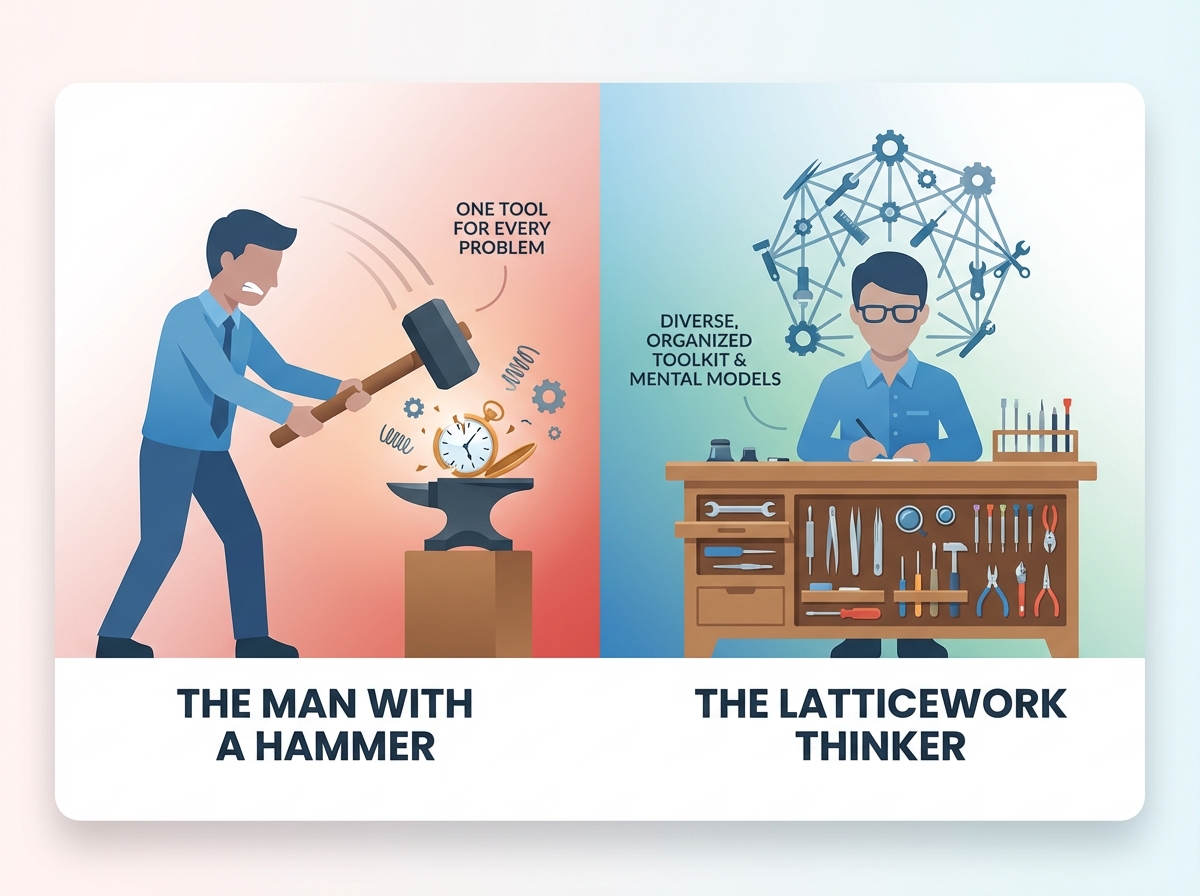
Most people approach problems through the narrow lens of their specific profession. An engineer sees an engineering problem; a marketer sees a branding problem. Munger argued that this approach is fatal to clear thinking. To make high-quality decisions, you must borrow the "big ideas" from physics, biology, psychology, mathematics, and history, and weave them into a system.
This guide will explore how to build a mental model toolkit, provide a core Charlie Munger mental models list, and show you how to apply these frameworks to everyday decision-making.
At its simplest, a mental model is a representation of how something works. It is a framework that helps you understand the world, perceive relationships, and predict outcomes.
We all use mental models, whether we realize it or not. Supply and demand is a mental model from economics. Natural selection is a mental model from biology. The problem arises when we rely on too few models.
Munger frequently warned against the "Man with a Hammer" syndrome, derived from the proverb: "To the man with only a hammer, every problem looks like a nail."
If your only model is economics, you might try to solve a marriage dispute with cost-benefit analysis (and fail miserably). If your only model is psychology, you might ignore the hard mathematics of compound interest in your investment portfolio.
To function effectively in a complex world, you need a diverse toolkit—a latticework—where models from different disciplines overlap and reinforce one another.
> 💡 Expand Your Toolkit with AI Coaching > > Struggling to break out of single-track thinking? GPTnius AI Mentors are trained on research analyzing frameworks like Munger's mental models to help you view challenges through multiple lenses. > > Meet the AI mentors built from this research →
Before diving into specific examples, it is crucial to understand the three pillars that hold the latticework together:
While Munger advocated for knowing 80 to 90 models, a handful carry the most weight. Here are five essential mental models for decision making that you can apply immediately.
The Concept: Invert, always invert. Many problems are best solved backwards. Instead of asking how to achieve success, ask how to achieve failure, and then avoid those actions.
Application: If you want to improve productivity, don't just list "things to do." List the things that kill your productivity (doom-scrolling, unnecessary meetings, lack of sleep) and ruthlessly eliminate them.
The Concept: Everything you do has a cost, which is the value of the next best alternative you gave up to do it. It is the bridge between finite resources and infinite desires.
Application: When deciding to hold a meeting, the cost isn't just the room rental. It is the hourly wage of every person in that room multiplied by the duration, plus the value of the work they didn't do during that time.
The Concept: A map is a reduction of reality, not reality itself. Models and spreadsheets are simplifications. They are useful, but they are never 100% accurate representations of the chaotic real world.
Application: Do not blindly trust financial projections or business plans. Acknowledge that the "map" (your plan) misses the terrain (market shifts, human emotion, black swan events).
The Concept: The human tendency to search for, interpret, and recall information in a way that confirms one's preexisting beliefs. This is a primary cause of bad investment decisions.
Application: When you have a brilliant idea, actively seek out evidence that disproves it. As Charles Darwin did, write down every counter-argument immediately, or your brain will conveniently forget it.
The Concept: Einstein reportedly called it the eighth wonder of the world. Growth upon growth. This applies to money, but also to knowledge, relationships, and habits.
Application: Read 20 pages a day. It seems insignificant in a week, but over a decade, the compounding knowledge creates a massive competitive advantage.
Creating your own latticework isn't an overnight task. It is a lifelong project of self-education. Here is a step-by-step approach on how to build a mental model ecosystem.
If you work in tech, read biology (evolutionary strategies often mirror market competition). If you work in finance, read history (market cycles are driven by human nature, which hasn't changed).
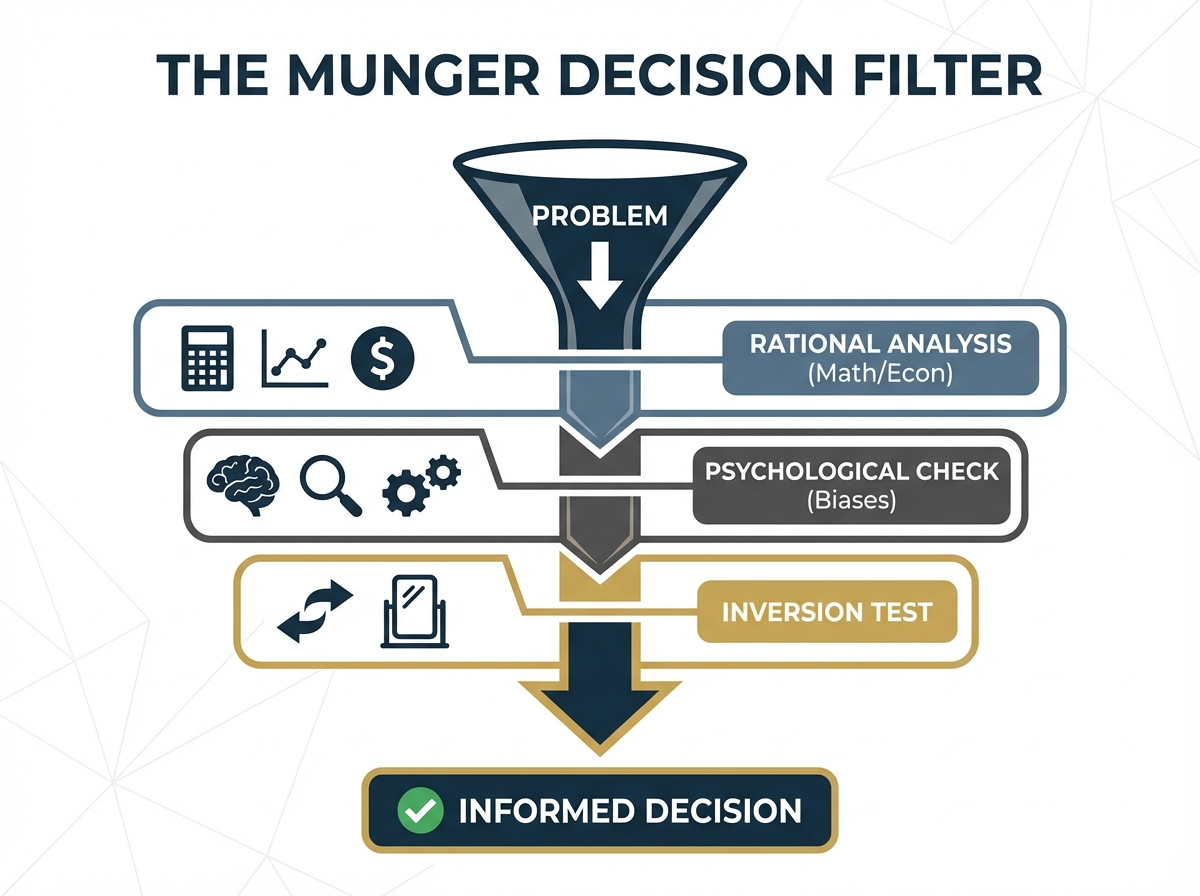
Munger suggests analyzing every problem through two tracks:
Pilots use checklists to ensure they don't miss critical steps. You should use mental model checklists for major decisions. Before making a hire or an investment, run the scenario through your models: Is there social proof bias here? What is the opportunity cost? Have I inverted the problem?
Let’s look at how utilizing a latticework changes the outcome of a decision.
Scenario: Launching a New Product Feature
By layering these perspectives, the Latticework Thinker avoids a costly mistake that the Specialist would have missed.
Reading about mental models is easy; applying them in the heat of the moment is difficult. This is where GPTnius bridges the gap between theory and practice.
GPTnius offers AI Mentors trained on proprietary research analyzing the published works, philosophies, and proven methodologies of thought leaders, including thinkers like Charlie Munger. Our mentors do not impersonate anyone. They synthesize researched frameworks, such as the latticework of mental models, into personalized coaching conversations built around your specific goals.
When you engage with an AI Mentor on GPTnius, you aren't just getting generic advice. You get:
> 💡 Build Your Latticework with an AI Mentor > > Don't leave your decision-making to chance. Use GPTnius to access AI Mentors trained on the research of world-class thinkers and apply their mental models to your life today. > > Meet the AI mentors built from this research →
Charlie Munger’s legacy is not just in the billions of dollars he helped generate for Berkshire Hathaway, but in the wisdom he shared on how to think. By constructing a latticework of mental models, you insulate yourself from stupidity and position yourself for long-term success.
Remember, the goal isn't to be a genius every time. It is to consistently be a little less irrational than everyone else. Start building your latticework today, and let the compound interest of wisdom work in your favor.
While Munger cited over 90 models, the most critical include Inversion (thinking backwards), Opportunity Cost, Compound Interest, Social Proof, and the 'Lollapalooza Effect' (where multiple biases converge).
Charlie Munger suggested that knowing 80 to 90 key models carries about 90% of the freight in making you a worldly-wise person. However, starting with a core 10-15 from major disciplines like psychology, economics, and physics provides a massive advantage.
The latticework is a metaphor for interconnected knowledge. Instead of isolating facts in separate brain compartments, you link them together. This structure allows you to solve problems using a multidimensional approach rather than a single, limited viewpoint.