Master the Regret Minimization Framework to overcome analysis paralysis. Learn how projecting yourself to age 80 can clarify bold life decisions and reduce future regret.
The Regret Minimization Framework is a powerful decision-making tool designed to bypass short-term fears and analysis paralysis. By mentally projecting yourself to age 80 and looking back on your life, you can identify which choices will lead to genuine fulfillment versus lasting regret. The core insight is that humans typically regret inaction (things they didn't do) far more than failed actions. This guide explains the psychology behind the framework and how to apply it using modern tools like AI mentorship.
---
We have all stood at the precipice of a major life decision. Whether it is quitting a stable job to launch a startup, moving to a new country, or expressing feelings to someone we care about, the weight of the unknown can be paralyzing.
In these moments, our brains often default to safety. We overanalyze the immediate risks: the potential embarrassment, the financial instability, or the discomfort of change. However, optimizing for safety in the short term often leads to a specific type of long-term pain: the gnawing question of "What if?"
To combat this, successful entrepreneurs and thought leaders rely on a mental model known as the Regret Minimization Framework. This cognitive tool forces a shift in perspective, moving you away from the anxiety of the present moment and into the clarity of hindsight. By understanding and applying this framework, you can make bold life decisions with confidence, ensuring that your future self looks back with pride rather than remorse.
At its core, the Regret Minimization Framework is a visualization exercise. It gained global prominence when Jeff Bezos described the logic he used to leave a lucrative career on Wall Street to found Amazon. However, the principle itself is rooted in stoic philosophy and behavioral psychology.
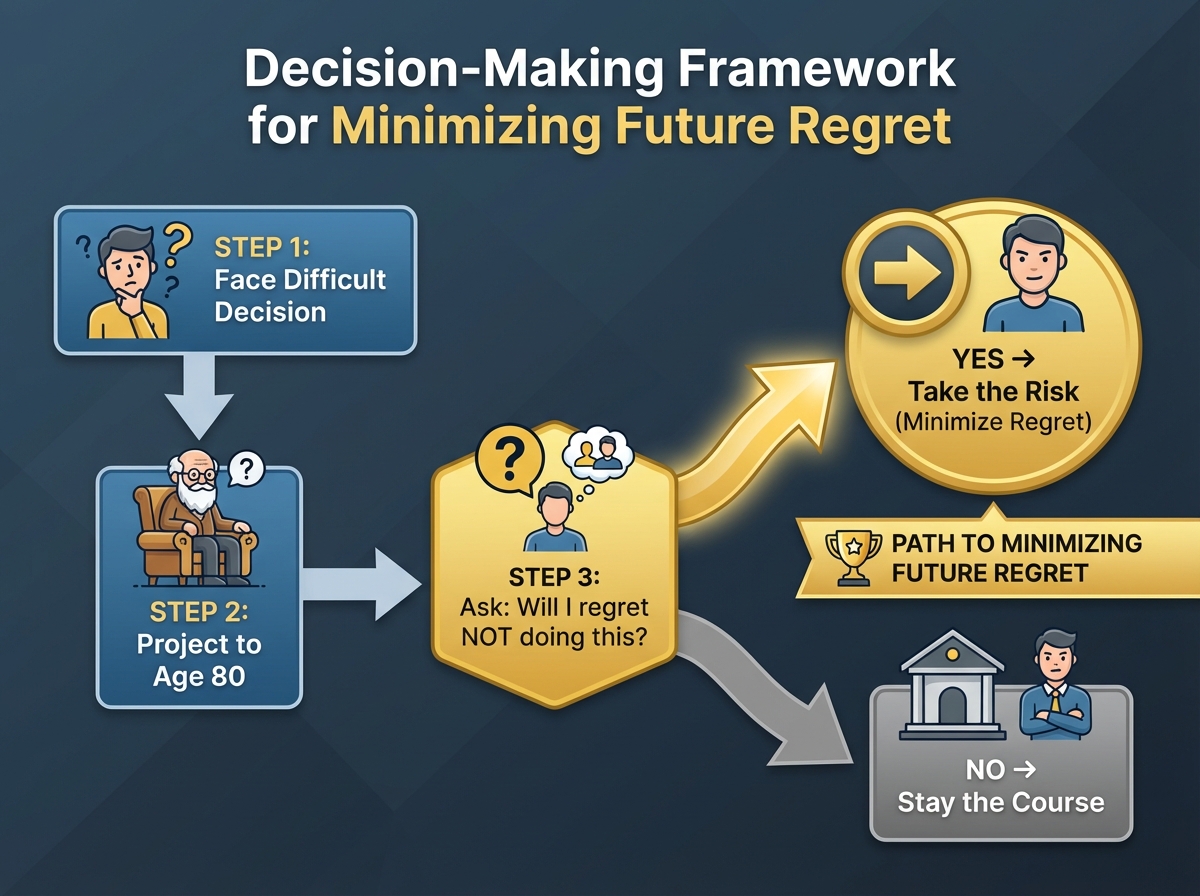
The framework asks you to engage in a mental time-travel exercise. You imagine yourself at age 80, looking back over your life. From that vantage point, you evaluate a current decision not based on what is safe or easy today, but on what will minimize your regret in that final narrative.
When you view a decision through the lens of your daily life, the "cons" list often looks overwhelming. You might worry about losing your end-of-year bonus or looking foolish if you fail. These are legitimate short-term concerns.
However, when you view the same decision as an 80-year-old, those short-term concerns vanish. An 80-year-old does not care about a missed 1994 bonus. They care about whether they pursued their passions and tested their potential. The framework operates on a binary logic:
> 💡 Clarify Your Long-Term Vision > > Struggling to visualize your 80-year-old self? GPTnius AI Mentors, trained on research into mental models and strategic foresight, can guide you through a simulation to uncover what truly matters to you in the long run. > > Meet the AI mentors built from this research →
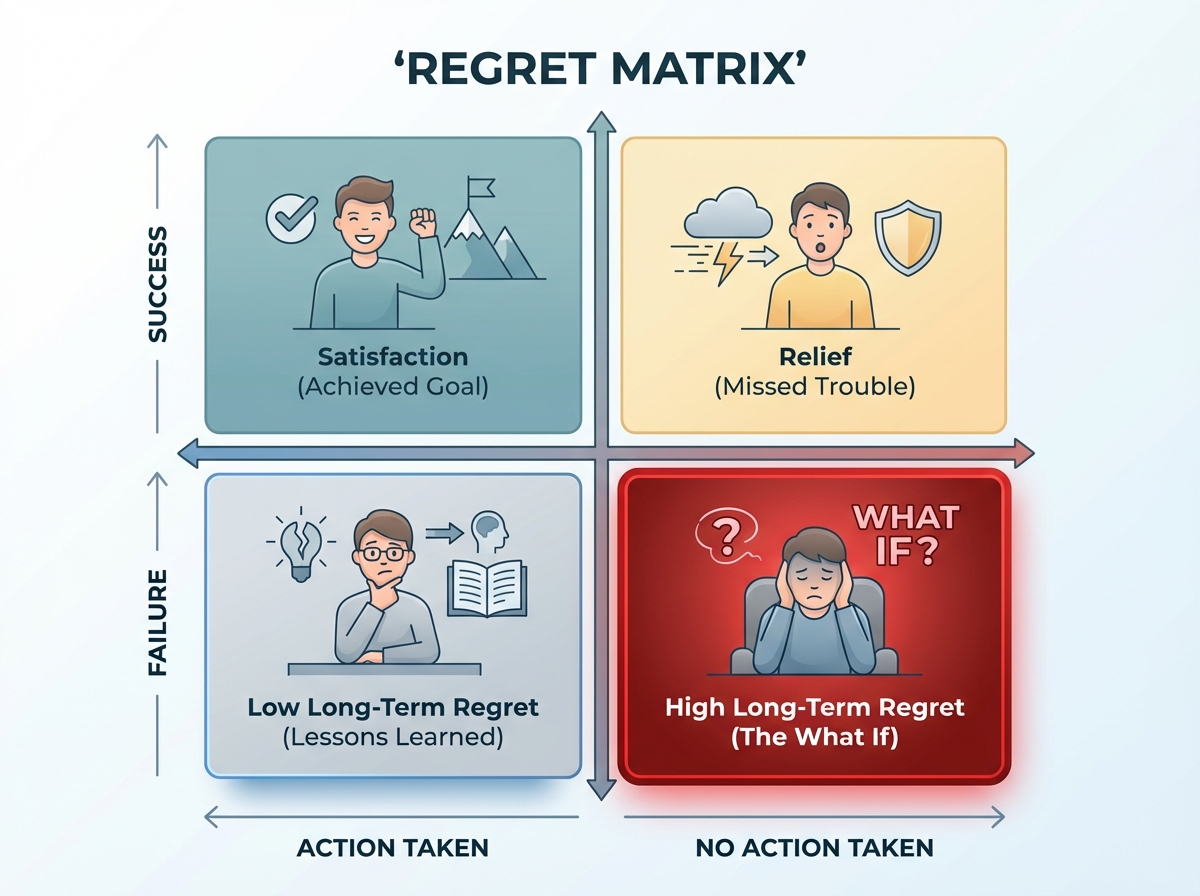
To understand why this framework is so effective, we must look at how human psychology processes regret. Researchers distinguish between two types of regret:
Psychological research consistently shows that over short time frames, people tend to regret actions that went wrong. If you try a new haircut and it looks terrible, you regret the action immediately.
However, over the long term—years and decades—the regret of inaction dominates. The sting of a failed business venture fades as you recover and learn. But the regret of never starting the business grows because the outcome remains an infinite, idealized possibility in your mind. The Regret Minimization Framework forces you to adopt the long-term perspective immediately, bypassing the short-term bias toward safety.
Applying this mental model requires more than just a fleeting thought. It requires a structured approach to deeply visualize the future.
Identify the specific choice causing you anxiety. It should be a binary choice: "Do X" vs. "Don't do X." If the decision is too complex, break it down into smaller binary components.
Find a quiet space. Close your eyes and vividly imagine yourself at age 80. Construct the scene details: Where are you sitting? Who is around you? How do you feel physically?
From this perspective, look back at the decision you are facing today.
Imagine you decided not to take the risk. You stayed on the safe path.
This is the critical step. Imagine you took the risk, and it failed. You started the company, and it went bankrupt after two years. You moved to the new city, and you got homesick and moved back.
One of the biggest obstacles to using the Regret Minimization Framework is the Sunk Cost Fallacy. We often refuse to make a bold change because we have already invested time, money, or emotion into our current path.
For example, a lawyer might hesitate to become a writer because they spent three years in law school.
When applying the Regret Minimization Framework, the 80-year-old self provides a distinct advantage: they are immune to sunk costs. To an 80-year-old, the three years spent in law school are a blip in a long life. They are far more concerned with the 40 subsequent years spent in a career that made you miserable. By projecting forward, you detach from the emotional investments of the past and focus solely on the trajectory of the future.
While the Regret Minimization Framework is a cognitive exercise, modern technology can help us perform it with greater precision. We often lie to ourselves or let our current emotions cloud our visualization. This is where AI-driven mentorship and objective analysis come into play.
An AI tool does not have fears, insecurities, or a mortgage to pay. It can act as a neutral party to help you simulate the 80-year-old perspective. By inputting your scenario, your values, and your fears, you can engage in a dialogue that challenges your biases.
For instance, you might tell an AI mentor, "I'm afraid to quit because I might run out of money." The AI can help you quantify that risk, propose mitigation strategies, and then ask the pivotal question: "Even if you ran out of money and had to get another job, would you regret the attempt at age 80?"
Applying mental models like the Regret Minimization Framework can be difficult when you are trapped in your own head. This is where GPTnius provides a distinct advantage.
GPTnius offers AI Mentors trained on proprietary research analyzing the published works, philosophies, and proven methodologies of thought leaders, including thinkers like Jeff Bezos. Our mentors do not impersonate anyone. They synthesize researched frameworks, such as the Regret Minimization Framework, into personalized coaching conversations built around your specific goals.
When you discuss a major life decision with a GPTnius AI Mentor, it can help you:
By engaging with a GPTnius mentor, you aren't just journaling; you are stress-testing your life decisions against the world's best mental models.
> 💡 Minimize Regret, Maximize Potential > > Don't let fear dictate your future. Use GPTnius to analyze your decisions through the lens of proven mental models and ensure your 80-year-old self will be proud. > > Meet the AI mentors built from this research →
The Regret Minimization Framework is a mental model where you project yourself to age 80 to evaluate current decisions. It helps prioritize long-term fulfillment over short-term fears by asking if you would regret inaction.
While the concept has roots in philosophy, it was famously popularized by Jeff Bezos, who used it to decide to quit his job and start Amazon.
It cuts through the noise of short-term worries (like embarrassment or temporary financial loss) and focuses on the only metric that matters in the long run: regret of inaction.
Yes. Platforms like GPTnius use AI trained on decision-making frameworks to act as objective sounding boards, helping you simulate scenarios and remove emotional bias from your choices.