Learn Jocko Willink's 'Detach and Look' strategy to overcome stress, eliminate emotional bias, and master objective decision-making under pressure.
Imagine you are in a high-stakes board meeting. The project is over budget, the client is furious, and your team is looking to you for immediate answers. Your heart rate spikes, your palms sweat, and your vision narrows. You feel the urge to react immediately—to defend yourself, to shout orders, or to dive into the minutiae to fix the problem yourself.
This physiological response is natural, but in leadership and decision-making, it is often fatal. When we are in the weeds, buried in the chaos, we lose sight of the strategic objective. We become reactive rather than proactive.
This is where the concept of "Detach and Look" becomes a critical tool for success. Popularized by former Navy SEAL commander and author Jocko Willink, this methodology is not just for the battlefield; it is a vital framework for navigating the complexities of modern business and life. By learning to detach, you can transition from an emotional participant to an objective observer, allowing you to make clear, effective decisions under extreme pressure.
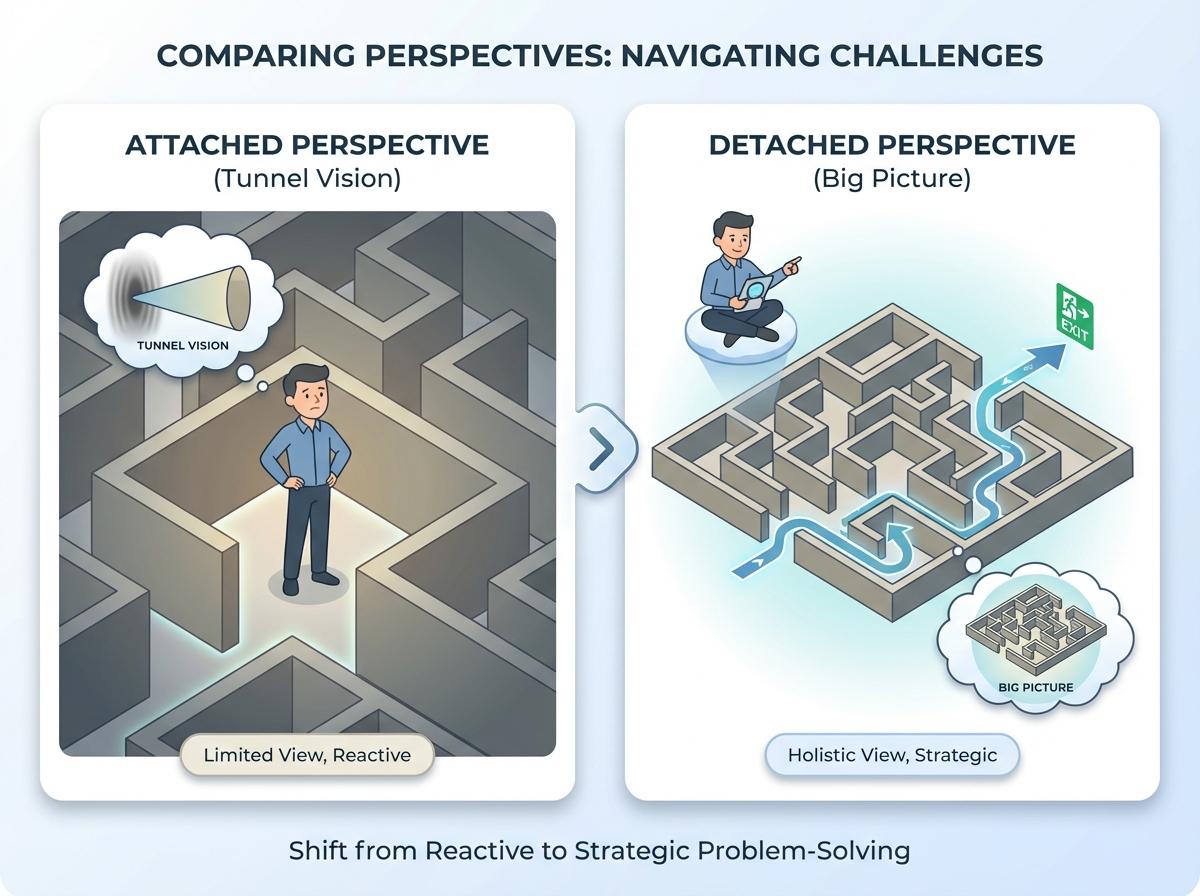
At its core, Detach and Look is the act of pulling yourself out of the immediate emotional chaos of a situation to view it with clarity. It is the antidote to "tunnel vision."
In combat, tunnel vision occurs when a soldier focuses so intensely on a specific threat that they lose awareness of their surroundings, exposing themselves and their team to greater danger. In business, tunnel vision manifests when a leader becomes obsessed with a single problem or emotional conflict, ignoring the broader market forces or long-term consequences.
To "detach" does not mean to disengage or stop caring. It means to disconnect your ego and your immediate emotional reaction from the equation so that you can "look" at the facts objectively. It is about creating a mental distance that allows your prefrontal cortex—the logical part of your brain—to override the amygdala, which drives the fight-or-flight response.
When pressure mounts, our biological programming takes over. Cortisol and adrenaline flood the system. This was useful for our ancestors running from predators, but for a modern leader trying to navigate a complex negotiation, it is detrimental. This chemical cocktail restricts our cognitive flexibility.
Detach and Look is a manual override for this system. It forces a pause, breaking the chemical feedback loop of stress and allowing you to reassess the landscape.
> 💡 Master Your Mental Game > > struggling to keep your cool in high-stakes meetings? Our AI Mentors, trained on research into the mental models of top performers, can help you simulate pressure scenarios and practice detachment techniques. > > Meet the AI mentors built from this research →
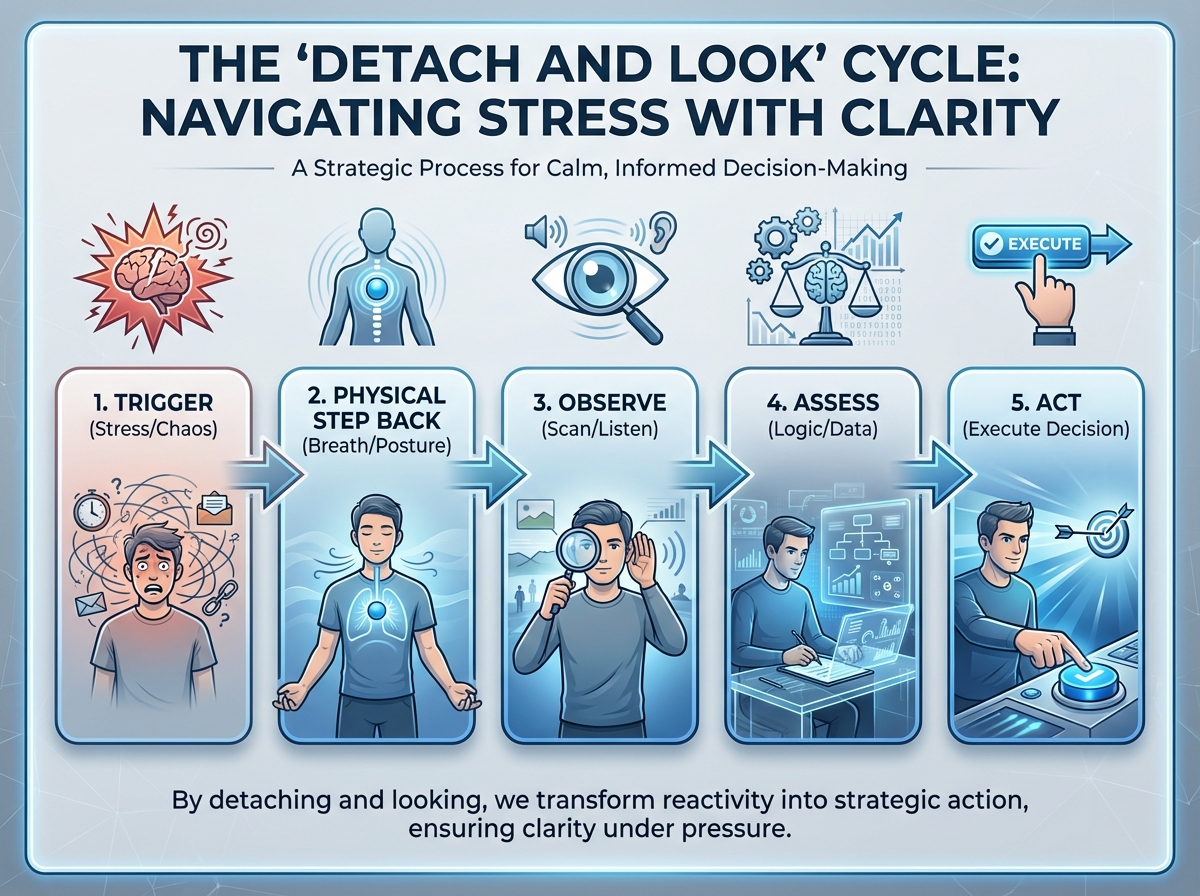
Understanding the concept is one thing; applying it when your heart is pounding is another. Here is a breakdown of how to operationalize the "Detach and Look" strategy in real-time.
Jocko Willink often describes the physical act of stepping back. In a tactical environment, this meant literally taking a step away from the firing line to see the whole battlefield. In a corporate setting, this can be subtle but effective:
Your breath is the remote control for your nervous system. Short, shallow breaths signal panic. Deep, slow breaths signal safety.
Before you speak or make a decision, take one deep, controlled breath. This oxygenates the brain and provides a momentary gap between the stimulus (the problem) and the response (your decision). This micro-pause is often all that is needed to prevent an emotional outburst.
Panic is contagious, but so is calm. When chaos erupts, the natural tendency is to raise your voice to be heard. The "Detach and Look" method suggests the opposite. Lower your volume and slow your cadence. This forces others to listen more closely and forces you to articulate your thoughts more deliberately.
When you feel the pressure to have all the answers, detach by asking questions. "What is the current status?" "What are our options?" "What does the data say?"
Asking questions engages the logical brain and forces you to listen. Listening is a passive action that naturally requires detachment. You cannot be shouting and listening at the same time.
Once you have successfully detached, you must make a decision. Here are strategies to ensure those decisions remain objective.
"Detach and Look" pairs perfectly with the OODA Loop (Observe, Orient, Decide, Act), a military strategy developed by Colonel John Boyd. Detachment is essentially the "Observe" and "Orient" phases.
Under pressure, multiple problems often arise simultaneously. A detached leader does not try to solve them all at once. They identify the single most critical threat, focus resources on solving it, and then move to the next. This prevents analysis paralysis.
To ensure objectivity, mentally "Red Team" your own decision. Ask yourself: "If I were the competition (or the opposing party), how would I defeat this plan?" By detaching from your own plan and viewing it through the eyes of an adversary, you can identify weaknesses you might have missed due to confirmation bias.
It is crucial to distinguish between healthy detachment and harmful disassociation. Misapplying this concept can lead to poor leadership and team alienation.
Detachment does not mean you don't care about the outcome or your people. You must remain emotionally invested in the mission while remaining emotionally detached from the friction of the moment. If your team perceives you as cold or uncaring, trust will erode.
Some leaders use detachment as an excuse to delay decision-making. They step back and keep looking, but never decide. Detachment is a temporary state to gather perspective, not a permanent vacation from responsibility. You detach to look, but you must re-attach to act.
Remaining calm while others are panicking can sometimes come across as arrogant. It is important to validate the stress your team is feeling. Use your calmness to stabilize them, not to judge them for their reaction.
Scenario: You receive a furious email from a key client accusing your team of incompetence. Reaction (Attached): You feel attacked. You immediately type a defensive reply pointing out the client's own errors. Reaction (Detached): You read the email. You feel the anger rise. You step away from the computer. You realize the client is under pressure from their own boss. You look at the facts: there was a minor delay. You draft a response acknowledging their frustration, taking ownership of the delay, and proposing a solution. The crisis is averted.
Scenario: Your product launch is failing. The data shows users aren't engaging. Reaction (Attached): You worked on this for two years. You blame the marketing. You double down on the budget to prove you were right. Reaction (Detached): You step back. You view the product as if you were an outside investor. You acknowledge the market fit isn't there. You pivot resources to a feature that is working, saving the company.
Reading about detachment is helpful, but practicing it is essential. This is where GPTnius bridges the gap between theory and application.
GPTnius offers AI Mentors that have been trained on proprietary research analyzing the published works, philosophies, and proven methodologies of thought leaders. For example, our "The Architect" mentor draws from research on frameworks like mental models and disciplined execution systems, combined with proven coaching models.
Here is how GPTnius can help you master "Detach and Look":
GPTnius provides a safe, judgment-free zone to practice the art of keeping your head when everyone else is losing theirs.
> 💡 Train Your Brain for the Battlefield of Business > > Don't wait for a crisis to test your decision-making skills. Use GPTnius to practice objective analysis and strategic detachment with a specialized AI Mentor today. > > Meet the AI mentors built from this research →
Jocko Willink's "Detach and Look" is more than a military tactic; it is a life skill. In a world that constantly demands our immediate attention and emotional reaction, the ability to step back is a superpower. It allows us to see the bigger picture, control our biology, and make decisions based on logic and long-term strategy rather than temporary emotion. By practicing physical repositioning, breath control, and strategic observation, you can navigate the storms of leadership with a steady hand.
The 'Detach and Look' method is a strategy popularized by Jocko Willink that involves mentally and physically stepping back from a chaotic situation to gain perspective, control emotional reactions, and make objective decisions.
No. Detachment is not apathy. It means caring enough about the outcome to remove your ego and emotional bias from the process so you can solve the problem effectively.
You can practice by physically leaning back in your chair, taking a deep breath, lifting your chin to widen your field of view, and listening more than you speak.