Learn to solve complex problems like Richard Feynman using First Principles Thinking. A comprehensive guide to deconstructing challenges and unlocking innovation.
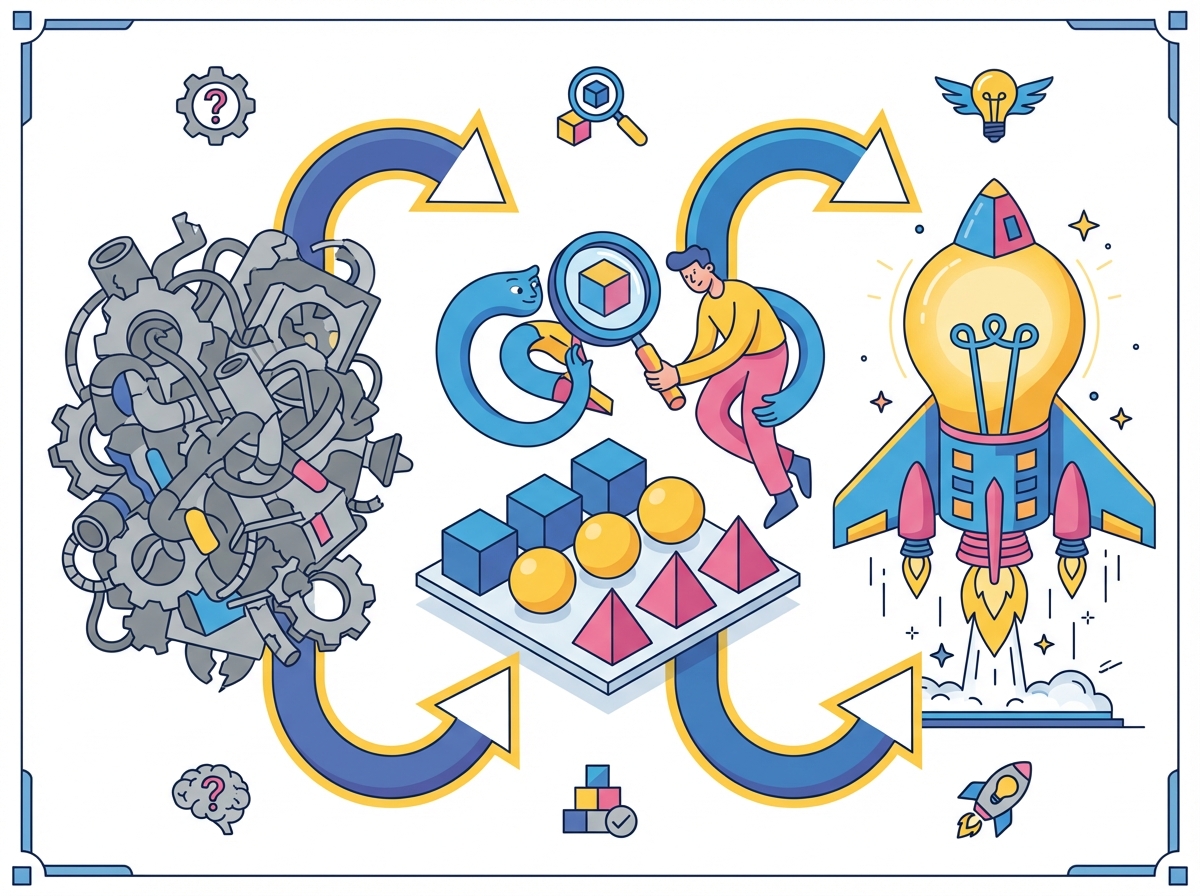
First Principles Thinking is a problem-solving framework that involves breaking complex problems down to their most basic elements and rebuilding them from the ground up. Championed by physicist Richard Feynman, this method bypasses "reasoning by analogy" to uncover original solutions. This article guides you through the step-by-step process of applying this mental model to business, learning, and innovation.
---
Innovation is rarely about creating something entirely new from thin air. More often, it is about stripping away the dogma, assumptions, and "best practices" that clutter our thinking to reveal the fundamental truths underneath. This is the essence of First Principles Thinking.
While the concept dates back to Aristotle, it was mastered and popularized in the modern era by the Nobel Prize-winning physicist Richard Feynman. Feynman was famous not just for his contributions to quantum mechanics, but for his refusal to accept complicated jargon or established authority as a substitute for understanding. He believed that if you couldn't explain a concept in simple terms, you didn't understand it—and if you couldn't derive a solution from basic truths, you were likely just copying someone else.
In a world dominated by copycat strategies and incremental improvements, First Principles Thinking is the tool you need to unlock breakthrough insights. This guide will explore how to apply Feynman's approach to deconstruct your biggest challenges and reconstruct them into innovative solutions.
To understand First Principles Thinking, we must first understand its opposite: Reasoning by Analogy.
Reasoning by analogy is how most people navigate the world. It involves building knowledge and solving problems based on prior assumptions, beliefs, and what other people are doing. It sounds like:
Reasoning by analogy is efficient for daily survival, but it is terrible for innovation. It traps you in the status quo.
First Principles Thinking, on the other hand, requires you to dig deeper until you are left with only the foundational truths of a situation. A "first principle" is a basic assumption that cannot be deduced from any other proposition. In physics, these are laws of nature. In business, they are the undeniable facts of the market or unit economics.
Think of it as a chef versus a line cook. A line cook follows a recipe (analogy). If they lose the recipe, they cannot cook. A chef understands the chemistry of flavor and heat (first principles). They can create a masterpiece from random ingredients without ever looking at a cookbook.
> 💡 Stop Copying, Start Innovating > > Struggling to break free from "how it's always been done"? GPTnius AI Mentors, trained on proprietary research into mental models like First Principles, can guide you through the deconstruction process. > > Meet the AI mentors built from this research →
Richard Feynman was a master of the "Why?" game. He was known for walking into lectures in fields he knew nothing about (like biology) and asking questions so fundamental that he would stump the experts. He wasn't trying to be difficult; he was trying to find the ground floor of truth.
Feynman’s variation of First Principles Thinking is closely tied to his learning method (The Feynman Technique). He distinguished between knowing the name of something and knowing the thing itself.
For example, knowing that a bird is called a "Brown-throated Thrush" tells you nothing about the bird. It is just a label humans invented. Knowing how the bird migrates, how it builds its nest, and why it sings—that is knowledge. First Principles Thinking requires you to strip away the labels (jargon, buzzwords, corporate speak) to see the mechanics underneath.
Perhaps the most famous example of Feynman applying First Principles was during the investigation of the Space Shuttle Challenger disaster. NASA engineers and managers were trapped in reasoning by analogy and bureaucratic dogma. They argued that the O-rings (rubber seals) were safe because they had worked in previous launches, despite data suggesting issues in cold weather.
Feynman cut through the noise. He didn't rely on the "safety protocols" documents. He looked at the fundamental physics: Rubber becomes brittle when cold.
During a televised hearing, he famously dipped a piece of the O-ring material into a glass of ice water and showed that it didn't bounce back when squeezed. He demonstrated a first principle—temperature affects elasticity—which shattered the complex, flawed reasoning NASA had built up. He reduced a billion-dollar failure to a single, fundamental physical truth.
How do you apply this physics-based framework to your business strategy, coding problems, or personal life? Here is a practical first principles thinking framework.
Be specific. "I want to grow my business" is too vague. "I want to double my revenue, but I can't afford to double my marketing budget" is a concrete problem.
Write down everything you think you know about the problem. These are usually the barriers stopping you.
This is where you channel Feynman. Challenge every assumption. Ask "Why?" repeatedly until you hit a wall of undeniable fact.
Example: "Battery packs are too expensive for mass-market electric cars."
The Insight: The cost isn't a physical law; it's a market inefficiency. If you can figure out how to combine those materials yourself, you can dramatically lower the cost. (This is exactly how Elon Musk approached Tesla).
Once you have the pile of fundamental bricks (the raw truths), build a new solution. Ignore how others combine these bricks. Look at what is possible given the constraints.
If you know the raw materials of a battery are cheap, the solution is not "negotiate better with suppliers." The solution is "build a factory to manufacture batteries in-house from raw materials."
Before the printing press, books were hand-copied by monks. It was slow and expensive. If Gutenberg had reasoned by analogy, he would have tried to train monks to write faster.
Instead, he broke the problem down to its components:
He combined these existing fundamental technologies—which had never been used together—to create the movable type printing press, revolutionizing history.
In the late 90s, the dominant analogy was Blockbuster: "Video rental requires physical stores so people can browse tapes."
Reed Hastings looked at the fundamentals:
He reconstructed the model: Mail DVDs (leveraging the postal service) and charge a subscription (removing late fees). Later, he applied first principles again to transition to streaming, realizing that internet bandwidth (the fundamental constraint) was improving enough to make physical media obsolete.
Adopting this mindset is difficult because our brains are wired to conserve energy. Here are common traps:
You don't need to be running a space agency to use this.
Applying First Principles Thinking requires significant mental energy. It demands that you constantly question your own biases and dismantle complex ideas. This is where having a dedicated mentor becomes invaluable.
GPTnius offers AI Mentors trained on proprietary research analyzing the published works, philosophies, and proven methodologies of thought leaders, including thinkers like Richard Feynman. Our mentors do not impersonate anyone. They synthesize researched frameworks, such as first principles deconstruction and mental models, into personalized coaching conversations built around your specific goals. Here is how an AI Mentor helps you:
By engaging in guided discussions with an AI Mentor trained on these specific cognitive frameworks, you can turn First Principles Thinking from an abstract concept into a daily habit.
> 💡 Ready to Deconstruct Your Biggest Challenge? > > Don't solve problems based on yesterday's assumptions. Work with an AI Mentor to apply First Principles Thinking and build innovative solutions from the ground up. > > Meet the AI mentors built from this research →
Richard Feynman once said, "The first principle is that you must not fool yourself—and you are the easiest person to fool." First Principles Thinking is the ultimate defense against self-deception. It is the practice of clearing away the fog of tradition, analogy, and "best practices" to see the machinery of the world clearly.
Whether you are trying to cut costs, learn a new skill, or disrupt an industry, the path to innovation starts at the bottom. Break it down. Verify the pieces. Build it back up. That is how you change the world.
Reasoning by analogy involves solving problems by looking at what has worked before or what others are doing (copying). First Principles Thinking involves breaking a problem down to its fundamental truths and building a new solution from scratch, ignoring established conventions.
Feynman used this approach to strip away jargon and complexity. He believed in understanding concepts at their most basic level. A famous example is his investigation of the Challenger disaster, where he demonstrated the fundamental physical failure of O-rings in cold weather, bypassing complex bureaucratic excuses.
Yes. You can apply it to personal finance (Zero-Based Budgeting), health (focusing on biological needs rather than diet trends), or career planning (building a career based on your fundamental skills rather than a standard job ladder).