Discover how Meditative Learning combines neuroplasticity, mindfulness, and AI tools to enhance focus, retention, and deep work in a distracted world.
Meditative Learning is a hybrid approach that fuses ancient mindfulness techniques with modern AI tools to combat digital distraction. By regulating brain states and using AI for structured inquiry rather than passive consumption, learners can unlock deeper focus and accelerate neuroplasticity.
---
In an era defined by the "attention economy," the ability to learn deeply is becoming a rare and valuable commodity. We are drowning in information but starving for wisdom. The average knowledge worker checks communication tools every 6 minutes, fragmenting the sustained attention required for deep cognitive work. This constant context switching doesn't just lower productivity; it physically alters the brain, strengthening neural pathways associated with distraction and weakening those required for deep focus.
Enter Meditative Learning—a transformative methodology that bridges the gap between Neuroplasticity & Brain Health and advanced technology. It is not about learning to meditate; it is about meditating to learn. By integrating the psychological principles of mindfulness with the capabilities of AI, we can reclaim our cognitive sovereignty and turn the learning process into a state of flow rather than a struggle against distraction.
To understand why Meditative Learning is effective, we must look at the biology of learning. Neuroplasticity—the brain's ability to reorganize itself by forming new neural connections—is heavily influenced by our state of arousal and focus.
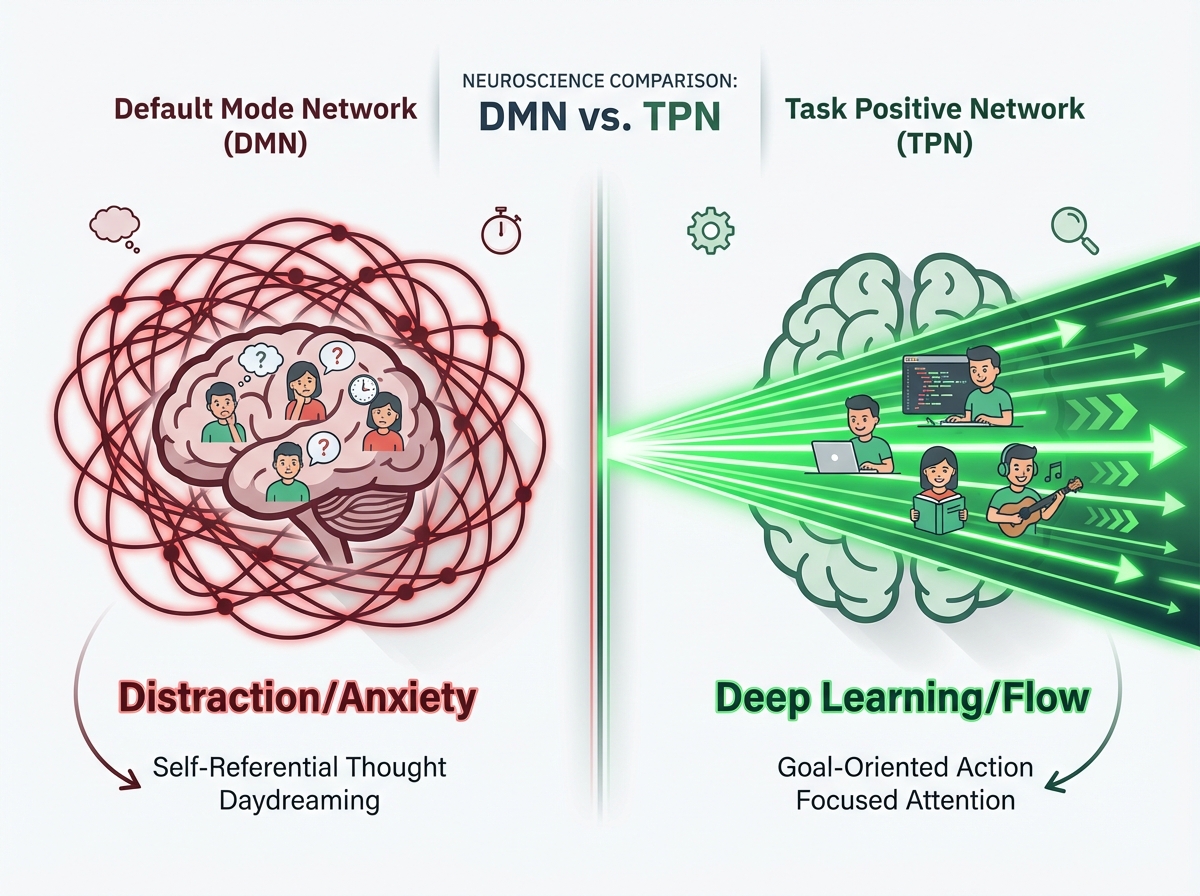
Neuroscience identifies two primary networks in the brain that are relevant to focus:
These two networks are generally anticorrelated; when one is active, the other is suppressed. Chronic multitasking and digital overstimulation keep the DMN hyper-active, making it difficult to switch into the TPN. Meditative Learning uses mindfulness cues to deliberately silence the DMN, allowing the TPN to engage fully. This state is often referred to as "Alpha state" learning, characterized by brain waves oscillating at 8–12 Hz, which is optimal for absorbing new information.
Stress is the enemy of memory. High levels of cortisol (the stress hormone) inhibit the hippocampus, the part of the brain responsible for memory consolidation. Conversely, a calm, meditative state promotes the release of Brain-Derived Neurotrophic Factor (BDNF), a protein that acts like fertilizer for brain cells, encouraging the growth of new neurons and synapses. By approaching AI learning sessions with a meditative mindset, you are chemically priming your brain to retain information.
> 💡 Master Your Mental Models with Clarity > > Stop fighting distraction and start building wisdom. GPTnius AI Mentors, trained on proprietary research into the habits of the world's clearest thinkers, can help you structure your learning to maintain a flow state. > > Meet the AI mentors built from this research →
Meditative Learning is not passive. It requires a shift from being a consumer of content to being an architect of your own understanding. Here are the pillars of this practice:
Traditional internet usage is driven by availability—we click what is in front of us. Meditative Learning is driven by intentionality. Before opening a browser or an AI interface, the learner pauses to set a specific cognitive goal. This pause acts as a "micro-meditation," severing the dopamine loop of doom-scrolling.
In standard learning, we seek immediate answers. In Meditative Learning, we value the question. When using AI tools, instead of asking for a summary, we engage in a dialogue. We ask the AI to challenge our assumptions, forcing us to think critically. The space between reading an AI's response and formulating your counter-point is where the learning happens. That pause is the "meditation."
AI is often used to multitask (e.g., having an LLM write an email while you watch a video). Meditative Learning demands single-tasking. When you are conversing with an AI mentor or exploring a complex topic, that is all you are doing. No background music, no other tabs. You are treating the AI interaction with the same presence you would offer a human professor.
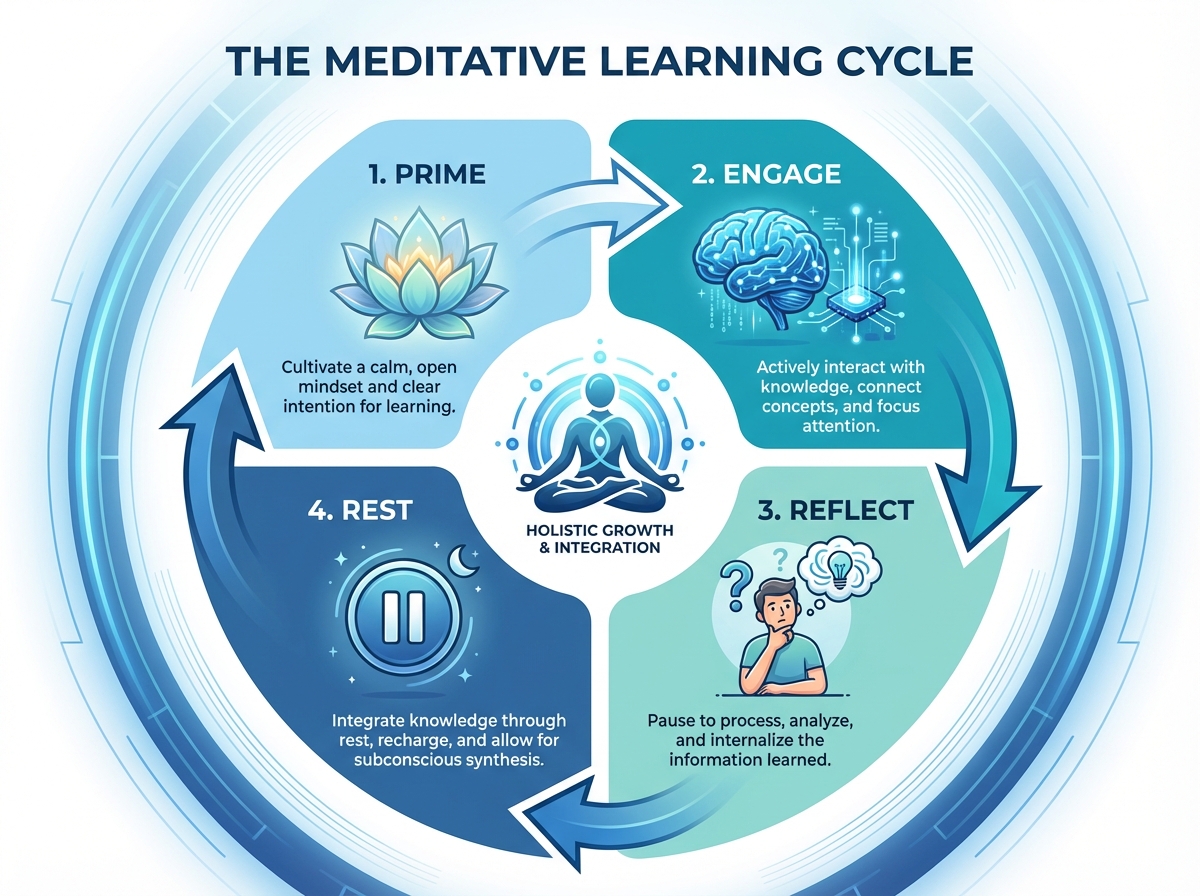
Artificial Intelligence is often viewed as a shortcut that atrophies human thinking. However, when used correctly, it is a powerful tool for Personal Development. An AI mentor never gets tired, never judges your ignorance, and is always ready to explore a tangent. Here is how to structure a Meditative Learning session using AI.
Before typing a single prompt, sit quietly. Close your eyes. Take ten deep breaths. Visualize the concept you want to master. This lowers cortisol and prepares the TPN.
Action: State your intention out loud or write it down physically. "I am entering this session to understand the principles of Game Theory."
Engage with the AI. However, do not just ask for facts. Ask for perspectives.
This turns the session into a reflective mirror. You are not downloading data; you are examining your own mind through the lens of the AI's training.
Step away from the screen. This is crucial. Do not jump to the next task. Sit in silence and mentally replay the key insights. This activates "neural replay," a mechanism essential for moving information from short-term to long-term memory.
Write down one actionable step you will take based on the session. Knowledge without application is merely data storage; application is where neuroplasticity occurs.
While generic chatbots can provide information, they often lack the pedagogical structure required for deep learning. GPTnius offers AI Mentors trained on proprietary research analyzing the published works, philosophies, and proven methodologies of thought leaders, including thinkers like James Clear and Charlie Munger. Our mentors do not impersonate anyone.
Instead of simply giving you a list of tips, a GPTnius AI Mentor synthesizes these researched frameworks to provide personalized coaching conversations. It might ask you, "What is the cue that triggers your distraction?" or "How can we design your environment to make focus the path of least resistance?"
This interactive, research-backed dialogue mimics the Socratic method, keeping your brain engaged, active, and in a state of high-retention flow. It transforms the AI from a search engine into a partner in your cognitive evolution.
The future of intelligence is not just about who has the fastest AI, but who has the clearest mind to direct it. Meditative Learning offers a sanctuary in the noise—a way to harness the immense power of technology without sacrificing our human capacity for depth, focus, and insight. By treating learning as a sacred, mindful practice, we ensure that as our tools become smarter, we become wiser.
> 💡 Experience the Future of Mentorship > > Don't just learn passively. Engage with AI Mentors trained on the methodologies of the world's greatest strategists and thinkers to elevate your thinking. > > Meet the AI mentors built from this research →
Meditative Learning is a methodology that combines mindfulness techniques with study sessions—often using AI—to regulate brain waves, reduce stress, and improve information retention and focus.
It can if used passively. However, when used intentionally as a tool for Socratic inquiry and active dialogue, AI can actually enhance focus by keeping the brain in an engaged, flow state.
Neuroplasticity is the brain's ability to form new connections. Focus and low stress (states promoted by meditative learning) increase BDNF production, which accelerates this process.